
Leave your Message

-
Yongqi Chen sales consultant
-
Phone/WhatsApp: +86 13187012919

13×6 Lace Front Wigs Wholesale Guide: How to Choose the Right Human Hair Wigs for Your Business
For wholesalers, salon owners, wig retailers, and online hair sellers, choosing a 13×6 lace front wig is not simply about finding an attractive hairstyle at the lowest price. Two wigs that look almost identical in product photos can perform very differently after washing, styling, coloring, or repeated wear.
The differences often come from the human hair quality, lace material, lace construction, density, cap workmanship, and consistency of production.
This makes 13×6 lace front wigs wholesale sourcing a product-specification decision as much as a price decision. Before placing a bulk order, buyers need to understand what they are actually paying for and whether the specifications match their target customers.
As an experienced wig manufacturer serving overseas B2B buyers, we recommend evaluating the product from the inside out. This guide explains the key factors to consider when sourcing 13×6 human hair wigs, from lace size and hair quality to HD lace, density, length, samples, MOQ, customization, and supplier capability.
What Is a 13×6 Lace Front Wig?
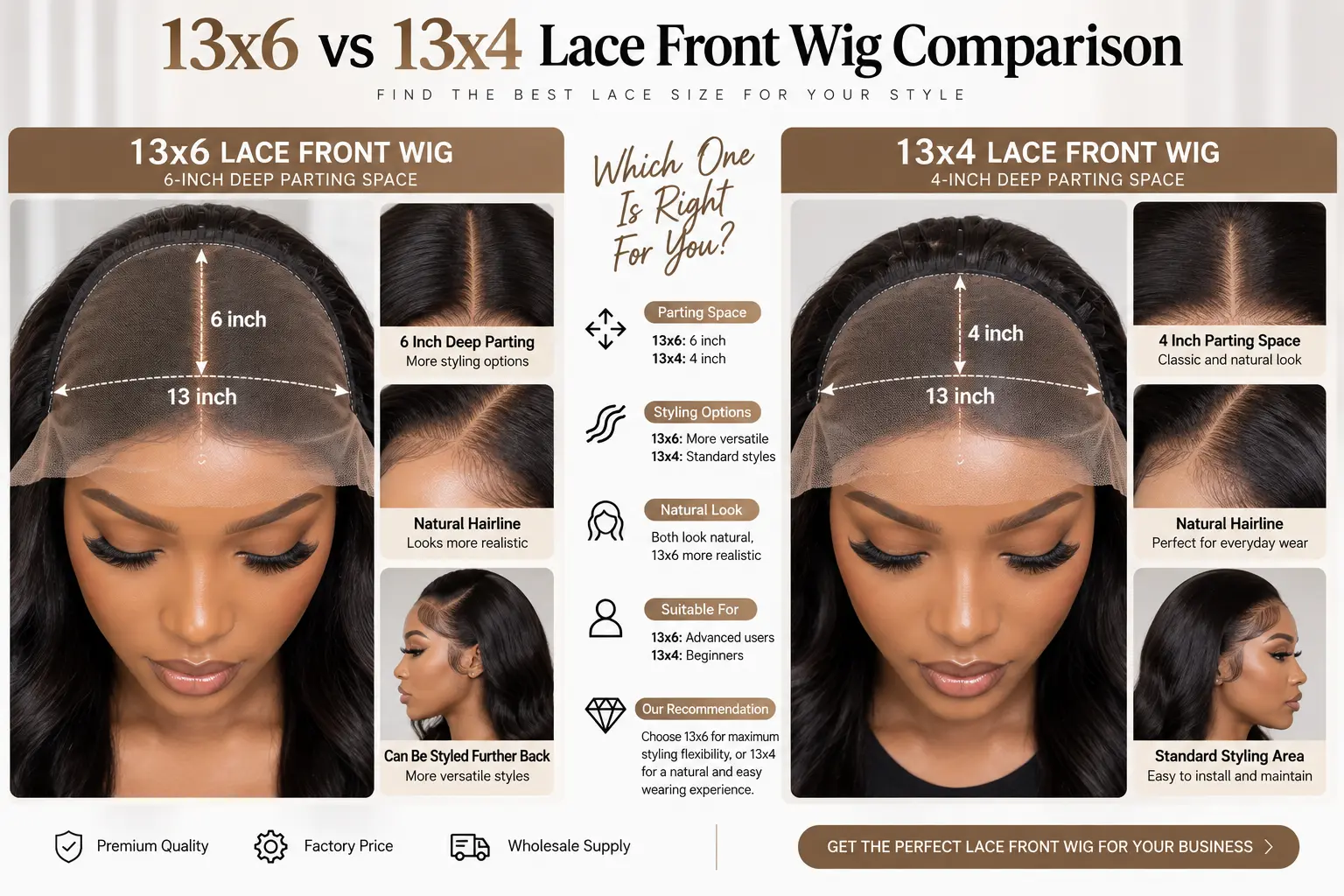
A 13×6 lace front wig uses a frontal lace area that is approximately 13 inches across the front of the head and extends about 6 inches back into the top section.
The larger lace area is the main feature that separates a 13×6 human hair lace front wig from many standard lace front constructions.
For the end customer, this generally provides three important benefits:
- A natural-looking frontal hairline
- Deeper parting space
- Greater flexibility for middle and side-part hairstyles
For a wig business, these characteristics also affect product positioning.
A larger lace area normally requires more lace, more ventilation work, and more careful construction than smaller frontal structures. As a result, 13×6 wigs are often positioned above basic lace front products and can be attractive to customers who prioritize styling freedom and a more natural appearance.
However, the label “13×6” alone does not guarantee quality. Wholesale buyers should still verify the actual lace dimensions, construction, hair quality, density, and workmanship before purchasing in volume.

13×6 vs. 13×4 Lace Front Wigs: What Should Wholesale Buyers Know?
One of the most common questions in lace front wigs wholesale sourcing is whether to stock 13×6 or 13×4 wigs.
Both constructions cover the frontal hairline, but the difference in lace depth influences styling flexibility and production cost.
| Feature | 13×6 Lace Front Wig | 13×4 Lace Front Wig |
|---|---|---|
| Frontal Width | Approx. 13 inches | Approx. 13 inches |
| Parting Depth | Approx. 6 inches | Approx. 4 inches |
| Parting Space | Deeper | Standard |
| Styling Flexibility | Higher | Good |
| Lace Usage | More | Less |
| Typical Cost Position | Higher | More economical |
| Suitable Positioning | Mid-range to premium | Entry to mid-range |
Neither construction is automatically better for every business.
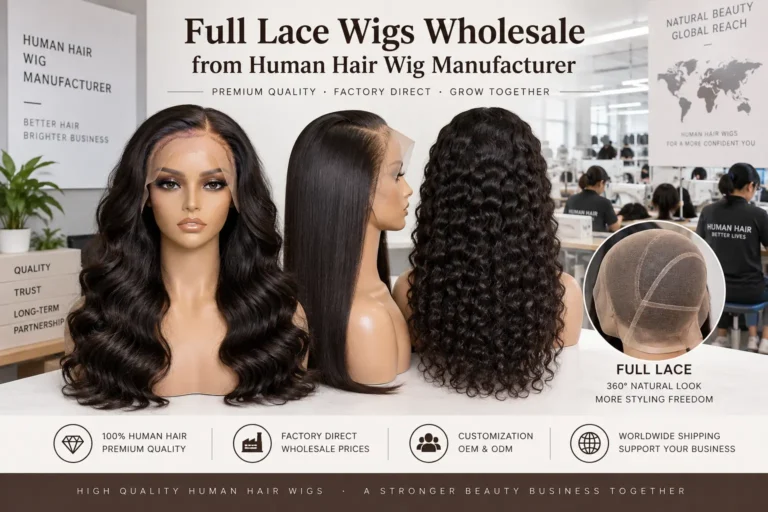
Buyers who need even greater styling flexibility can also compare 13×6 construction with Full Lace Wigs Wholesale options. Full lace wigs use a more extensive lace construction, making them suitable for customers who prioritize versatile parting and styling, although the product positioning and cost are typically different from standard lace front wigs.
If your customers focus heavily on realistic styling, deeper parts, and premium lace wigs, 13×6 may deserve a larger share of your inventory.
If your market is highly price-sensitive, 13×4 wigs may allow you to offer a more competitive retail price while retaining the key visual benefits of a lace frontal.
Many established sellers therefore carry both instead of treating them as competing products.
Human Hair Quality Is the Foundation of a Good 13×6 Wig
The lace may attract the customer’s attention first, but hair quality determines much of the long-term product experience.
When purchasing 13×6 lace frontal wig human hair products in bulk, do not rely entirely on labels such as “10A,” “12A,” or other grade names. There is no universal grading system that makes these labels identical from one supplier to another.
Instead, evaluate the actual hair.
Important areas include hair alignment, softness, shedding, tangling, end fullness, chemical processing, color consistency, and performance after washing.
Remy Hair vs. Virgin Hair
Remy human hair generally refers to hair processed so that the cuticles remain aligned in the same direction. Good cuticle alignment helps reduce friction and tangling.
Virgin human hair normally refers to human hair that has not undergone significant chemical processing. It is commonly selected for higher-end wigs, especially when buyers require better coloring and styling potential.
The terminology used in the market is not always consistent, however. That is why a physical sample and a clear specification sheet are more useful than a grade name alone.
For wholesale orders, test how the hair behaves after washing and drying rather than judging only the factory-finished sample.
A wig can look extremely smooth immediately after production because of conditioning and styling. Its behavior after washing gives you more information about the underlying hair quality.
How to Choose Between HD Lace, Transparent Lace and Regular Lace
Lace selection is another major factor affecting the appearance, durability, and wholesale price of 13×6 wigs.
13×6 HD Lace Front Wig
A 13×6 HD lace front wig is usually positioned toward customers who want a highly natural, less visible hairline.
HD lace is thin and can blend very well with the skin when properly selected and installed. This makes HD lace front wigs especially useful for premium collections, salon customers, social-media-focused brands, and sellers whose customers prioritize a “melted” lace appearance.
The trade-off is that very fine lace generally requires more careful handling.
Wholesale buyers should therefore consider both visual performance and the expectations of their customers.
Transparent Lace
Transparent lace offers a practical balance between appearance, durability, and cost.
For many wholesale businesses, it can serve as a strong core specification because it is versatile across different products and can often be adapted during installation.
Regular Lace
Standard lace can be appropriate for price-sensitive markets where durability and accessible retail pricing are more important than achieving the finest possible lace appearance.
The key lesson is simple: do not choose lace based only on which specification sounds more premium.
Choose according to your retail price, customer expectations, installation habits, and target market.
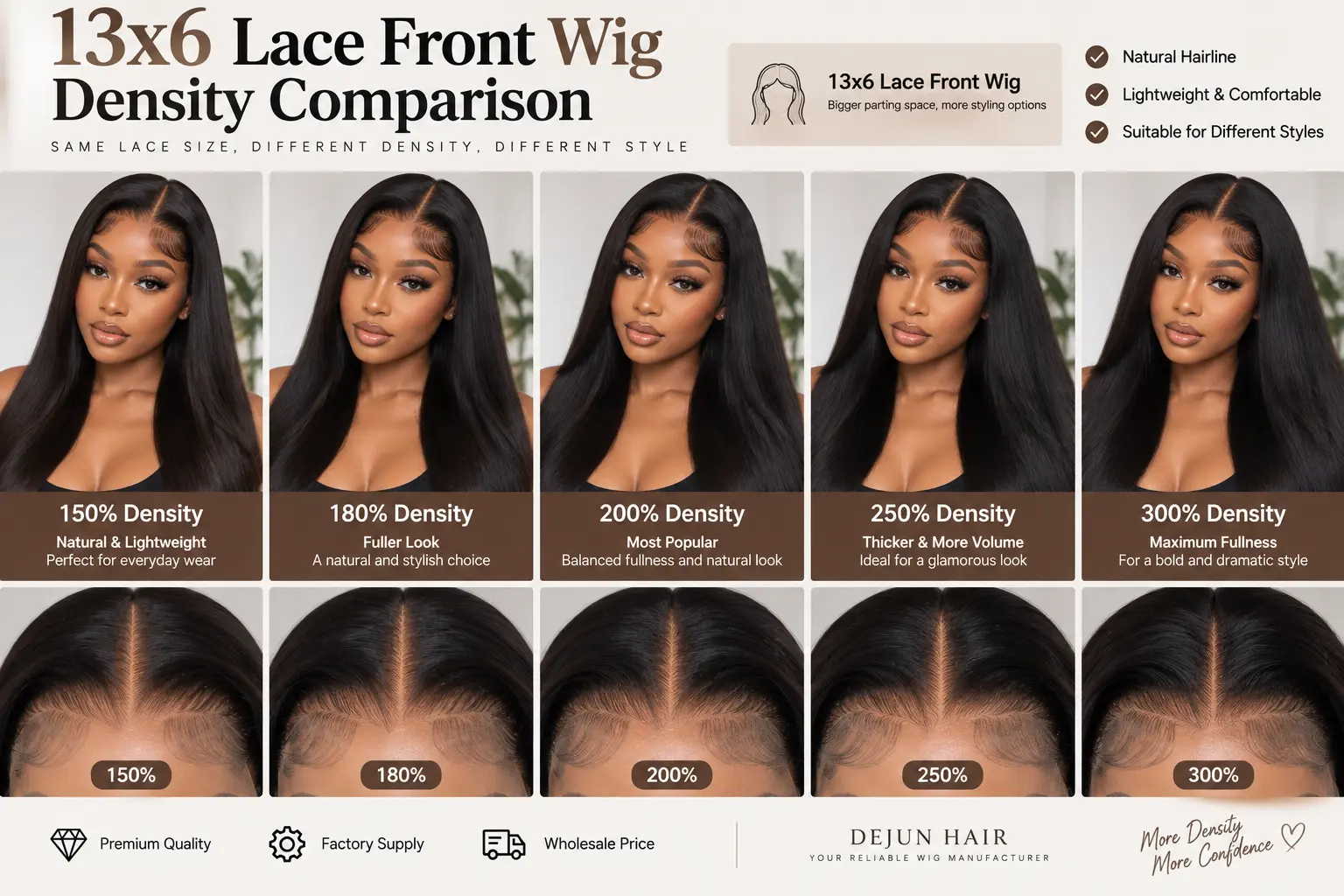
Choose the Right Density for Your Customer Base
Density influences both appearance and cost.
Common wholesale specifications may include 150%, 180%, and 200% or higher density, although exact construction and perceived fullness can vary between factories.
150% Density
This is useful for customers who prefer a lighter and more natural appearance. It can also help sellers maintain a more accessible retail price.
180% Density
For many wig businesses, 180% can provide a useful balance between fullness, natural appearance, and cost.
It is suitable for many straight, body wave, and curly styles.
200% and Higher Density
Higher densities are suitable for customers who want a fuller, more dramatic appearance, particularly with longer wigs.
However, higher density does not automatically mean a better wig.
Adding more hair increases material requirements and weight. The density should therefore match the length, texture, hairstyle, and customer preference.
When comparing quotations from different lace front wig suppliers, make sure the suppliers are quoting comparable densities. Otherwise, a lower price may simply reflect a different product specification.
How to Select Lengths and Textures for Wholesale Inventory
A common inventory mistake is ordering too many variations before knowing which SKUs actually sell.
For first-time buyers, a more controlled strategy is usually safer.
Start with several proven lengths and textures, test them in your market, and then increase inventory based on real sales data.
Straight and body wave are often useful foundational textures because they appeal to a broad customer base. Depending on your market, deep wave, loose wave, curly, and other textures can then provide additional variety.
Length strategy should follow the same principle.
Instead of purchasing equal quantities across every available length, divide inventory into core and test products.
For example, a business might allocate more purchasing budget to several dependable medium and long lengths while buying smaller quantities of extra-long or trend-driven products.
This is especially useful for smaller wholesalers, salons, and new e-commerce wig brands that need to protect cash flow.
Should You Stock Glueless 13×6 Lace Front Wigs?
Ease of installation has become an important product consideration for many wig sellers.
A glueless construction can include features such as adjustable elastic bands, combs, clips, or other cap adjustments designed to improve security without depending entirely on adhesive.
From a B2B perspective, this can expand the potential customer base.
Experienced wig users and salon clients may be comfortable with traditional installation methods, while online consumers may prefer products that require less installation knowledge.
For that reason, glueless construction can be particularly relevant to independent online wig brands and social-commerce sellers.
However, the word “glueless” should not be treated as a complete product specification. Buyers should still inspect cap fit, elastic-band construction, lace placement, stability, and overall comfort.
What Should You Test Before Buying 13×6 Lace Front Wigs in Bulk?
Sample testing is one of the simplest ways to reduce risk before a large 13×6 lace front wigs wholesale order.
A useful sample test should go beyond opening the package and checking whether the wig looks attractive.
Inspect the following areas:
- Confirm the lace dimensions and frontal construction.
- Check the hairline and knot workmanship.
- Measure the actual hair length.
- Evaluate whether the density matches the ordered specification.
- Comb the wig to observe initial shedding and tangling.
- Wash and dry the hair.
- Check softness and manageability after washing.
- Inspect the ends for excessive thinness.
- Test styling performance when relevant.
- Test coloring or bleaching if this is important to your business.
- Inspect cap construction, stitching, bands, and combs.
- Compare the sample with the written specification supplied by the factory.
For repeat orders, consistency becomes just as important as the quality of the first sample.
A good sample is useful only when the supplier can reproduce comparable quality in the bulk order.
MOQ and Mixed Orders: An Important Issue for Wholesale Buyers
MOQ can directly affect inventory risk.
Large distributors may prefer to purchase substantial quantities of a small number of proven SKUs. A salon or new online seller, however, may need several lengths and textures in much smaller quantities.
That is why buyers should ask suppliers two different questions:
What is the MOQ for ready-stock products?
and
What is the MOQ for custom production?
They are not necessarily the same.
Ready-stock human hair lace front wigs can sometimes support more flexible mixed orders, allowing buyers to combine different lengths, textures, or styles.
Custom specifications may require a higher MOQ because materials, lace construction, coloring, packaging, or production processes have to be prepared specifically for that order.
At Dejun, we work with different types of overseas buyers, so order structures can be discussed according to whether the requirement involves available inventory or OEM/ODM production.
For smaller businesses, mixed trial orders can be particularly useful. They allow you to collect actual sales data before committing more capital to a single specification.
OEM and Private Label Options for 13×6 Lace Front Wigs
Once a wig business moves beyond basic resale, customization becomes increasingly important.
A capable manufacturer should be able to discuss more than simply attaching a logo to an existing product.
Depending on the project and order quantity, customization may cover:
- Hair length
- Hair density
- Texture
- Hair color
- Lace material
- Cap size
- Elastic-band construction
- Hairline requirements
- Packaging
- Logo printing
- Hang tags
- Private labels
- Product development and samples
For an established wholesaler, these options can help create differentiated SKUs.
For a new wig brand, they make it possible to start building a consistent product identity rather than selling exactly the same specification as every competitor.
Before beginning an OEM project, prepare a clear specification sheet. The more accurately you define the product before sampling, the easier it is for the factory to develop and reproduce it.
How to Compare 13×6 Lace Front Wig Wholesale Prices Correctly
The cheapest quotation is not always the lowest-cost sourcing decision.
When comparing prices for wholesale 13×6 lace front wigs, make sure each supplier is quoting the same or genuinely comparable specifications.
Compare:
- Human hair type and quality
- Lace material
- Lace dimensions
- Length
- Density
- Texture
- Cap construction
- Hairline and knot requirements
- Customization
- Packaging
- MOQ
- Quality-control requirements
For example, a 24-inch 13×6 HD lace wig with higher density and stronger human hair quality should not be compared directly with a lower-density transparent-lace product simply because both are described as “13×6 human hair wigs.”
For B2B buyers, the more useful calculation is the total landed and sellable cost.
If a slightly cheaper product creates more shedding complaints, returns, refunds, or negative reviews, the initial saving can quickly disappear.
How to Choose a Reliable 13×6 Lace Front Wig Supplier
A dependable supplier should provide consistency, not simply a competitive first quotation.
Before selecting a lace front wig supplier, investigate several areas.
1. Is It a Factory or Trading Supplier?
Working directly with a manufacturer can provide advantages in product development, specification control, production communication, and OEM customization.
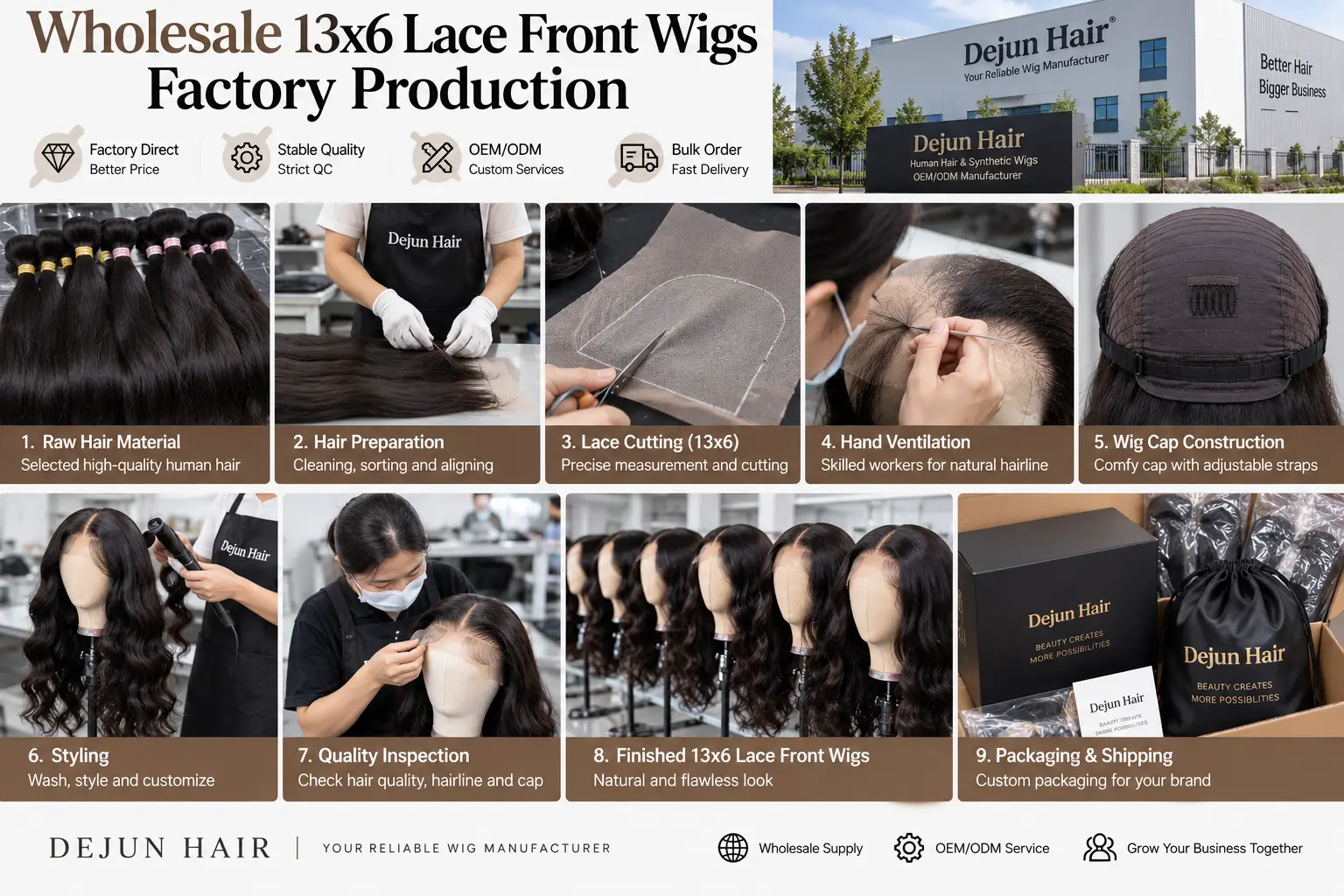
Dejun operates its own wig production facility in Shaoyang, Hunan, China, with production processes covering hair preparation, cap construction, lace work, styling, inspection, and warehousing.
2. Can the Supplier Explain the Hair Quality Clearly?
A professional supplier should be able to explain what hair is being offered and how different options affect price and performance.
Be cautious when every product is described using impressive grade terminology but the supplier cannot explain the actual differences.
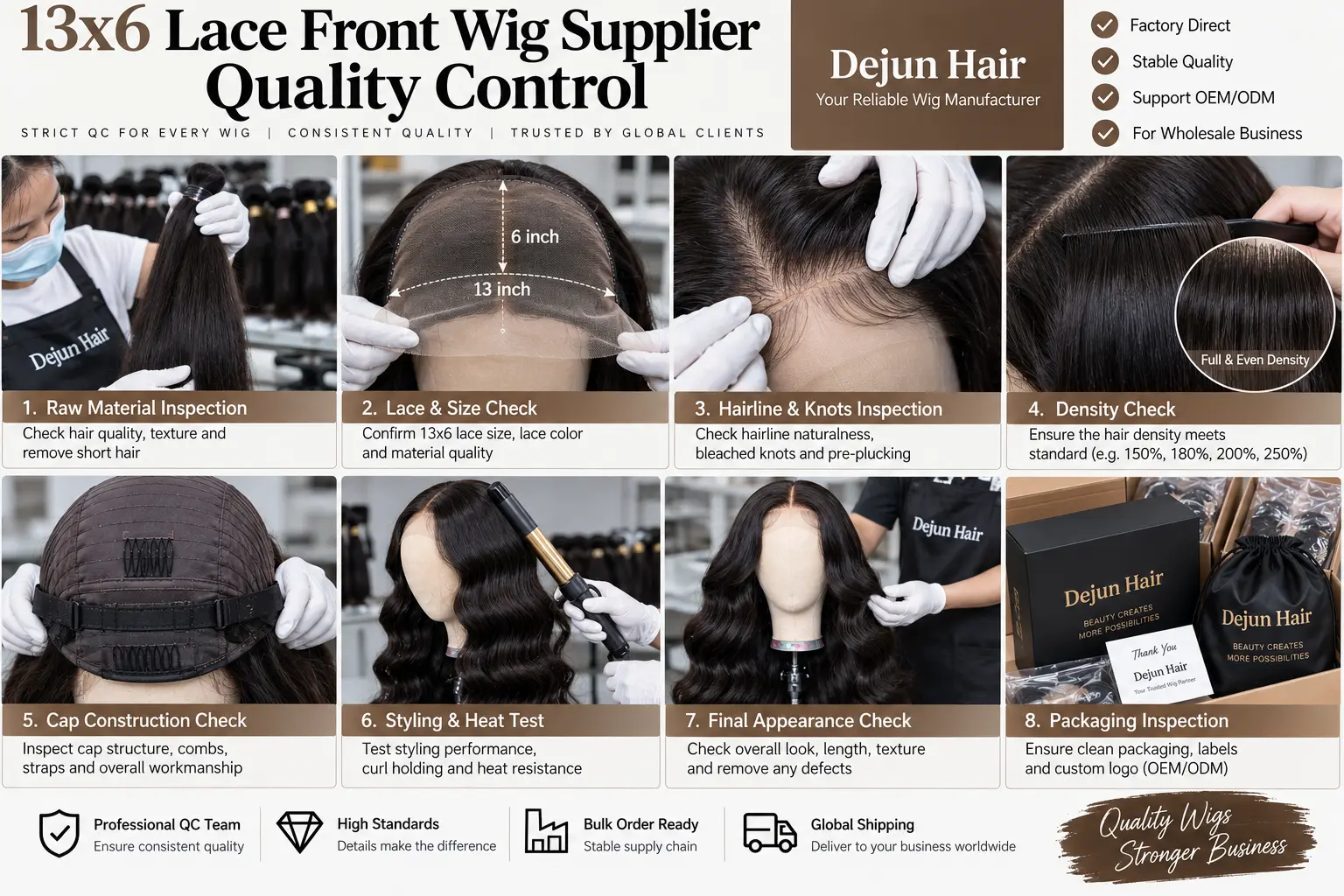
3. Is Quality Control Performed Before Shipment?
For bulk human hair wigs wholesale, QC should cover more than appearance.
At Dejun, inspection focuses on factors such as hair smoothness, construction security, color, sizing, and other product-specific requirements before shipment.
4. Can the Supplier Support Samples?
Samples are important for verifying hair, lace, construction, and specifications before committing to a larger order.
A supplier willing to work through sample feedback is generally more useful for long-term OEM development than one focused only on closing the first bulk order.
5. Can Production Scale With Your Business?
Your first order may be small, but your supplier should also be able to handle repeat and larger orders if a product sells well.
Ask about production capacity, lead times, stock availability, and how the supplier manages large-volume orders.
6. Does the Supplier Understand Export Requirements?
International B2B sourcing involves more than production.
Export documentation, packaging, air or sea shipping options, and destination-market experience all influence the purchasing process.
For buyers in Africa, Europe, and North America, working with an experienced export supplier can reduce communication problems and make repeat purchasing more predictable.
Build a Smarter 13×6 Lace Front Wig Product Mix
Instead of asking, “Which 13×6 wig is the best?”, wholesale buyers should ask:
Which combination of 13×6 wigs gives my business the best balance of sales potential, margin, and inventory risk?
One practical approach is to divide products into three groups.
Core Products
These are dependable specifications that receive most of your purchasing budget.
Examples may include natural colors, established textures, and popular lengths.
Premium Products
These target customers willing to pay more for features such as HD lace, longer lengths, higher density, or upgraded human hair.
Test Products
These include new colors, textures, lengths, or trend-driven specifications.
Order these in smaller quantities first. If the sell-through rate is strong, they can become core products in the next purchase cycle.
This approach is particularly useful for businesses purchasing wholesale wigs with limited inventory budgets.
Product variety does not have to come only from different lace, density, or length specifications. Buyers building a broader inventory can also combine longer 13×6 styles with Bob Wigs Wholesale products to serve customers looking for shorter, easier-to-manage hairstyles and create a more balanced wig collection.
Why Factory Consistency Matters More as Your Business Grows
Small differences between products become bigger business problems as order volume increases.
If you buy five wigs, a specification inconsistency may be inconvenient. If you order hundreds or thousands of units, the same inconsistency can affect customer complaints, returns, inventory planning, and your brand reputation.
This is why long-term human hair wigs wholesale sourcing should focus on repeatability.
At Dejun, our wig factory in Shaoyang has around 20 years of local manufacturing experience. We manage multiple production processes in-house and supply both human hair and synthetic wig categories for overseas buyers.
For B2B customers, the goal is not simply to manufacture one good sample. The more important goal is to establish clear specifications, quality standards, and communication processes that can be repeated as order volumes increase.
Final Checklist Before Placing Your 13×6 Lace Front Wig Order
Before confirming a wholesale order, make sure you can answer these questions:
- Is the hair quality clearly specified?
- Is the lace actually the size and material you requested?
- Have you selected an appropriate density?
- Are the lengths and textures suitable for your customers?
- Have you tested a sample?
- Did you wash the sample before approval?
- Are the bulk-order specifications documented?
- Is the MOQ appropriate for your inventory strategy?
- Can different styles or lengths be mixed if required?
- Does the supplier support OEM or private labeling?
- Is the production lead time clear?
- Is there a quality-control process before shipment?
- Can the supplier support repeat orders at larger volumes?
- Have packaging and shipping requirements been confirmed?
If several of these questions remain unanswered, it is usually better to resolve them before paying for a large order.
Conclusion: Choose Specifications First, Then Compare Suppliers
Successful 13×6 lace front wigs wholesale sourcing starts with understanding the product you need rather than simply collecting the lowest quotations.
Evaluate the human hair quality, lace construction, HD or transparent lace options, density, length, texture, cap workmanship, MOQ, customization, and supplier consistency together.
For new buyers, start with samples or a controlled mixed order. Test the products under realistic conditions, identify the specifications that work for your customers, and scale purchasing based on actual sales.
For established wholesalers and wig brands, focus on repeatable quality, OEM capability, production capacity, and long-term supply stability.
Dejun is a wig manufacturer based in Shaoyang, Hunan, China, supplying human hair and synthetic wigs for overseas B2B customers. We support ready-stock wholesale as well as OEM/ODM projects covering product specifications, private labels, packaging, and other customization requirements.
Looking for 13×6 human hair lace front wigs for your business? Contact Dejun to request samples, discuss your target specifications, or get a wholesale quotation for your next order.For wholesalers, salon owners, wig retailers, and online hair sellers, choosing a 13×6 lace front wig is not simply about finding an attractive hairstyle at the lowest price. Two wigs that look almost identical in product photos can perform very differently after washing, styling, coloring, or repeated wear.
The differences often come from the human hair quality, lace material, lace construction, density, cap workmanship, and consistency of production.
This makes 13×6 lace front wigs wholesale sourcing a product-specification decision as much as a price decision. Before placing a bulk order, buyers need to understand what they are actually paying for and whether the specifications match their target customers.
As an experienced wig manufacturer serving overseas B2B buyers, we recommend evaluating the product from the inside out. This guide explains the key factors to consider when sourcing 13×6 human hair wigs, from lace size and hair quality to HD lace, density, length, samples, MOQ, customization, and supplier capability.
What Is a 13×6 Lace Front Wig?
A 13×6 lace front wig uses a frontal lace area that is approximately 13 inches across the front of the head and extends about 6 inches back into the top section.
The larger lace area is the main feature that separates a 13×6 human hair lace front wig from many standard lace front constructions.
For the end customer, this generally provides three important benefits:
- A natural-looking frontal hairline
- Deeper parting space
- Greater flexibility for middle and side-part hairstyles
For a wig business, these characteristics also affect product positioning.
A larger lace area normally requires more lace, more ventilation work, and more careful construction than smaller frontal structures. As a result, 13×6 wigs are often positioned above basic lace front products and can be attractive to customers who prioritize styling freedom and a more natural appearance.
However, the label “13×6” alone does not guarantee quality. Wholesale buyers should still verify the actual lace dimensions, construction, hair quality, density, and workmanship before purchasing in volume.
13×6 vs. 13×4 Lace Front Wigs: What Should Wholesale Buyers Know?
One of the most common questions in lace front wigs wholesale sourcing is whether to stock 13×6 or 13×4 wigs.
Both constructions cover the frontal hairline, but the difference in lace depth influences styling flexibility and production cost.
| Feature | 13×6 Lace Front Wig | 13×4 Lace Front Wig |
|---|---|---|
| Frontal Width | Approx. 13 inches | Approx. 13 inches |
| Parting Depth | Approx. 6 inches | Approx. 4 inches |
| Parting Space | Deeper | Standard |
| Styling Flexibility | Higher | Good |
| Lace Usage | More | Less |
| Typical Cost Position | Higher | More economical |
| Suitable Positioning | Mid-range to premium | Entry to mid-range |
Neither construction is automatically better for every business.
If your customers focus heavily on realistic styling, deeper parts, and premium lace wigs, 13×6 may deserve a larger share of your inventory.
If your market is highly price-sensitive, 13×4 wigs may allow you to offer a more competitive retail price while retaining the key visual benefits of a lace frontal.
Many established sellers therefore carry both instead of treating them as competing products.
Human Hair Quality Is the Foundation of a Good 13×6 Wig
The lace may attract the customer’s attention first, but hair quality determines much of the long-term product experience.
When purchasing 13×6 lace frontal wig human hair products in bulk, do not rely entirely on labels such as “10A,” “12A,” or other grade names. There is no universal grading system that makes these labels identical from one supplier to another.
Instead, evaluate the actual hair.
Important areas include hair alignment, softness, shedding, tangling, end fullness, chemical processing, color consistency, and performance after washing.
Remy Hair vs. Virgin Hair
Remy human hair generally refers to hair processed so that the cuticles remain aligned in the same direction. Good cuticle alignment helps reduce friction and tangling.
Virgin human hair normally refers to human hair that has not undergone significant chemical processing. It is commonly selected for higher-end wigs, especially when buyers require better coloring and styling potential.
The terminology used in the market is not always consistent, however. That is why a physical sample and a clear specification sheet are more useful than a grade name alone.
For wholesale orders, test how the hair behaves after washing and drying rather than judging only the factory-finished sample.
A wig can look extremely smooth immediately after production because of conditioning and styling. Its behavior after washing gives you more information about the underlying hair quality.
How to Choose Between HD Lace, Transparent Lace and Regular Lace
Lace selection is another major factor affecting the appearance, durability, and wholesale price of 13×6 wigs.
13×6 HD Lace Front Wig
A 13×6 HD lace front wig is usually positioned toward customers who want a highly natural, less visible hairline.
HD lace is thin and can blend very well with the skin when properly selected and installed. This makes HD lace front wigs especially useful for premium collections, salon customers, social-media-focused brands, and sellers whose customers prioritize a “melted” lace appearance.
The trade-off is that very fine lace generally requires more careful handling.
Wholesale buyers should therefore consider both visual performance and the expectations of their customers.
Transparent Lace
Transparent lace offers a practical balance between appearance, durability, and cost.
For many wholesale businesses, it can serve as a strong core specification because it is versatile across different products and can often be adapted during installation.
Regular Lace
Standard lace can be appropriate for price-sensitive markets where durability and accessible retail pricing are more important than achieving the finest possible lace appearance.
The key lesson is simple: do not choose lace based only on which specification sounds more premium.
Choose according to your retail price, customer expectations, installation habits, and target market.
Choose the Right Density for Your Customer Base
Density influences both appearance and cost.
Common wholesale specifications may include 150%, 180%, and 200% or higher density, although exact construction and perceived fullness can vary between factories.
150% Density
This is useful for customers who prefer a lighter and more natural appearance. It can also help sellers maintain a more accessible retail price.
180% Density
For many wig businesses, 180% can provide a useful balance between fullness, natural appearance, and cost.
It is suitable for many straight, body wave, and curly styles.
200% and Higher Density
Higher densities are suitable for customers who want a fuller, more dramatic appearance, particularly with longer wigs.
However, higher density does not automatically mean a better wig.
Adding more hair increases material requirements and weight. The density should therefore match the length, texture, hairstyle, and customer preference.
When comparing quotations from different lace front wig suppliers, make sure the suppliers are quoting comparable densities. Otherwise, a lower price may simply reflect a different product specification.
How to Select Lengths and Textures for Wholesale Inventory
A common inventory mistake is ordering too many variations before knowing which SKUs actually sell.
For first-time buyers, a more controlled strategy is usually safer.
Start with several proven lengths and textures, test them in your market, and then increase inventory based on real sales data.
Straight and body wave are often useful foundational textures because they appeal to a broad customer base. Depending on your market, deep wave, loose wave, curly, and other textures can then provide additional variety.
Length strategy should follow the same principle.
Instead of purchasing equal quantities across every available length, divide inventory into core and test products.
For example, a business might allocate more purchasing budget to several dependable medium and long lengths while buying smaller quantities of extra-long or trend-driven products.
This is especially useful for smaller wholesalers, salons, and new e-commerce wig brands that need to protect cash flow.
Should You Stock Glueless 13×6 Lace Front Wigs?
Ease of installation has become an important product consideration for many wig sellers.
A glueless construction can include features such as adjustable elastic bands, combs, clips, or other cap adjustments designed to improve security without depending entirely on adhesive.
From a B2B perspective, this can expand the potential customer base.
Experienced wig users and salon clients may be comfortable with traditional installation methods, while online consumers may prefer products that require less installation knowledge.
For that reason, glueless construction can be particularly relevant to independent online wig brands and social-commerce sellers.
However, the word “glueless” should not be treated as a complete product specification. Buyers should still inspect cap fit, elastic-band construction, lace placement, stability, and overall comfort.
What Should You Test Before Buying 13×6 Lace Front Wigs in Bulk?
Sample testing is one of the simplest ways to reduce risk before a large 13×6 lace front wigs wholesale order.
A useful sample test should go beyond opening the package and checking whether the wig looks attractive.
Inspect the following areas:
- Confirm the lace dimensions and frontal construction.
- Check the hairline and knot workmanship.
- Measure the actual hair length.
- Evaluate whether the density matches the ordered specification.
- Comb the wig to observe initial shedding and tangling.
- Wash and dry the hair.
- Check softness and manageability after washing.
- Inspect the ends for excessive thinness.
- Test styling performance when relevant.
- Test coloring or bleaching if this is important to your business.
- Inspect cap construction, stitching, bands, and combs.
- Compare the sample with the written specification supplied by the factory.
For repeat orders, consistency becomes just as important as the quality of the first sample.
A good sample is useful only when the supplier can reproduce comparable quality in the bulk order.
MOQ and Mixed Orders: An Important Issue for Wholesale Buyers
MOQ can directly affect inventory risk.
Large distributors may prefer to purchase substantial quantities of a small number of proven SKUs. A salon or new online seller, however, may need several lengths and textures in much smaller quantities.
That is why buyers should ask suppliers two different questions:
What is the MOQ for ready-stock products?
and
What is the MOQ for custom production?
They are not necessarily the same.
Ready-stock human hair lace front wigs can sometimes support more flexible mixed orders, allowing buyers to combine different lengths, textures, or styles.
Custom specifications may require a higher MOQ because materials, lace construction, coloring, packaging, or production processes have to be prepared specifically for that order.
At Dejun, we work with different types of overseas buyers, so order structures can be discussed according to whether the requirement involves available inventory or OEM/ODM production.
For smaller businesses, mixed trial orders can be particularly useful. They allow you to collect actual sales data before committing more capital to a single specification.
OEM and Private Label Options for 13×6 Lace Front Wigs
Once a wig business moves beyond basic resale, customization becomes increasingly important. Working directly with a Custom Wig Manufacturer can give wholesalers and private-label brands greater control over hair length, density, texture, lace material, cap construction, color, packaging, and other product specifications.
A capable manufacturer should be able to discuss more than simply attaching a logo to an existing product.
Depending on the project and order quantity, customization may cover:
- Hair length
- Hair density
- Texture
- Hair color
- Lace material
- Cap size
- Elastic-band construction
- Hairline requirements
- Packaging
- Logo printing
- Hang tags
- Private labels
- Product development and samples
For an established wholesaler, these options can help create differentiated SKUs.
For a new wig brand, they make it possible to start building a consistent product identity rather than selling exactly the same specification as every competitor.
Before beginning an OEM project, prepare a clear specification sheet. The more accurately you define the product before sampling, the easier it is for the factory to develop and reproduce it.
How to Compare 13×6 Lace Front Wig Wholesale Prices Correctly
The cheapest quotation is not always the lowest-cost sourcing decision.
When comparing prices for wholesale 13×6 lace front wigs, make sure each supplier is quoting the same or genuinely comparable specifications.
Compare:
- Human hair type and quality
- Lace material
- Lace dimensions
- Length
- Density
- Texture
- Cap construction
- Hairline and knot requirements
- Customization
- Packaging
- MOQ
- Quality-control requirements
For example, a 24-inch 13×6 HD lace wig with higher density and stronger human hair quality should not be compared directly with a lower-density transparent-lace product simply because both are described as “13×6 human hair wigs.”
For B2B buyers, the more useful calculation is the total landed and sellable cost.
If a slightly cheaper product creates more shedding complaints, returns, refunds, or negative reviews, the initial saving can quickly disappear.
How to Choose a Reliable 13×6 Lace Front Wig Supplier
A dependable supplier should provide consistency, not simply a competitive first quotation.
Before selecting a lace front wig supplier, investigate several areas.
1. Is It a Factory or Trading Supplier?
Working directly with a manufacturer can provide advantages in product development, specification control, production communication, and OEM customization.
Dejun operates its own wig production facility in Shaoyang, Hunan, China, with production processes covering hair preparation, cap construction, lace work, styling, inspection, and warehousing.
2. Can the Supplier Explain the Hair Quality Clearly?
A professional supplier should be able to explain what hair is being offered and how different options affect price and performance.
Be cautious when every product is described using impressive grade terminology but the supplier cannot explain the actual differences.
3. Is Quality Control Performed Before Shipment?
For bulk human hair wigs wholesale, QC should cover more than appearance.
At Dejun, inspection focuses on factors such as hair smoothness, construction security, color, sizing, and other product-specific requirements before shipment.
4. Can the Supplier Support Samples?
Samples are important for verifying hair, lace, construction, and specifications before committing to a larger order.
A supplier willing to work through sample feedback is generally more useful for long-term OEM development than one focused only on closing the first bulk order.
5. Can Production Scale With Your Business?
Your first order may be small, but your supplier should also be able to handle repeat and larger orders if a product sells well.
Ask about production capacity, lead times, stock availability, and how the supplier manages large-volume orders.
6. Does the Supplier Understand Export Requirements?
International B2B sourcing involves more than production.
Export documentation, packaging, air or sea shipping options, and destination-market experience all influence the purchasing process.
For buyers in Africa, Europe, and North America, working with an experienced export supplier can reduce communication problems and make repeat purchasing more predictable.
Build a Smarter 13×6 Lace Front Wig Product Mix
Instead of asking, “Which 13×6 wig is the best?”, wholesale buyers should ask:
Which combination of 13×6 wigs gives my business the best balance of sales potential, margin, and inventory risk?
One practical approach is to divide products into three groups.
Core Products
These are dependable specifications that receive most of your purchasing budget.
Examples may include natural colors, established textures, and popular lengths.
Premium Products
These target customers willing to pay more for features such as HD lace, longer lengths, higher density, or upgraded human hair.
Test Products
These include new colors, textures, lengths, or trend-driven specifications.
Order these in smaller quantities first. If the sell-through rate is strong, they can become core products in the next purchase cycle.
This approach is particularly useful for businesses purchasing wholesale wigs with limited inventory budgets.
Why Factory Consistency Matters More as Your Business Grows
Small differences between products become bigger business problems as order volume increases.
If you buy five wigs, a specification inconsistency may be inconvenient. If you order hundreds or thousands of units, the same inconsistency can affect customer complaints, returns, inventory planning, and your brand reputation.
This is why long-term human hair wigs wholesale sourcing should focus on repeatability.
As an experienced wholesale wig manufacturer, Dejun operates its own wig factory in Shaoyang, China, supplying both human hair and synthetic wig categories for overseas B2B buyers. With around 20 years of local manufacturing experience, we manage multiple production processes in-house to improve product consistency and support both small wholesale orders and larger-volume sourcing.
For B2B customers, the goal is not simply to manufacture one good sample. The more important goal is to establish clear specifications, quality standards, and communication processes that can be repeated as order volumes increase.
Final Checklist Before Placing Your 13×6 Lace Front Wig Order
Before confirming a wholesale order, make sure you can answer these questions:
- Is the hair quality clearly specified?
- Is the lace actually the size and material you requested?
- Have you selected an appropriate density?
- Are the lengths and textures suitable for your customers?
- Have you tested a sample?
- Did you wash the sample before approval?
- Are the bulk-order specifications documented?
- Is the MOQ appropriate for your inventory strategy?
- Can different styles or lengths be mixed if required?
- Does the supplier support OEM or private labeling?
- Is the production lead time clear?
- Is there a quality-control process before shipment?
- Can the supplier support repeat orders at larger volumes?
- Have packaging and shipping requirements been confirmed?
If several of these questions remain unanswered, it is usually better to resolve them before paying for a large order.
Conclusion: Choose Specifications First, Then Compare Suppliers
Successful 13×6 lace front wigs wholesale sourcing starts with understanding the product you need rather than simply collecting the lowest quotations.
Evaluate the human hair quality, lace construction, HD or transparent lace options, density, length, texture, cap workmanship, MOQ, customization, and supplier consistency together.
For new buyers, start with samples or a controlled mixed order. Test the products under realistic conditions, identify the specifications that work for your customers, and scale purchasing based on actual sales.
For established wholesalers and wig brands, focus on repeatable quality, OEM capability, production capacity, and long-term supply stability.
Dejun is a wig manufacturer based in Shaoyang, Hunan, China, supplying human hair and synthetic wigs for overseas B2B customers. We support ready-stock wholesale as well as OEM/ODM projects covering product specifications, private labels, packaging, and other customization requirements.
Looking for 13×6 human hair lace front wigs for your business? Contact Dejun to request samples, discuss your target specifications, or get a wholesale quotation for your next order.


High Quality
All of our products have undergone production and quality control and come with certificates
Fast Delivery
Our supply chain management is a model of standardization and professionalism in the wig manufacturing industry, ensuring that our customers receive their wigs on time.
Customer Service
Fill out the wig order form to customize your base, size, hair length, and color.