
Leave your Message

-
Yongqi Chen sales consultant
-
Phone/WhatsApp: +86 13187012919
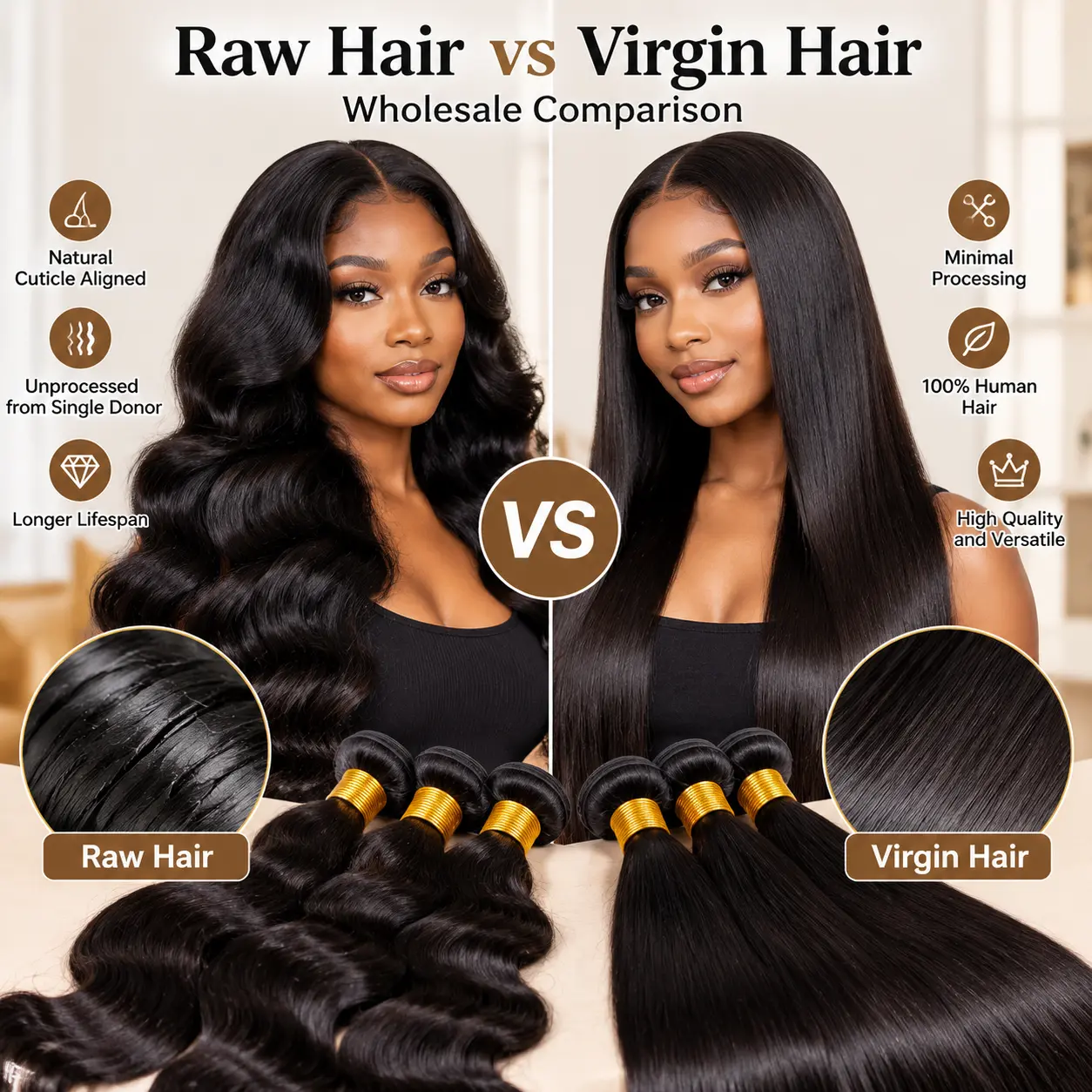
Raw Hair vs Virgin Hair: What Wholesale Buyers Need to Know Before Ordering
Table Of Contents
- What Is Raw Hair?
- What Is Virgin Hair?
- Raw Hair vs Virgin Hair: What Is the Difference?
- Raw Hair vs Virgin Hair Quality: Which Performs Better?
- Raw Hair vs Virgin Hair for Wholesale: Which Should Your Business Buy?
- Raw Hair vs Virgin Hair: Which Costs More Wholesale?
- How to Test Raw Hair and Virgin Hair Before a Bulk Order
- How to Choose a Raw Hair or Virgin Hair Wholesale Supplier
- Common Raw Hair vs Virgin Hair Buying Mistakes
- Raw Hair or Virgin Hair: Which Is Better for Your Business?
For salon owners, hair wholesalers, beauty supply stores, and online hair sellers, choosing between raw hair and virgin hair can be confusing.
Both are commonly marketed as premium human hair. You can use both for bundles, sew-ins, wigs, closures, and other hair products. Yet when you start comparing suppliers, the definitions, prices, textures, and claimed quality can vary significantly.
So, when comparing raw hair vs. virgin hair, what actually matters to a wholesale buyer?
The answer goes beyond deciding which hair sounds more premium. You need to understand how the hair was processed, how consistently the supplier can reproduce the quality, how it performs after washing and coloring, and whether the cost fits your target customers.
This guide explains the difference between raw hair and virgin hair from a wholesale purchasing perspective, helping you decide which option makes more sense for your inventory, customers, and business model.
What Is Raw Hair?
Raw hair generally refers to human hair that has received minimal processing and is sold as close as possible to its original condition.
Genuine raw human hair bundles are usually valued for their natural appearance, cuticle condition, styling flexibility, and potential longevity. Because the hair has not been heavily standardized through processing, some natural variation in color, wave pattern, or texture may occur between bundles.
This variation is not automatically a quality problem. In some cases, it is exactly what premium customers expect from minimally processed human hair.
However, wholesale buyers should be careful with terminology.
There is no universal international grading system that guarantees that every supplier using the term “raw hair” is selling exactly the same product. One supplier’s raw hair may not be identical to another supplier’s raw hair.
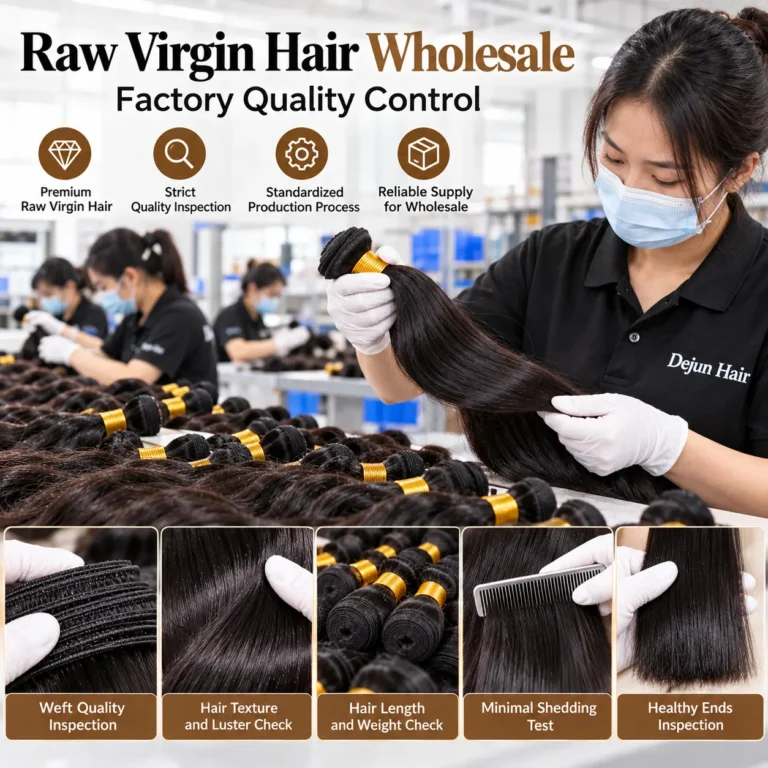
For this reason, buyers considering Raw Virgin Hair Wholesale should evaluate the actual specifications and sample performance instead of relying only on the product name.
Important questions include:
- Has the hair been chemically processed or color-treated?
- Are the cuticles intact and aligned?
- What is the standard weight of each bundle?
- How consistent are the length and fullness?
- How does the hair behave after washing?
- How much shedding or tangling occurs?
- Can the supplier reproduce similar quality in future batches?
For B2B buyers, these questions are more useful than simply asking whether a product is “100% raw hair.”
What Is Virgin Hair?
Virgin hair is another widely used term in the human hair industry.
Traditionally, virgin hair refers to human hair that has not undergone major chemical treatments such as bleaching, perming, or permanent coloring before collection and production.
In today’s wholesale market, however, virgin hair bundles cover a relatively broad range of products and price points.
Some high-quality virgin hair offers excellent cuticle condition, softness, fullness, coloring performance, and long-term wear. Other products marketed under the same term may have received more processing or may perform differently after repeated washing.
That means a label such as “100 virgin human hair bundles” should not be treated as a complete quality specification.
When buying Wholesale Human Hair Bundles, wholesale customers should compare measurable characteristics such as bundle weight, ends, cuticle condition, texture, shedding, tangling, washing performance, and batch consistency.
The supplier’s ability to maintain those standards across repeat orders matters just as much as the label printed on the package.
Raw Hair vs Virgin Hair: What Is the Difference?
The exact raw hair vs virgin hair difference depends partly on how an individual manufacturer defines and processes its products.
As a general wholesale purchasing framework, however, buyers can compare them like this:
| Buying Factor | Raw Hair | Virgin Hair |
|---|---|---|
| Processing | Typically minimal processing | Processing level may vary by supplier |
| Natural Variation | Usually more noticeable | Often easier to standardize |
| Texture | Natural characteristics may be more visible | Wide range of standardized textures |
| Color Consistency | Natural shade variations may occur | Often more consistent between SKUs |
| Bleaching & Coloring | Good potential when hair quality is suitable | Depends strongly on actual hair quality and prior processing |
| Lifespan | Potentially long with proper care | Good to very good depending on quality |
| Wholesale Price | Usually positioned at a premium | Available across a wider price range |
| Bulk Consistency | Requires careful sourcing and QC | Often easier to standardize for larger inventories |
| Best Market Position | Premium/custom hair customers | Broad salon, retail and online markets |
This comparison should be used as a starting point rather than an absolute industry rule.
The most important lesson for wholesale buyers is simple: buy according to verified specifications and performance, not terminology alone.
Raw Hair vs Virgin Hair Quality: Which Performs Better?
Many buyers searching for raw hair or virgin hair—which is better? expect a simple answer.
In practice, a high-quality virgin hair product can be a better commercial purchase than poorly sourced hair carrying a raw hair label.
Quality needs to be evaluated in several areas.
1. Cuticle Condition
Good human hair should maintain a healthy cuticle structure and appropriate alignment.
Poorly handled hair can become increasingly tangled after washing, regardless of what grade or marketing term appears on the packaging.
When testing samples, pay attention to how the hair feels not only when it arrives, but also after washing, drying, combing, and restyling.
2. Shedding and Weft Construction
For hair weave bundles, the hair itself is only part of the product.
The construction of the weft also matters.
A premium bundle with weak stitching can still create complaints for salons and end customers. Check the weft for secure construction and observe shedding during combing and washing.
This becomes especially important for wholesale buyers because a small construction problem multiplied across hundreds of bundles can create significant after-sales costs.
3. Tangling
Softness immediately after opening the package does not prove long-term quality.
Wash and dry your samples several times and observe the nape-prone or friction-prone areas during realistic use.
Quality hair should remain manageable when maintained correctly.
4. Ends and Fullness
Compare the fullness from the upper part of the bundle through the ends.
Extremely thin ends may make a bundle appear less valuable to customers even when the nominal weight is correct.
The acceptable level of natural taper depends on the product positioning and length, so your sample should be evaluated against the specification you plan to sell.
5. Coloring and Styling Performance
Coloring performance is one reason premium buyers are interested in unprocessed human hair.
But neither raw nor virgin hair should be assumed to withstand unlimited bleaching.
Chemical processing always places stress on human hair. The result depends on the original hair quality, previous processing, bleaching method, developer strength, target color, and aftercare.
If your customers frequently customize hair into lighter colors, tell your supplier exactly what you intend to do and perform controlled sample tests before placing a bulk order.
Raw Hair vs Virgin Hair for Wholesale: Which Should Your Business Buy?
This is where the comparison becomes more commercially useful.
The best hair for a wholesale business is not necessarily the most expensive hair. It is the product that matches your customer expectations, retail price, brand positioning, and inventory strategy.
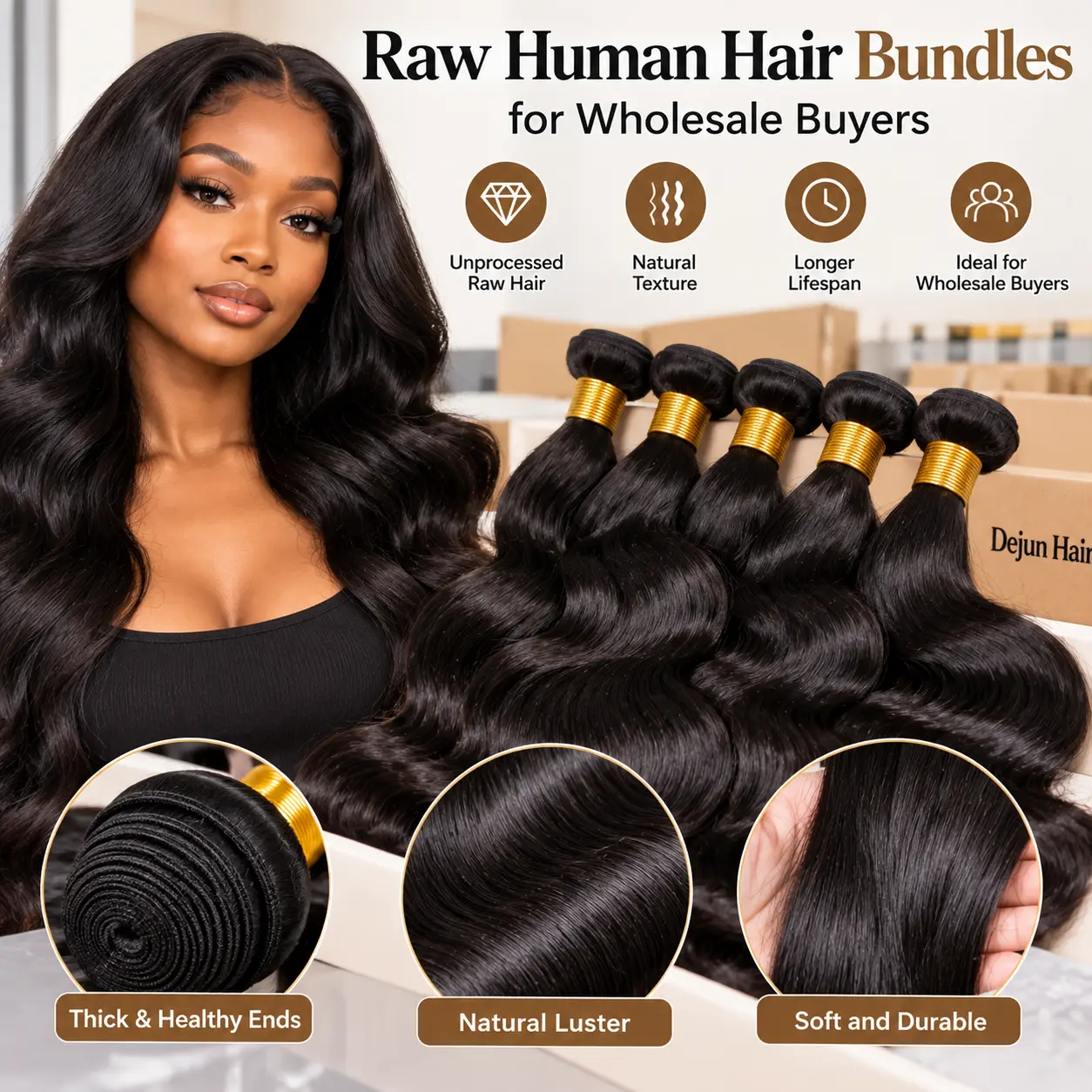
Choose Raw Hair If You Serve a Premium Market
Raw hair can make sense when your customers are willing to pay more for natural characteristics, customization potential, and premium product positioning.
Typical customers may include:
- High-end salons
- Premium hair boutiques
- Custom wig makers
- Professional colorists
- Luxury online hair brands
- Customers seeking premium sew-ins
- Buyers who regularly customize hair
If you are selling raw human hair bundles wholesale, consistency becomes particularly important.
Premium customers usually have higher expectations. If the first order performs exceptionally well but the next shipment behaves differently, your brand—not the factory—will usually receive the customer complaint.
This is why supplier stability matters as much as initial sample quality.
Choose Virgin Hair If You Need Broader Price and Product Options
Virgin hair can be a practical choice for wholesalers serving a wider customer base.
A hair business may need straight, body wave, deep wave, curly, and other textures across several lengths. It may also need products at different price points.
A stable virgin hair program can make this assortment easier to manage.
This is particularly useful for beauty supply stores, salons, distributors, and online sellers that need human hair bundles with predictable specifications and repeatable inventory.
The key is still supplier verification.
Do not assume that all virgin hair performs equally. Test the actual product before deciding where it belongs in your retail assortment.
Consider Selling Both
For many established hair businesses, the answer to raw hair vs. virgin hair for wholesale does not need to be one or the other.
You can create different product tiers.
For example:
Core Range: reliable virgin human hair bundles for customers looking for a balance between quality and price.
Premium Range: selected raw hair bundles for customers who prioritize natural characteristics and advanced customization.
This strategy lets you serve multiple customer segments without forcing every customer into the same price level.
It can also reduce inventory risk. Instead of purchasing large quantities of premium raw hair immediately, you can test several lengths and textures, collect sales data, and increase inventory in the SKUs that actually perform.
Raw Hair vs Virgin Hair: Which Costs More Wholesale?
In most cases, genuine premium raw hair is positioned at a higher wholesale price than more standardized virgin hair products.
But comparing only the price per bundle can be misleading.
Several factors affect the cost of raw human hair bundles wholesale and virgin human hair bundles wholesale, including:
- Hair quality and sourcing
- Length
- Bundle weight
- Texture
- Fullness
- Cuticle condition
- Previous processing
- Order quantity
- Packaging requirements
- Custom colors or textures
- Closures or frontals included in the order
- OEM/private-label requirements
Longer hair, for example, normally carries a higher sourcing cost because suitable long strands are less abundant.
Order quantity also matters. Wholesale pricing can change as purchasing volume increases, although buyers should never sacrifice verified quality simply to obtain the lowest unit price.
A better comparison is total purchasing value.
Consider the purchase price together with consistency, customer satisfaction, returns, complaints, usable lifespan, repeat sales, and your achievable retail margin.
A slightly more expensive bundle that produces fewer complaints may ultimately be more profitable than the cheapest option.
How to Test Raw Hair and Virgin Hair Before a Bulk Order
Sample testing is one of the best ways to reduce sourcing risk.
But simply touching a bundle and deciding that it feels soft is not enough.
Inspect the Hair Before Washing
Record the sample’s:
- Weight
- Length
- Texture
- Natural color
- Fullness
- Ends
- Weft construction
- Initial shedding
- Initial tangling
Take photographs and keep notes. This creates a reference if you later place a bulk order.
Perform a Wash Test
Wash the sample using an appropriate hair-care routine.
Observe whether the texture changes significantly, whether tangling increases, how much shedding occurs, and how the hair feels after drying.
A product should be evaluated after washing—not only in the factory-finished condition in which it arrives.
Test Heat Styling
If your customers straighten or curl their hair, reproduce those normal use cases.
Use reasonable styling temperatures and suitable heat protection. The purpose is to evaluate normal performance, not intentionally damage the sample.
Perform a Controlled Color Test
If bleaching or coloring is important to your business, test it before ordering large quantities.
Record the formula, processing time, target shade, hair response, dryness, breakage, and condition after washing.
Do not assume that every product labeled raw or virgin can safely reach the same blonde level.
Compare More Than One Bundle
This step is frequently overlooked.
One excellent sample proves that a supplier can provide one excellent sample. It does not prove that the supplier can reproduce the same quality across 100, 500, or 1,000 bundles.
Whenever possible, compare several samples or repeat orders.
Wholesale purchasing is ultimately about repeatability.
For a more detailed supplier evaluation process, read our Raw Virgin Hair Wholesale Supplier Guide, which covers supplier verification, sample testing, MOQ, quality control, and common sourcing risks.
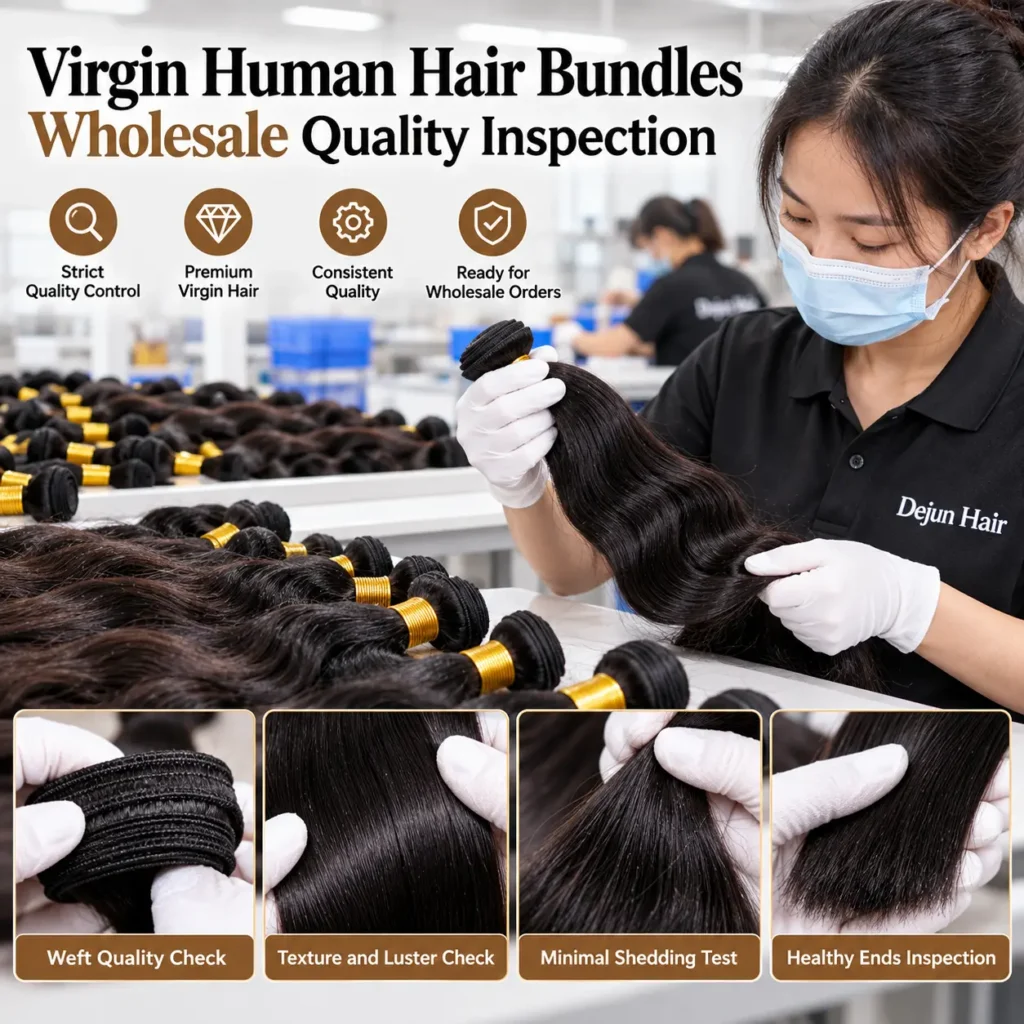
How to Choose a Raw Hair or Virgin Hair Wholesale Supplier
After deciding which hair category fits your business, the next question is who should supply it.
A reliable supplier should offer more than an attractive catalog and competitive quotation.
Ask About the Actual Product Specification
Instead of asking only, “Is this raw hair?” ask specific questions.
What treatment has the hair received? What is the standard bundle weight? How is the hair selected? What tolerance should you expect in length, color, and texture? How does the supplier control shedding and weft construction?
Specific questions produce more useful answers.
Evaluate Batch Consistency
For B2B buyers, consistency is critical.
Your customers expect the product they reorder next month to perform similarly to the product they bought this month.
Ask the supplier how incoming hair is graded, how production specifications are controlled, and what inspections are performed before shipment.
Compare MOQ and Mixed-Order Flexibility
A distributor ordering container quantities has different requirements from a salon testing its first 20 or 30 bundles.
If you are still testing your market, ask whether the supplier allows mixed lengths, textures, or SKUs within an order.
A flexible MOQ can help you discover your best-selling products before committing too much cash to inventory.
Check OEM and Private-Label Capabilities
If you plan to build your own brand, consider future requirements as well as your first order.
You may eventually need branded packaging, hang tags, logos, custom specifications, matching closures and frontals, or finished wigs.
Working with an experienced OEM/ODM wig and hair manufacturer can make it easier to expand your product range without rebuilding your supply chain every time your business grows.
Understand Production and Delivery Capacity
A supplier that can quickly ship five samples may not necessarily be able to produce 1,000 consistent units on your required schedule.
Ask about stock availability, production lead times, peak-season capacity, quality inspection, packaging, and international shipping before placing a large order.
Common Raw Hair vs Virgin Hair Buying Mistakes
Several purchasing mistakes appear repeatedly in the wholesale hair business.
The first is buying according to labels rather than specifications. “Raw,” “virgin,” “10A,” “12A,” and similar terms do not replace actual testing.
The second is choosing the lowest quotation without comparing the products under the same specifications. A lower price may reflect differences in weight, length, processing, fullness, sourcing, or quality control.
The third is testing only appearance and softness. Hair should also be evaluated after washing and normal styling.
The fourth is assuming every premium bundle can be aggressively bleached. If coloring is part of your business model, establish a realistic color requirement and test it.
The fifth is ignoring batch consistency. Wholesale success depends on what a supplier can reproduce, not just what it can send as the first sample.
And finally, avoid placing a large first order simply because the initial product looks promising. A staged purchasing process—sample, test order, customer feedback, then scale—is often safer.
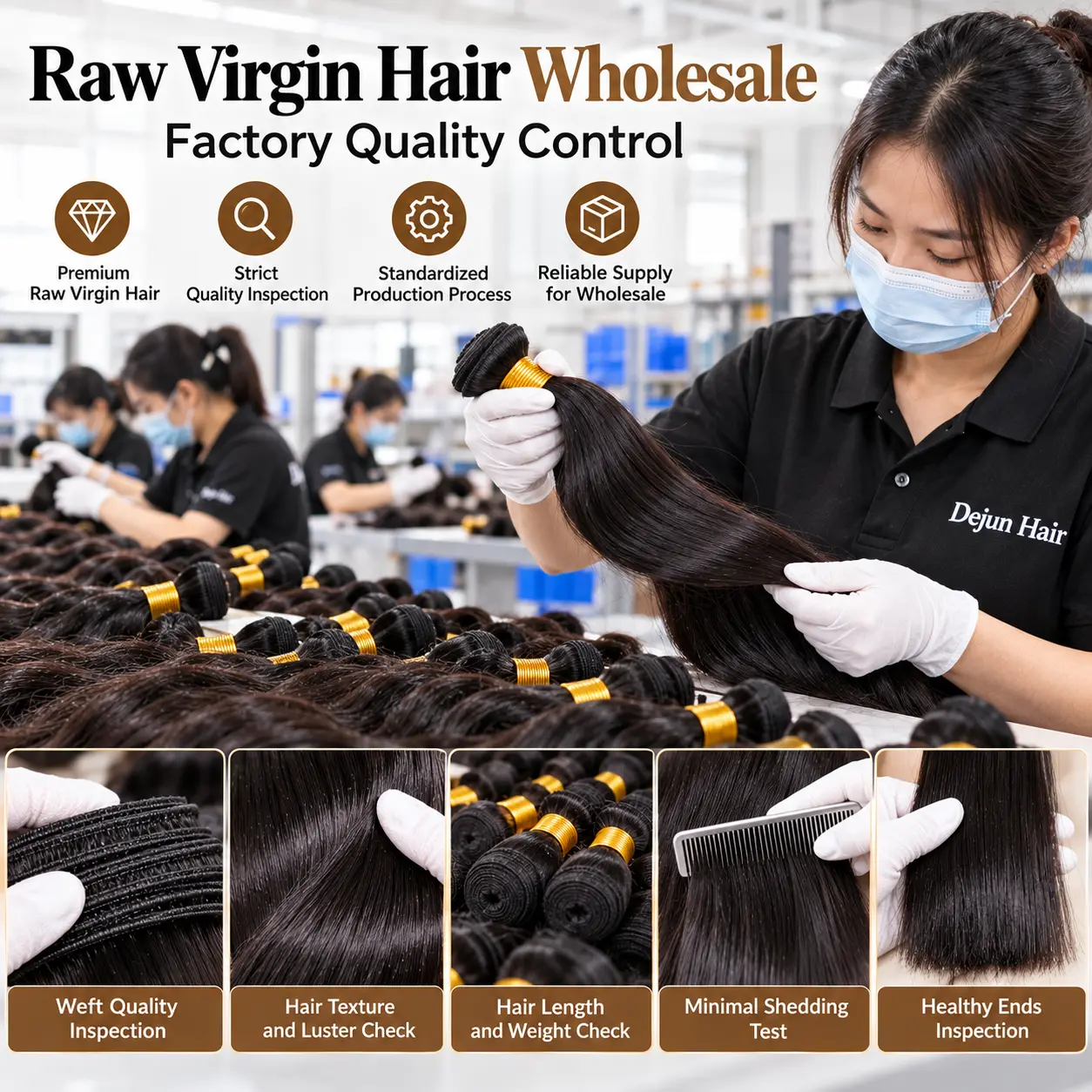
Raw Hair or Virgin Hair: Which Is Better for Your Business?
There is no universal winner in the raw hair vs virgin hair comparison.
Raw hair can be an excellent option for businesses targeting premium customers, professional customization, high-end sew-ins, and customers who value more natural characteristics.
Virgin hair can offer a strong balance of quality, product consistency, SKU variety, and pricing flexibility, making it suitable for a broad range of salons, beauty stores, wholesalers, and online hair businesses.
For many sellers, the strongest strategy is to carry both.
Use virgin hair for your dependable core assortment and carefully selected raw hair for your premium range. Then adjust your inventory according to actual customer demand rather than assumptions.
Most importantly, remember that the supplier and product specification matter more than the marketing label.
Before committing to a bulk purchase, test samples, compare multiple bundles, define your quality requirements, confirm MOQ and production capacity, and make sure the supplier can reproduce the approved standard.
Dejun works with overseas salons, wholesalers, distributors, online sellers, and private-label hair businesses on human hair products and customized supply programs. Buyers can discuss hair specifications, sample testing, mixed orders, wholesale quantities, packaging, and OEM/ODM requirements before scaling an order.
If you are currently comparing raw hair vs. virgin hair for wholesale, contact Dejun for a wholesale quotation and sample consultation based on your target market, required lengths, textures, quantity, and customization needs.
High Quality
All of our products have undergone production and quality control and come with certificates
Fast Delivery
Our supply chain management is a model of standardization and professionalism in the wig manufacturing industry, ensuring that our customers receive their wigs on time.
Customer Service
Fill out the wig order form to customize your base, size, hair length, and color.