
Leave your Message

-
Yongqi Chen sales consultant
-
Phone/WhatsApp: +86 13187012919
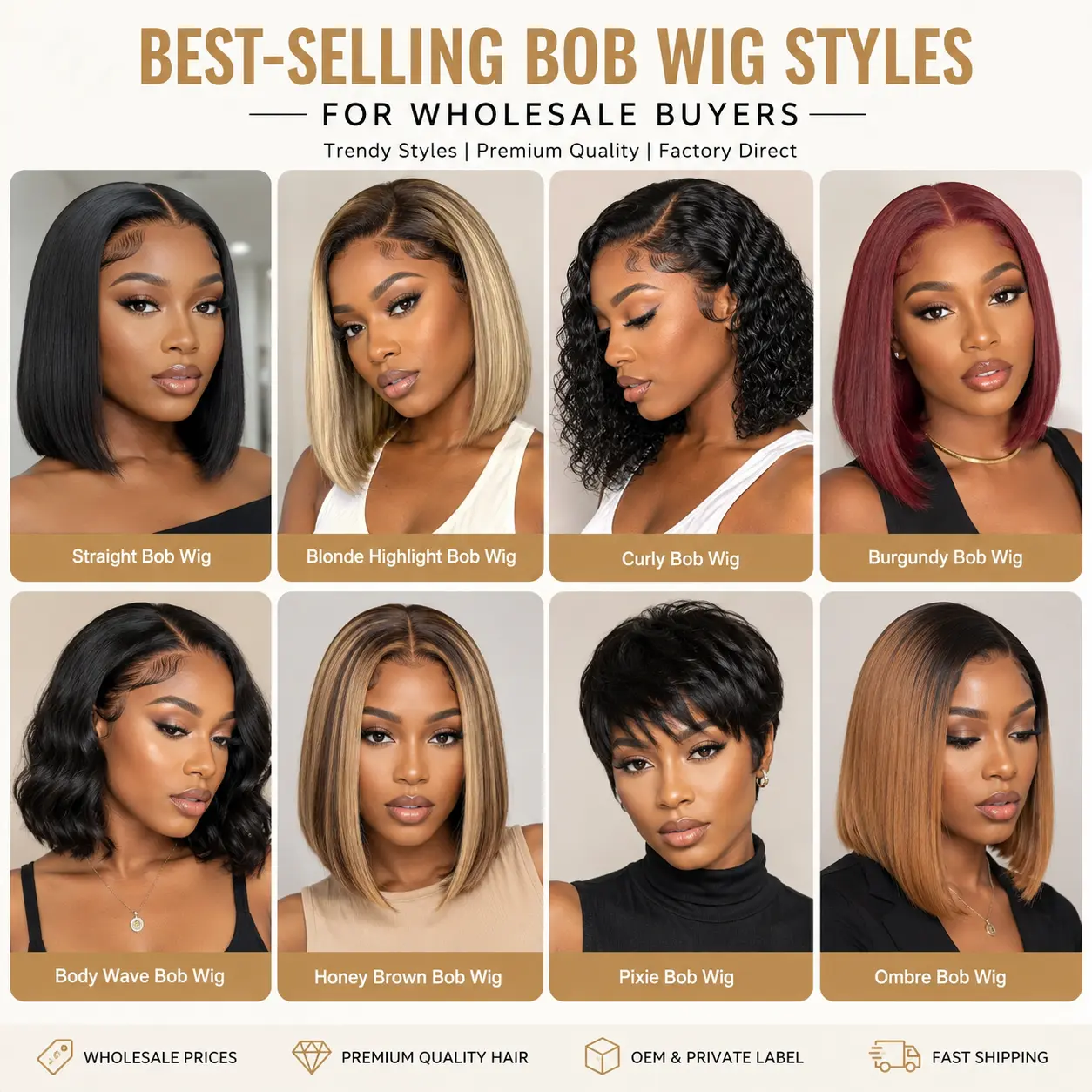
Best-Selling Bob Wig Styles for Wholesale Buyers: What to Stock for Your Hair Business
Meta Description:
Discover the best-selling Bob wig styles for wholesale buyers and learn which lengths, textures, lace types, and colors to stock for your hair business.
For wig wholesalers, salon owners, and online hair sellers, choosing a Bob wig is easy. Choosing the right Bob wigs to stock in quantity is much more difficult.
A supplier may offer straight Bob wigs, curly Bob wigs, lace front Bobs, glueless Bobs, colored styles, different densities, multiple lace sizes, and lengths ranging from very short cuts to shoulder-length designs. Ordering too many variations can tie up cash in slow-moving inventory. Ordering too few can leave your customers without enough choice.
For buyers sourcing Bob Wigs Wholesale, the goal should therefore not be to stock every available style. A better strategy is to build inventory around dependable core products, add several styles for differentiation, and test trend-driven designs in smaller quantities.
As a wig manufacturer working with overseas wholesale and salon buyers, Dejun sees inventory planning as an important part of the sourcing process. In this guide, we explain the Bob wig styles worth considering, how to structure your product mix, and what to discuss with your supplier before placing a bulk order.
Why Bob Wigs Are a Practical Category for Hair Businesses
Bob wigs can work well as a core category because one basic silhouette can be developed into many products.
A straight natural-black Bob can serve customers looking for an everyday style. Change the texture to curly or kinky curly, and it appeals to a different customer segment. Add lace, a glueless cap, highlights, or a fashion color, and the same basic category can move into a different price or style position.
For a buyer purchasing Bob wigs in bulk, this flexibility makes inventory easier to structure than simply adding more and more unrelated products.
Bob wigs also offer several practical selling points:
- Shorter styles are generally easy for consumers to wear and maintain.
- Human hair and synthetic options can cover different price levels.
- Straight, curly, wavy, and kinky textures provide broad styling choices.
- Lace front and glueless constructions can target customers who value a more natural or convenient installation.
- Colors and highlights can be introduced without changing the entire product category.
The important question is not whether you should carry Bob wigs. It is which Bob wig styles deserve the largest share of your inventory.
7 Bob Wig Styles Wholesale Buyers Should Consider
There is no universal style that sells equally well in every country, store, or customer segment. However, the following categories provide a useful starting point when developing a Bob Wigs Wholesale collection.
1. Classic Straight Bob Wigs: Build Your Core Inventory First
For many hair businesses, straight Bob wigs are the safest place to begin.
They have a simple, recognizable shape and can be offered in several lengths without dramatically changing the overall look. Natural black and 1B-style colors are especially useful when building an everyday product range.
Common wholesale options include short 8-inch and 10-inch Bobs, classic 12-inch cuts, and slightly longer 14-inch or 16-inch versions.
From an inventory perspective, you do not necessarily need equal quantities of every length. Instead, identify two or three lengths that fit your customer base and keep those as repeatable core SKUs.
For example, a new retailer might begin with:
Core: 10-inch and 12-inch straight Bob wigs
Secondary: 14-inch Bob wigs
Test: 8-inch or 16-inch styles
The exact mix should depend on your own sales data and target customer rather than a fixed industry formula.
For buyers sourcing human hair Bob wigs wholesale, straight styles also provide an effective product for evaluating a new supplier. Hair alignment, shedding, density consistency, ends, cap construction, and overall finishing are relatively easy to inspect on a clean straight style.
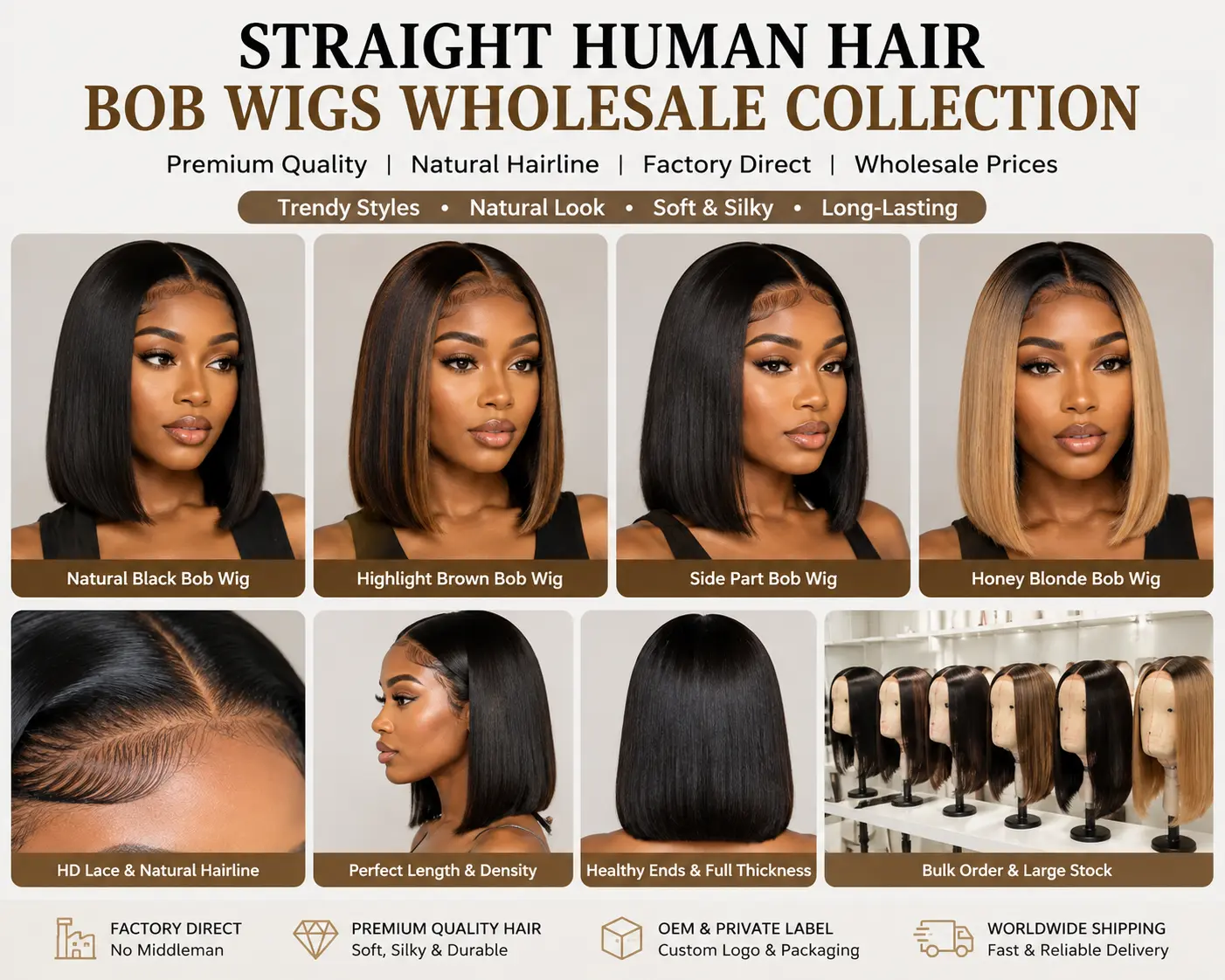
2. Lace Front Bob Wigs: Add a More Natural-Looking Option
Once basic Bobs are covered, lace front Bob wigs can provide a higher-value category.
The lace area allows buyers to offer customers a more natural-looking front hairline and greater styling flexibility than many basic machine-made caps. Depending on the target price, suppliers may offer different lace dimensions and materials.
For wholesalers, however, more lace specifications also mean more SKUs.
Before expanding your assortment, ask:
- Does my customer understand and value lace quality?
- What lace size fits my target retail price?
- Does my market prefer transparent, HD, or standard lace?
- Are customers willing to pay more for a larger lace area?
- Would a closure construction satisfy part of the same demand at a different price point?
If lace-front products are already important to your business, our Lace Front Wigs Wholesale range is a useful next category to compare when planning a broader lace wig assortment.
Buyers serving premium customers may also want to compare Full Lace Wigs Wholesale options. Unlike standard lace front constructions, full lace wigs provide lace coverage across a much larger area of the cap, making them suitable for customers who prioritize greater styling flexibility. For most Bob wig inventories, however, lace-front and glueless constructions may be more practical starting points, as the final choice should match your target price range and customer expectations.
The main purchasing principle is simple: do not automatically select the most expensive lace specification. Choose the construction that matches the customer’s expectations and price range.
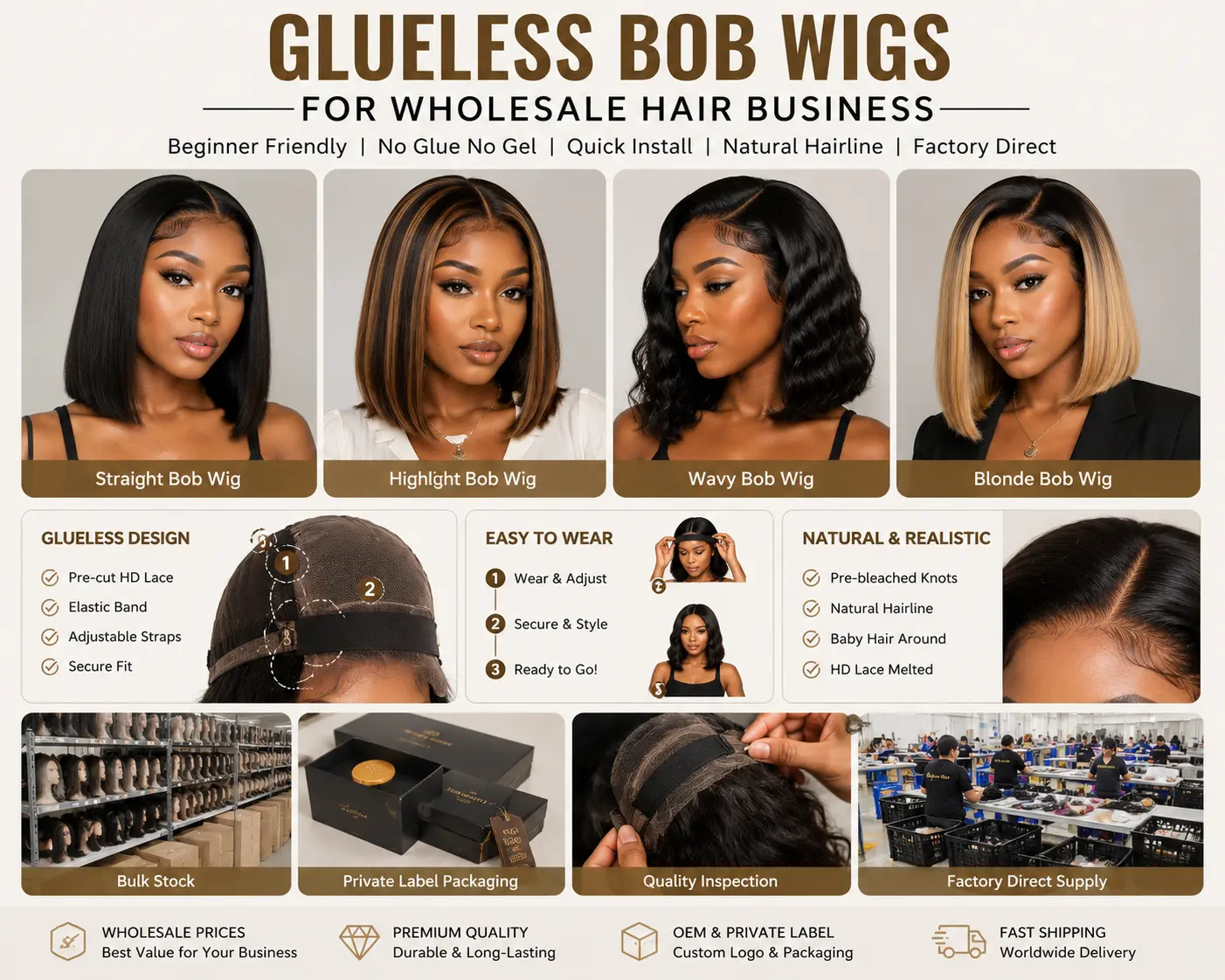
3. Glueless Bob Wigs: Target Convenience-Focused Customers
Glueless Bob wigs deserve consideration because installation convenience has become an important product feature for online wig buyers.
Instead of depending primarily on adhesive, a properly designed glueless wig may use adjustable features, elastic bands, suitable cap construction, and pre-finished details to improve security and ease of wear.
This can make glueless Bob styles particularly attractive to:
- First-time wig users
- Customers who change hairstyles frequently
- Online shoppers looking for ready-to-wear options
- Social-commerce sellers demonstrating quick installations
- Customers who prefer to avoid regular adhesive application
For wholesale buyers, construction quality matters as much as the “glueless” label. Ask for samples and test the cap fit, elastic band, comb placement, lace finishing, hairline, and overall stability.
Keyword research for the Bob category also shows meaningful search interest around terms such as glueless Bob wigs and glueless Bob wigs human hair, making this a useful subcategory to test rather than treating every Bob as the same basic product.
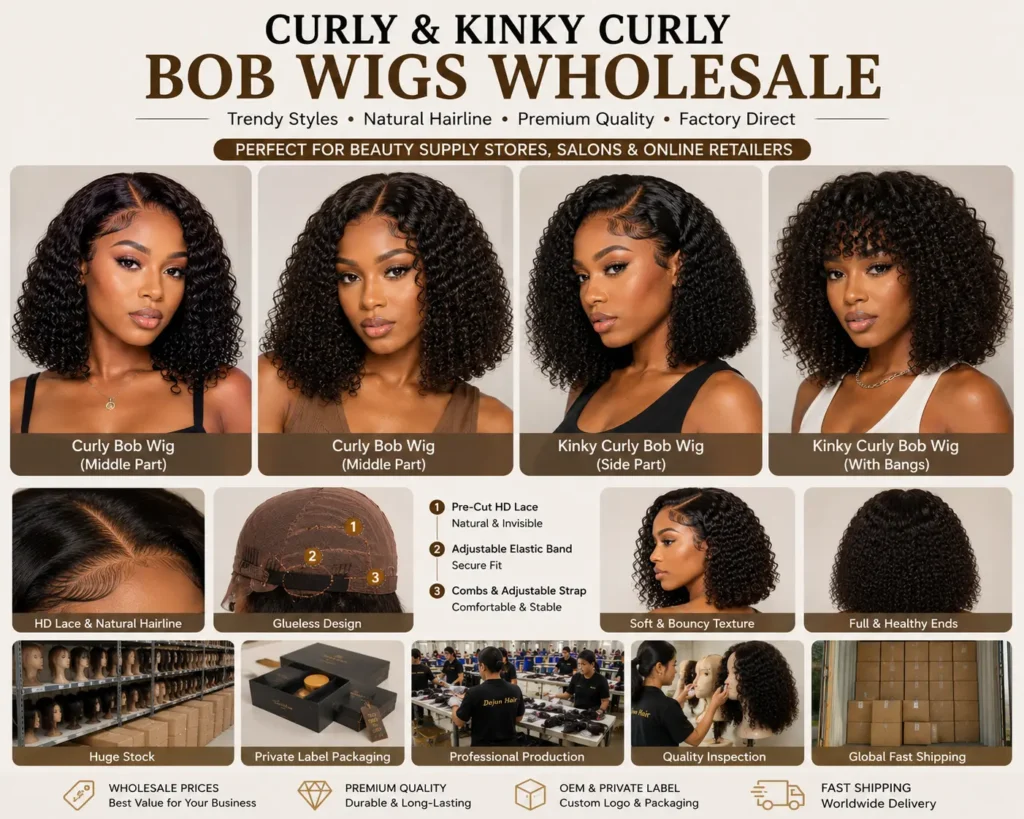
4. Curly and Kinky Curly Bob Wigs: Expand Through Texture
After establishing straight styles, texture is one of the easiest ways to diversify your collection.
Curly Bob wigs, water-wave Bobs, deep-wave styles, and the kinky curly Bob wig can appeal to customers who want more volume and a stronger visual identity.
This is particularly useful for wholesalers because you can create variety without introducing a large number of additional lengths.
For example, instead of stocking six straight lengths, a buyer might offer:
- 10-inch straight Bob
- 12-inch straight Bob
- 12-inch curly Bob
- 12-inch kinky curly Bob
- 14-inch wavy Bob
That creates visibly different choices while keeping the SKU structure manageable.
When sourcing wholesale curly Bob wigs, pay close attention to curl consistency. A sample may look excellent after styling at the factory, but wholesale buyers need to know how the texture behaves after washing.
Ask your supplier to explain recommended washing and maintenance procedures, and test a sample before scaling the order.
5. Blunt-Cut Bob Wigs: Create a Clean, Fashion-Focused Option
A blunt Bob has a clean, defined bottom line that gives the wig a noticeably different visual character from softer layered styles.
It can work particularly well for boutiques, salons, and online stores that want a polished, fashion-oriented product.
Manufacturing consistency is important here. Uneven ends are more visible on a blunt cut than on a heavily layered or curly style.
When evaluating samples, inspect:
- Symmetry of the cut
- Fullness at the ends
- Left/right balance
- Hair density
- Overall shape after combing
- Shape after washing and restyling
For human hair products, the fullness of the ends can also reveal useful information about hair quality and processing. A Bob that appears dense near the roots but becomes unusually thin toward the ends may not create the premium finished look your customers expect.
6. Colored and Highlight Bob Wigs: Use Smaller Orders to Test Demand
Color can turn a standard Bob into a strong visual product for Instagram, TikTok, online stores, and fashion-focused salons.
Popular options for testing may include:
- 613 blonde Bob wigs
- Burgundy Bobs
- Highlight Bobs
- Piano-color styles
- Ombre Bobs
- Brown shades
- Custom fashion colors
But colored Bob wigs should usually be treated differently from basic natural-color inventory.
A natural-black straight Bob may remain relevant for a long period, while demand for a particular highlight combination can change more quickly. That makes colored products well suited to smaller test orders.
If you have limited purchasing capital, avoid ordering large quantities of five or six fashion colors simply because they photograph well.
Start with the colors that fit your audience, measure actual sales, and reorder the winners.
For customized colors, also ask the Bob wigs manufacturer about color consistency between production batches. If a successful SKU is reordered three months later, significant shade differences can create problems for product photography and customer expectations.
7. Short Pixie Bobs and Asymmetrical Bobs: Differentiate Your Collection
Not every product in your catalog needs to be a high-volume core SKU.
Short pixie-inspired Bobs, asymmetrical cuts, side-part designs, and other distinctive short Bob wigs can help a store avoid looking identical to competitors.
These styles are best considered differentiation inventory.
They can be especially useful for salons that serve a known local customer base or online businesses that understand which looks perform well with their audience.
For a new wholesale buyer without historical sales data, however, order them more cautiously than classic straight Bobs.
The objective is to provide enough variety to make your collection interesting without allowing niche products to consume too much inventory capital.
Human Hair vs. Synthetic Bob Wigs: Which Should You Stock?
Material is another major decision when developing a Bob collection.
| Factor | Human Hair Bob Wigs | Synthetic Bob Wigs |
|---|---|---|
| Purchase cost | Generally higher | Generally lower |
| Natural movement | Typically stronger | Depends on fiber quality |
| Restyling flexibility | Higher | More limited depending on fiber |
| Heat styling | Depends on hair processing | Only when fiber is heat-resistant |
| Target positioning | Mid-range to premium | Budget to fashion-focused |
| Useful inventory role | Core/premium products | Entry-level/trend products |
Neither option is automatically better for every business.
Human hair Bob wigs are often more appropriate when your customers prioritize natural movement, restyling flexibility, and longer-term use. Synthetic products can make sense when price accessibility, fashion colors, or quick style changes matter more.
Some wholesalers deliberately carry both.
For example, human hair Bobs may form the main premium line while synthetic colored Bobs provide a lower-cost fashion range. Buyers interested in building this second category can also compare Wholesale Synthetic Lace Front Wigs rather than trying to serve every customer with human hair products alone.
How to Build a Smarter Bob Wig Inventory Mix
One of the biggest mistakes in Bob Wigs Wholesale purchasing is treating every style as an equal investment.
A more practical model is to divide products into three groups.
Core Inventory
These are products you expect to reorder consistently.
Examples may include:
- Straight Bob wigs
- Natural black colors
- Your two or three strongest lengths
- Standard densities
- Proven cap constructions
Core products should receive the largest share of inventory once sales data supports them.
Growth Inventory
These provide meaningful differentiation while still addressing broad customer needs.
Examples include:
- Lace front Bob wigs
- Glueless Bob wigs
- Curly Bob wigs
- Kinky curly Bobs
- Higher-specification human hair options
These products can gradually become core inventory if reorder data is strong.
Test Inventory
These are styles where demand is less predictable.
Examples include:
- 613 blonde Bobs
- Highlight combinations
- Ombre colors
- Asymmetrical cuts
- New textures
- Newly developed cap designs
Buy these in smaller quantities, gather customer feedback, and scale only the products that prove themselves.
A useful purchasing process is:
Sample → Mixed Small Order → Sales Test → Identify Winning SKUs → Reorder at Scale
This is one reason flexible MOQ and mixed orders can be more valuable than simply receiving the lowest unit price.
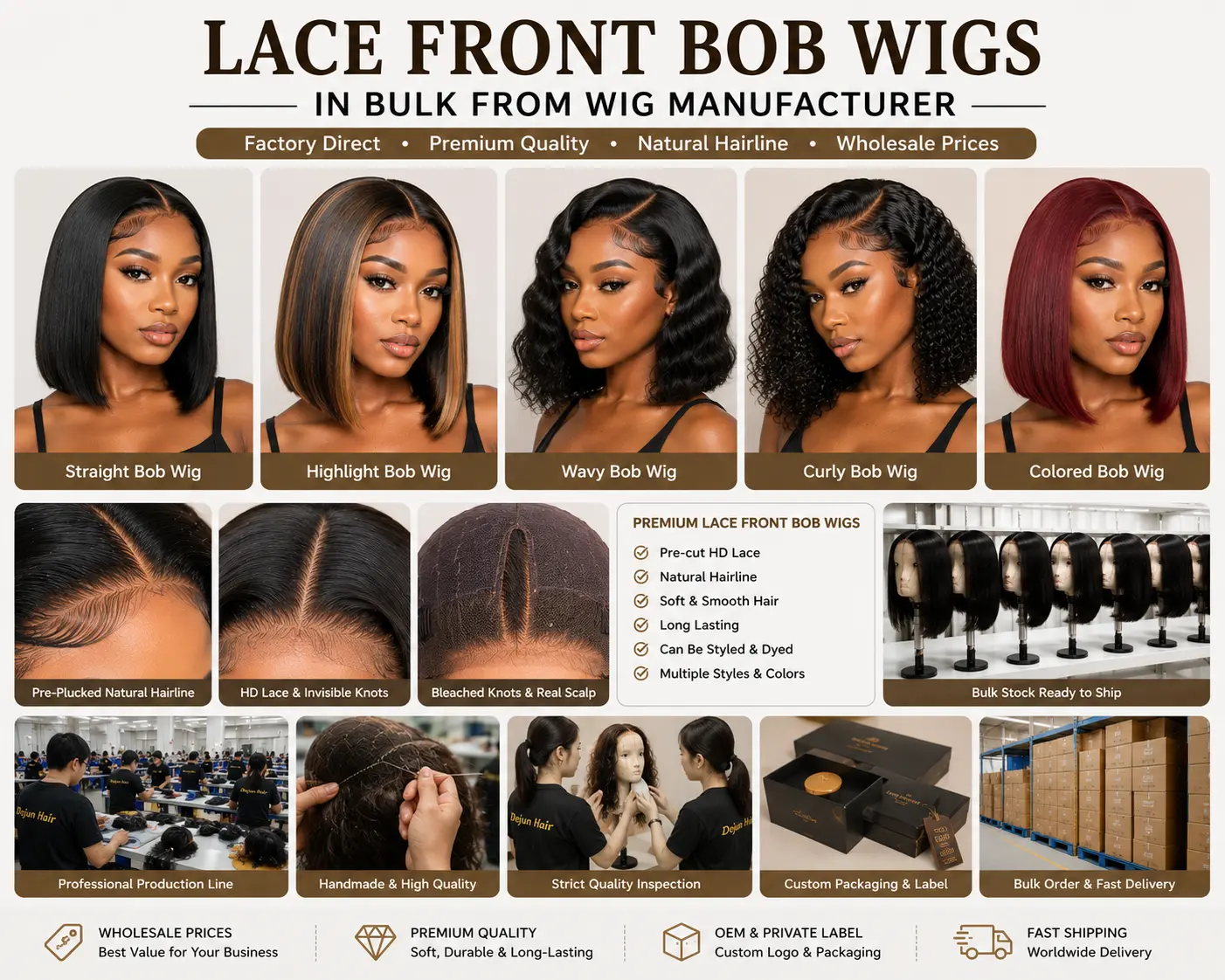
How Length, Density and Lace Affect Your Bob Wig SKUs
Style is only one part of inventory planning.
Imagine offering one Bob design in five lengths, three densities, three lace options, and four colors. That single design could theoretically become 180 combinations.
Most small and medium-sized hair businesses do not need that complexity.
Length
For Bob wigs, common short-to-medium options may include 8, 10, 12, 14, and 16 inches. Rather than carrying all lengths at the same depth, prioritize the lengths that fit the finished look your customers want.
Density
Different density levels change both appearance and cost. More density is not automatically better. A short Bob needs the right balance between fullness, natural appearance, and price.
Lace
Closure, lace-front, and larger lace constructions can serve different customer expectations and price points.
If lace specifications are becoming a major part of your purchasing decision, learning the differences between closure and frontal products can help you plan SKUs more accurately. See our guide to Human Hair Closures & Frontals Wholesale for a deeper comparison.
The same principle applies to lace material. An HD Lace Front Wig can be positioned toward customers who prioritize a less visible lace appearance and a more premium finish, while transparent or regular lace may provide a better balance between cost and durability for other market segments. Not every wholesale order needs the highest lace specification.
Stocking Bob Wigs for Different Markets and Sales Channels
The best Bob wigs to sell depend heavily on who is buying from you.
African Wholesale and Salon Markets
For wholesalers and salon operators, everyday wearability, price, durability, available textures, and restocking speed can be especially important.
A practical assortment might combine straight natural-color Bobs with several curly or textured options and a smaller number of fashion colors.
Buyers supplying street-level retailers or multiple salons may also benefit from mixed orders because individual downstream sellers often want variety rather than a large quantity of one SKU.
US and European Online Markets
Online buyers often compare more product details before purchasing.
Depending on your target segment, features such as glueless construction, lace quality, pre-plucked hairlines, natural-looking density, packaging, and ready-to-wear finishing can influence how a product is positioned.
Social media also makes visually distinctive products valuable. Highlighted or colored Bob wigs can generate attention, but online engagement should not automatically be treated as proof of repeat sales.
Use small test quantities and let conversion and reorder data guide the next purchase.
Small Hair Businesses and Startups
If you are starting with limited capital, product breadth should not come at the expense of inventory depth.
Twenty styles with one or two units each may look impressive in a catalog, but it can become difficult to identify genuine winners.
Start with a focused range, test customer response, and expand based on evidence.
Why Low MOQ and Mixed Orders Matter When Testing Bob Wig Styles
MOQ is not only a purchasing condition. It is an inventory-management tool.
Suppose Supplier A offers a slightly lower unit price but requires a large quantity of every color and length. Supplier B charges slightly more but allows several Bob styles to be combined in one initial order.
For a business still testing its market, Supplier B may create less inventory risk.
This is why buyers should ask a Bob wigs supplier about both total MOQ and MOQ per SKU.
At Dejun, we work with different types of overseas buyers, from larger wholesalers to smaller salons and emerging hair businesses. For stock products, mixed purchasing can help buyers build a broader assortment without committing excessive quantities to an untested style. OEM/ODM orders can then be discussed separately according to specifications and production requirements.
For new custom products, sampling is particularly important. A sample allows you to evaluate hair, cap construction, lace, density, color, sizing, and finishing before committing to bulk production.
What to Ask Your Bob Wig Supplier Before Placing a Bulk Order
Before buying Bob wigs in bulk, ask questions that reveal how the supplier actually manages production and quality.
1. Are you the manufacturer or a trading company?
Knowing who controls production can make customization, troubleshooting, and repeat-order consistency easier to manage.
2. What human hair qualities are available?
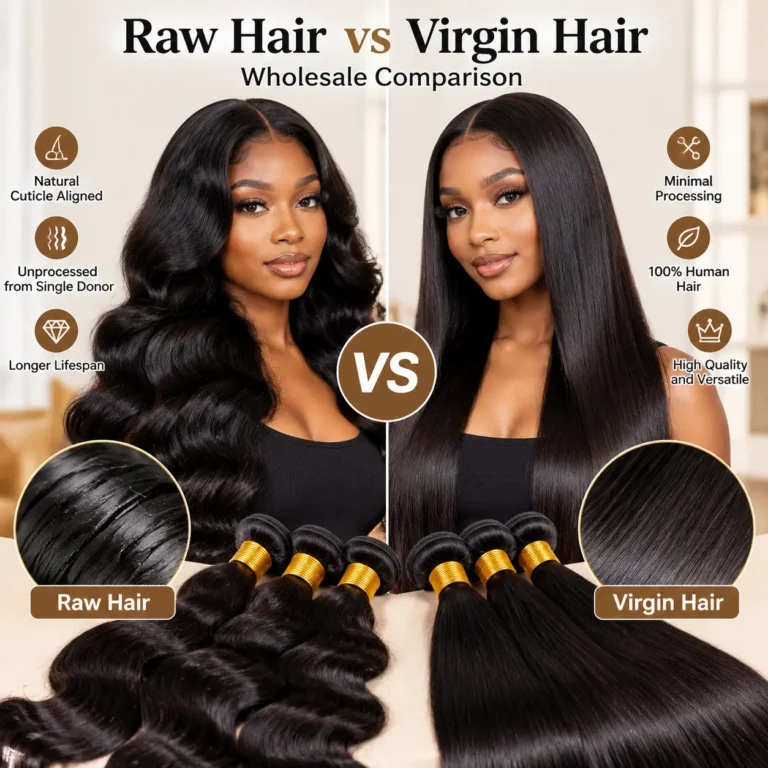
Terms such as Remy, virgin, and other commercial grades are not always used consistently across suppliers. Ask what the specification means in practice and test samples.
3. Can I mix Bob styles in one wholesale order?
This is particularly important for new buyers testing multiple lengths and textures.
4. What is the MOQ per style, length, and color?
A low total MOQ is less helpful if every individual SKU still requires a large quantity.
5. What can be customized?
Ask about length, density, texture, cap size, lace, color, elastic bands, logo, hang tags, and packaging.
6. Can I order samples before bulk production?
Sampling is one of the simplest ways to reduce sourcing risk.
7. What is the production lead time?
Ask separately about stocked products and customized orders.
8. How are finished wigs inspected?
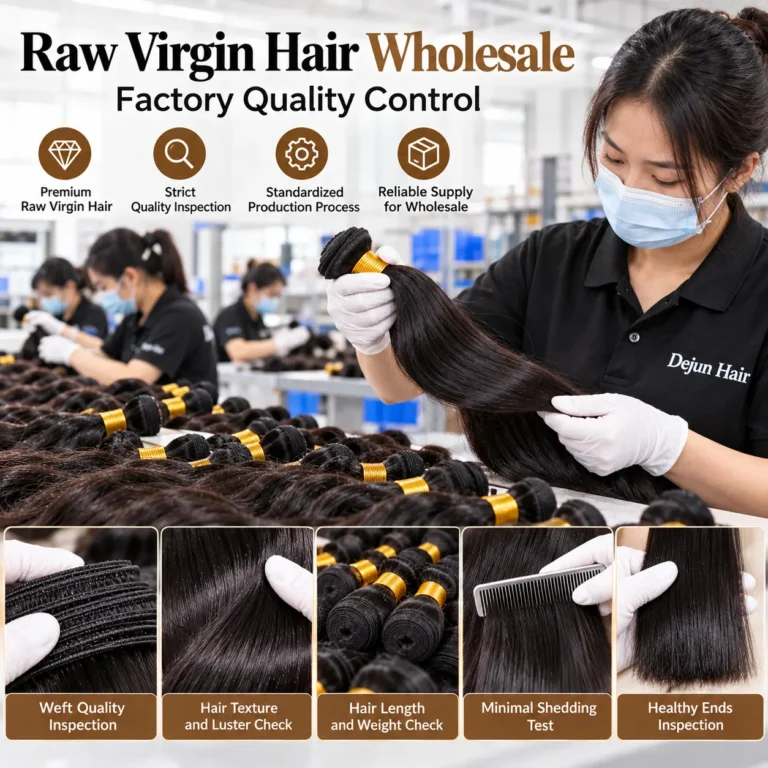
Quality control should include relevant checks for hair condition, construction, shedding, color, dimensions, and finishing.
If supplier evaluation is your main concern, our guide on choosing a reliable Bob Wigs Wholesale supplier explains the factory, quality, MOQ, pricing, customization, and delivery factors worth checking before committing to a long-term partnership.
Working With a Bob Wigs Manufacturer for a Custom Collection
Once you know which products sell, customization becomes much more useful.
Instead of asking a factory to create many untested styles immediately, use your sales data to identify the Bob products that deserve private-label development.
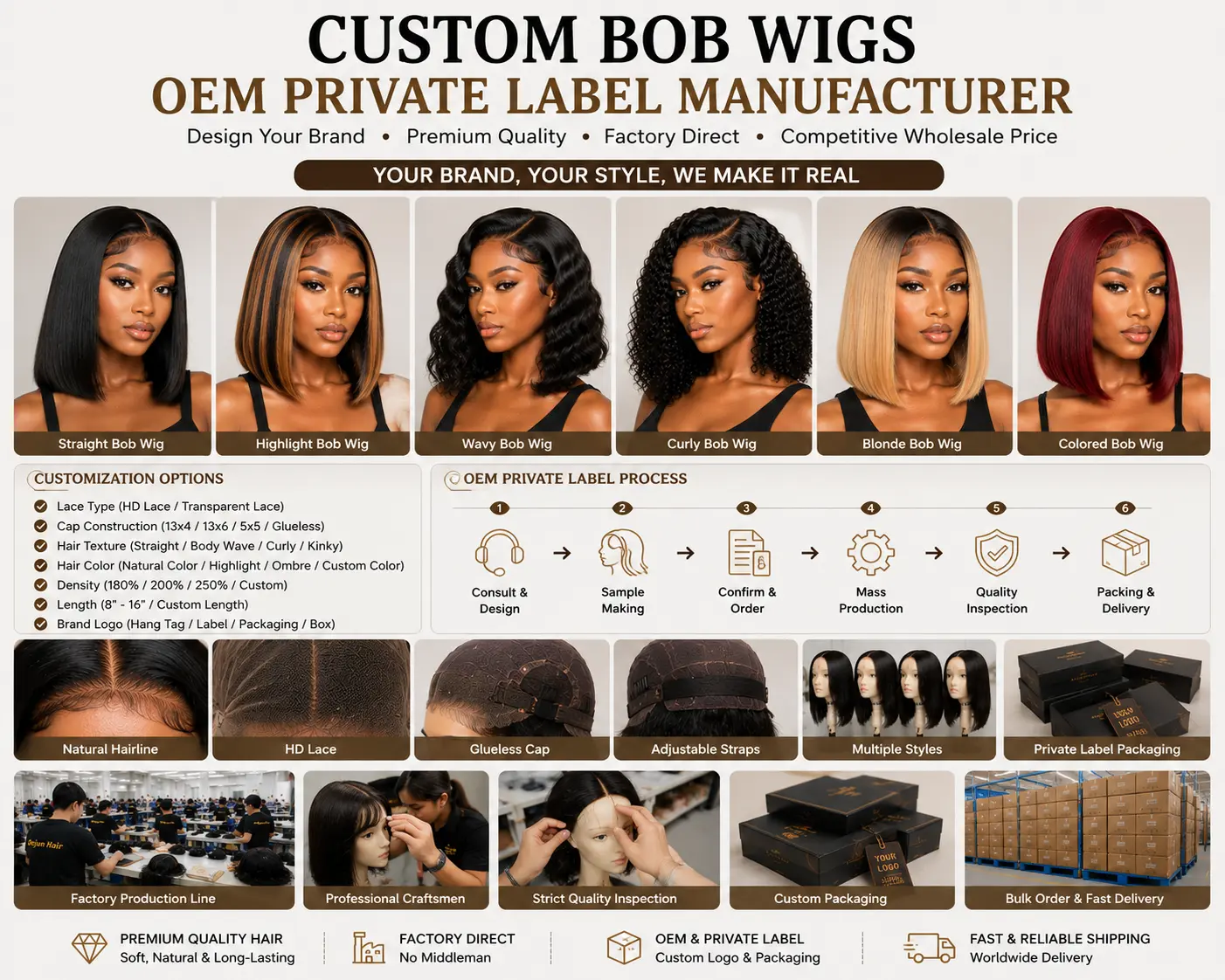
A Bob wigs manufacturer may be able to customize:
- Hair length
- Density
- Straight, wavy, or curly texture
- Lace dimensions and material
- Cap construction and circumference
- Glueless features
- Hair color and highlights
- Parting
- Logo and hang tags
- Retail packaging
For established sellers, this makes it possible to turn a proven wholesale SKU into a more distinctive branded product.
Dejun operates its own wig production facility in Shaoyang, Hunan, China, with production processes covering hair preparation, cap making, lace sewing, styling, inspection, and warehousing. With approximately 20 years of local wig manufacturing experience, we support both human hair and synthetic wig categories, stock wholesale orders, and OEM/ODM customization.
The advantage of working directly with a manufacturer is not simply price. For a growing hair business, the more important benefits can be specification control, repeat-order communication, flexible product development, and the ability to adjust products as you learn more about your market.
Final Takeaway: Stock Proven Styles First, Then Test New Bob Wigs
The strongest Bob Wigs Wholesale strategy is rarely “buy as many styles as possible.”
Start with products that have broad commercial potential: straight human hair Bobs, natural colors, manageable lengths, and constructions that fit your target price range. Then expand through lace front, glueless, curly, and kinky curly options.
Treat colored, highlighted, and more fashion-driven styles as test inventory until your own sales data proves they deserve larger orders.
Most importantly, build your purchasing decisions around your customers rather than a generic list of “best sellers.” A Bob style that performs strongly for a TikTok-focused US retailer may not be the same product mix required by an African salon wholesaler.
If you are planning your next Bob wig collection, send Dejun your target market, preferred Bob styles, lengths, approximate quantity, quality level, and customization requirements. Our team can help you evaluate suitable stock options, mixed-order possibilities, samples, and OEM/ODM specifications before you move to a larger order.
Industry reference resources related to wholesale wig manufacturing :
https://guguhair.com/bob-wigs-wholesale-bob-wigs-supplier/
High Quality
All of our products have undergone production and quality control and come with certificates
Fast Delivery
Our supply chain management is a model of standardization and professionalism in the wig manufacturing industry, ensuring that our customers receive their wigs on time.
Customer Service
Fill out the wig order form to customize your base, size, hair length, and color.