
Leave your Message

-
Yongqi Chen sales consultant
-
Phone/WhatsApp: +86 13187012919
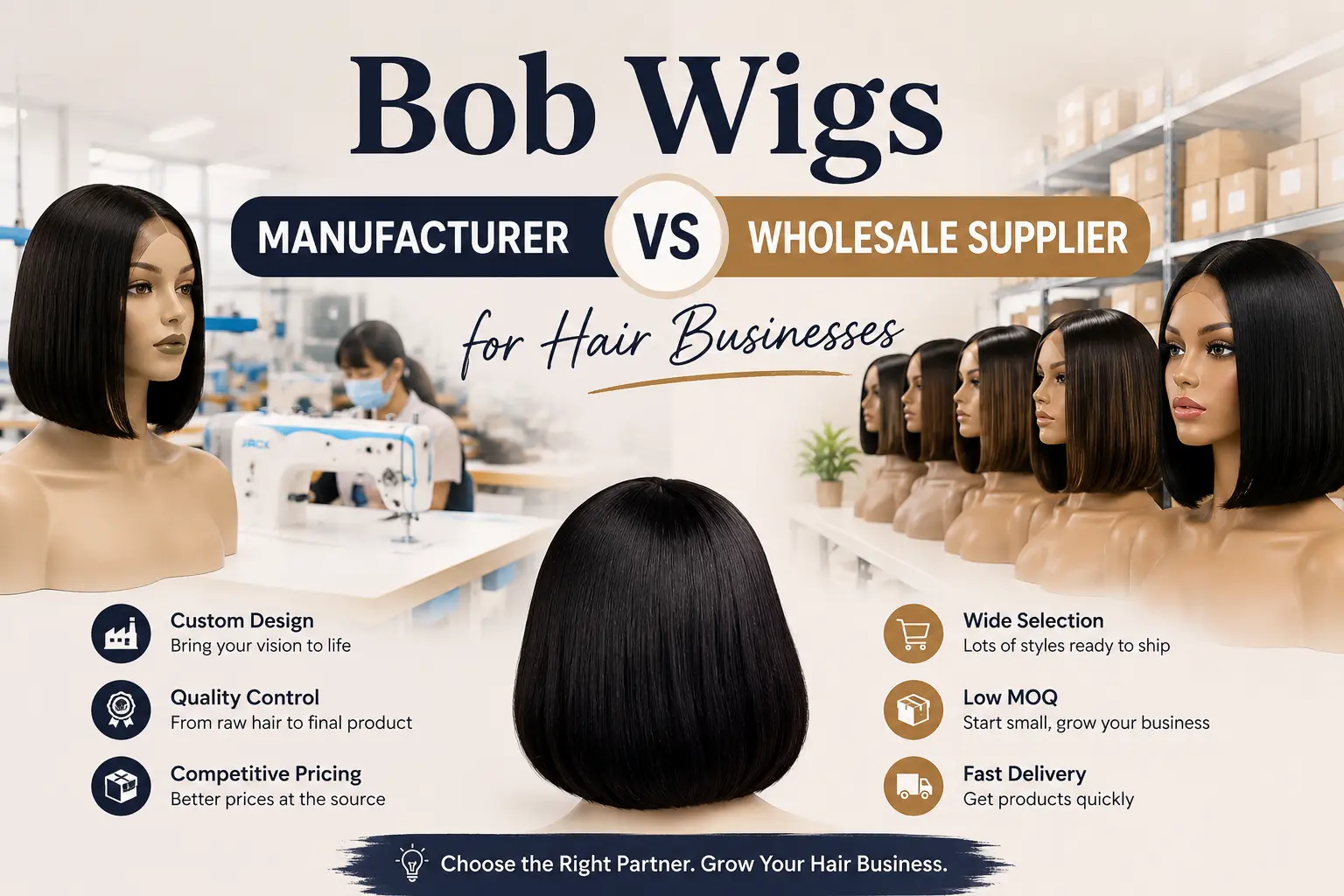
Bob Wigs Manufacturer vs. Wholesale Supplier: Which Is Better for Your Hair Business?
Table Of Contents
- What Is a Bob Wigs Manufacturer?
- What Is a Bob Wigs Wholesale Supplier?
- Bob Wigs Manufacturer vs. Wholesale Supplier: Key Differences
- 1. Pricing: Is Buying Directly From a Bob Wigs Manufacturer Cheaper?
- 2. MOQ and SKU Flexibility: Which Is Better for Small and Growing Buyers?
- 3. OEM/ODM and Customization: Where Manufacturers Have an Advantage
- 4. Quality Control: Who Has More Control Over Human Hair Bob Wigs?
- 5. Lead Time and Inventory: Is a Factory Always Faster?
- 6. SKU Flexibility: Wholesalers Have an Advantage—But Not Always
- 7. Which Supplier Model Is Better for Different Hair Businesses?
- When Should You Buy Bob Wigs Directly From a Manufacturer?
- When Is a Wholesale Supplier Still the Better Choice?
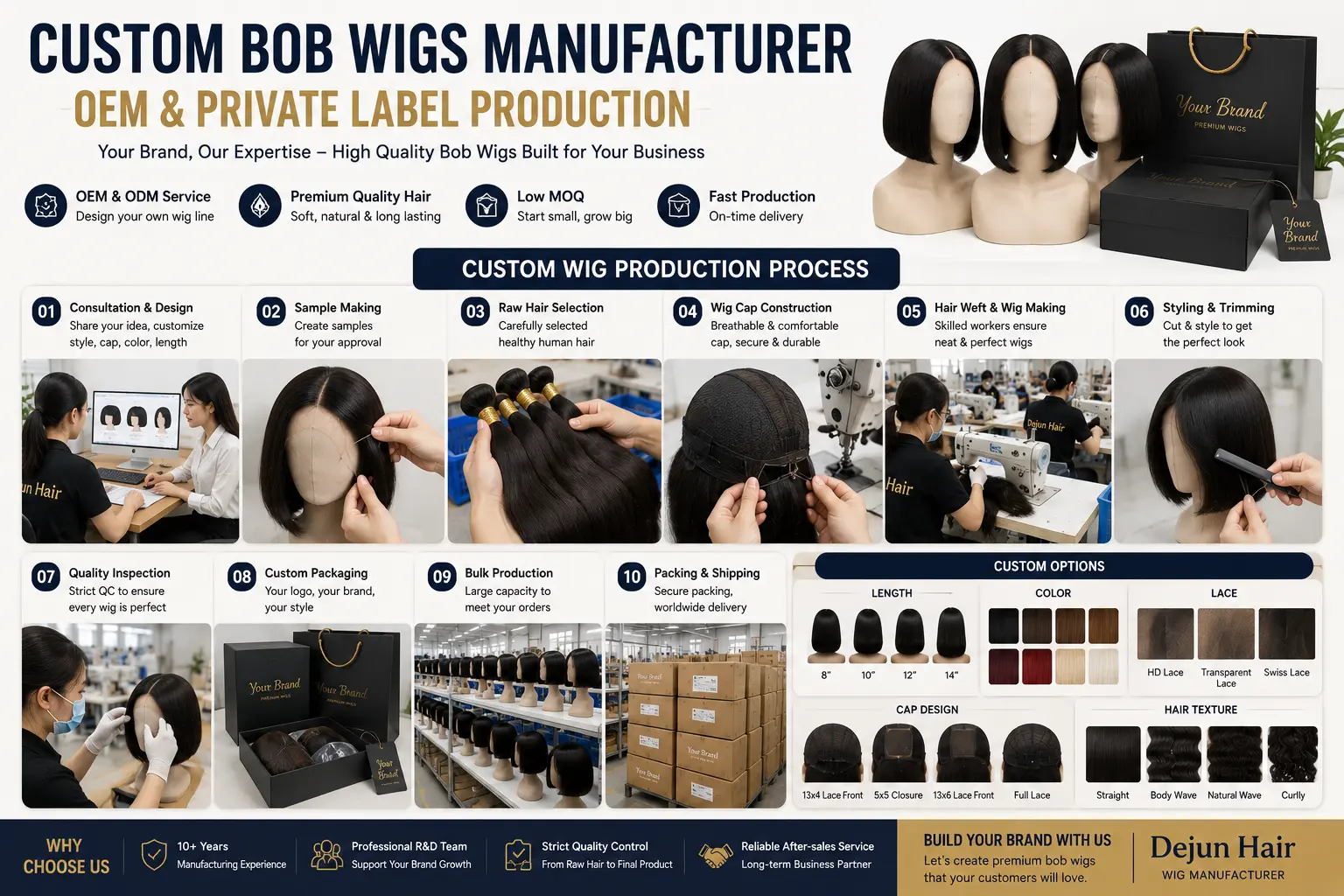
- How to Verify a Real Bob Wigs Manufacturer Before Ordering
- Questions to Ask a Bob Wigs Manufacturer Before Placing an Order
- How Dejun Supports Wholesale and Custom Bob Wig Orders
- Final Decision: Bob Wigs Manufacturer or Wholesale Supplier?
For a hair business, choosing where to source Bob wigs can affect much more than the purchase price. It can influence product consistency, minimum order quantities, customization options, inventory flexibility, delivery schedules, and even how quickly you can build your own wig brand.
One common decision is whether to work directly with a Bob Wigs Manufacturer or purchase from a wholesale supplier.
Both sourcing models can work. A wholesaler may be convenient when you need small quantities of ready-stock products quickly, while a manufacturer can offer stronger advantages when your business requires OEM/ODM development, private labeling, consistent bulk supply, or greater control over product specifications.
The right choice therefore depends on your order volume, business stage, target market, and customization requirements.
This guide compares a Bob wigs manufacturer vs wholesale supplier from a practical B2B purchasing perspective so you can decide which sourcing model makes more sense for your hair business.
What Is a Bob Wigs Manufacturer?
A Bob wigs manufacturer is directly involved in producing the wigs it supplies.
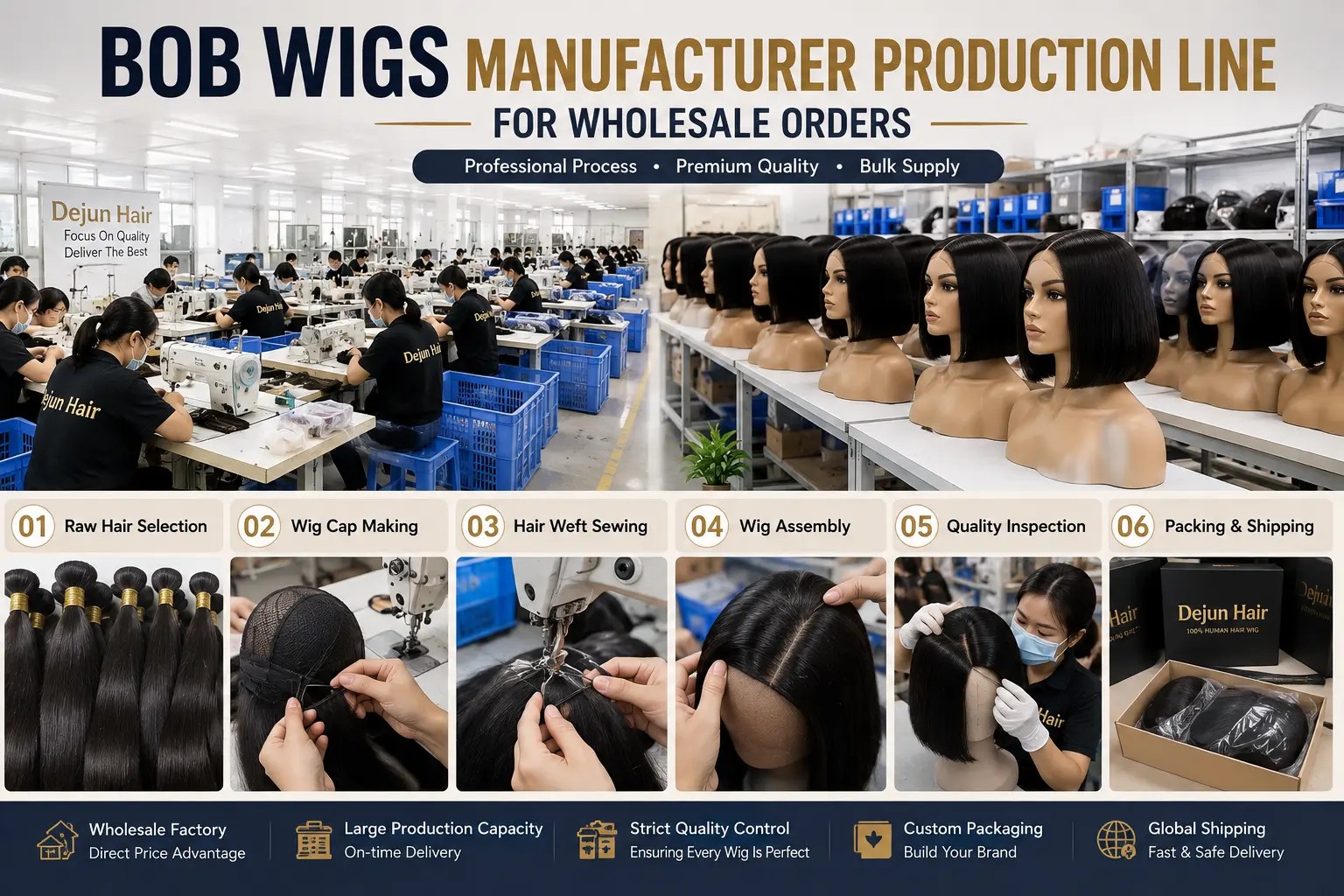
Depending on the factory, production may include hair material selection and processing, cap construction, lace sewing, ventilation, styling, coloring, quality inspection, packaging, and preparation for shipment.
A professional human hair Bob wig manufacturer therefore has direct influence over important product specifications such as:
- Hair material and quality
- Bob length and cut
- Hair density
- Straight, body wave, or curly texture
- Lace size and material
- Cap construction and circumference
- Natural black or custom colors
- Glueless construction
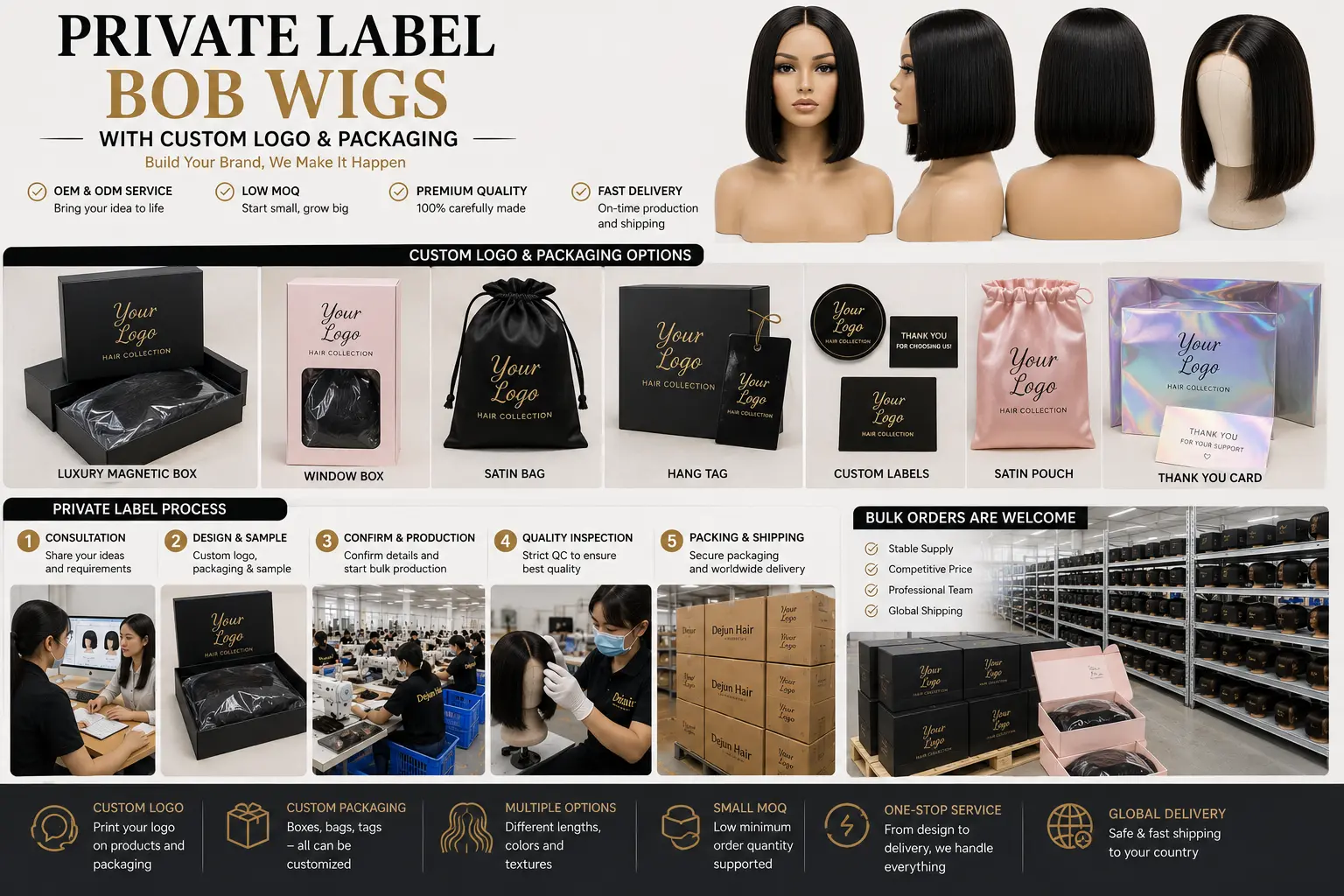
- Logo, tags, and packaging
This production control becomes particularly important for buyers who are developing a private-label collection rather than simply reselling standard stock.
However, buyers should not assume that every company using the word “manufacturer” actually owns or operates production facilities. Factory verification, sample testing, and detailed product discussions should still be part of the sourcing process.
What Is a Bob Wigs Wholesale Supplier?
A Bob wigs supplier or wholesaler primarily purchases products from manufacturers and resells them to other businesses.
Some wholesalers maintain large inventories and offer a broad selection of styles from different factories. This can be useful for buyers who want to purchase several products in small quantities without committing to factory production runs.
For example, a new salon may want only a few straight Bob wigs, colored Bob wigs, and lace Bob wigs to test local demand. A wholesaler with ready inventory may make this type of purchase simple.
The trade-off is that the supplier may have less direct control over manufacturing specifications, raw materials, production schedules, and custom development.
The distinction becomes more important as your business grows.
A reseller primarily asks:
“What products do you currently have available?”
A manufacturer should also be able to discuss:
“What product can we manufacture according to your requirements?”
That difference is at the center of the manufacturer-versus-wholesaler decision.
Bob Wigs Manufacturer vs. Wholesale Supplier: Key Differences
The two sourcing models can be compared across several important purchasing factors.
| Factor | Bob Wigs Manufacturer | Wholesale Supplier |
|---|---|---|
| Product Price | Direct factory pricing may reduce intermediary costs | Price normally includes wholesale/distribution margin |
| MOQ | Flexible for stock; custom production may require MOQ | Often convenient for small ready-stock orders |
| Customization | Strong OEM/ODM capabilities | Usually limited to available specifications |
| Quality Control | Direct control over production and inspection | Relies partly on upstream manufacturers |
| SKU Flexibility | Depends on factory inventory and mixed-order policy | Can be strong for ready-stock products |
| Private Label | Logo, tags, packaging, and product specifications can be developed | Usually more limited |
| New Product Development | Can manufacture according to buyer specifications | Mainly resells existing products |
| Bulk Supply | Better suited to planned large-volume production | Depends on available inventory and upstream supply |
| Lead Time | Stronger control over production schedules | Fast when products are already in stock |
| Long-Term Scalability | Suitable for growing brands and distributors | Suitable for resale and market testing |
The best choice should not be based on one factor alone. Buyers should consider their total sourcing requirements.
1. Pricing: Is Buying Directly From a Bob Wigs Manufacturer Cheaper?
Price is often the first reason buyers consider purchasing directly from a Bob Wigs Manufacturer.
A factory-direct supply chain can remove one or more intermediary margins. This becomes particularly meaningful when purchasing hundreds or thousands of units over time.
However, “factory direct” does not automatically mean that every order will have the lowest total cost.
Suppose one wholesaler allows you to buy five ready-stock wigs, while a factory requires a larger MOQ for a fully customized design. For a new seller testing one style, the wholesaler may involve less financial risk even if the per-unit price is higher.
For larger or repeat orders, the calculation changes.
When comparing quotations for Bob wigs wholesale, consider:
Unit price + customization cost + shipping + defective-product risk + inventory cost + packaging + potential rework or replacement costs.
A slightly cheaper wig is not necessarily cheaper if hair quality varies significantly between batches or if high defect rates create customer returns.
For established businesses purchasing bulk Bob wigs, direct manufacturing generally becomes more attractive because buyers can negotiate prices based on volume while controlling product specifications more closely.
2. MOQ and SKU Flexibility: Which Is Better for Small and Growing Buyers?
MOQ is one of the most important concerns for overseas wig buyers.
Traditional manufacturing is often associated with high minimum order quantities, while wholesalers are associated with smaller orders. In practice, the distinction is becoming less rigid.
Some factories combine production capability with ready-stock wholesale programs.
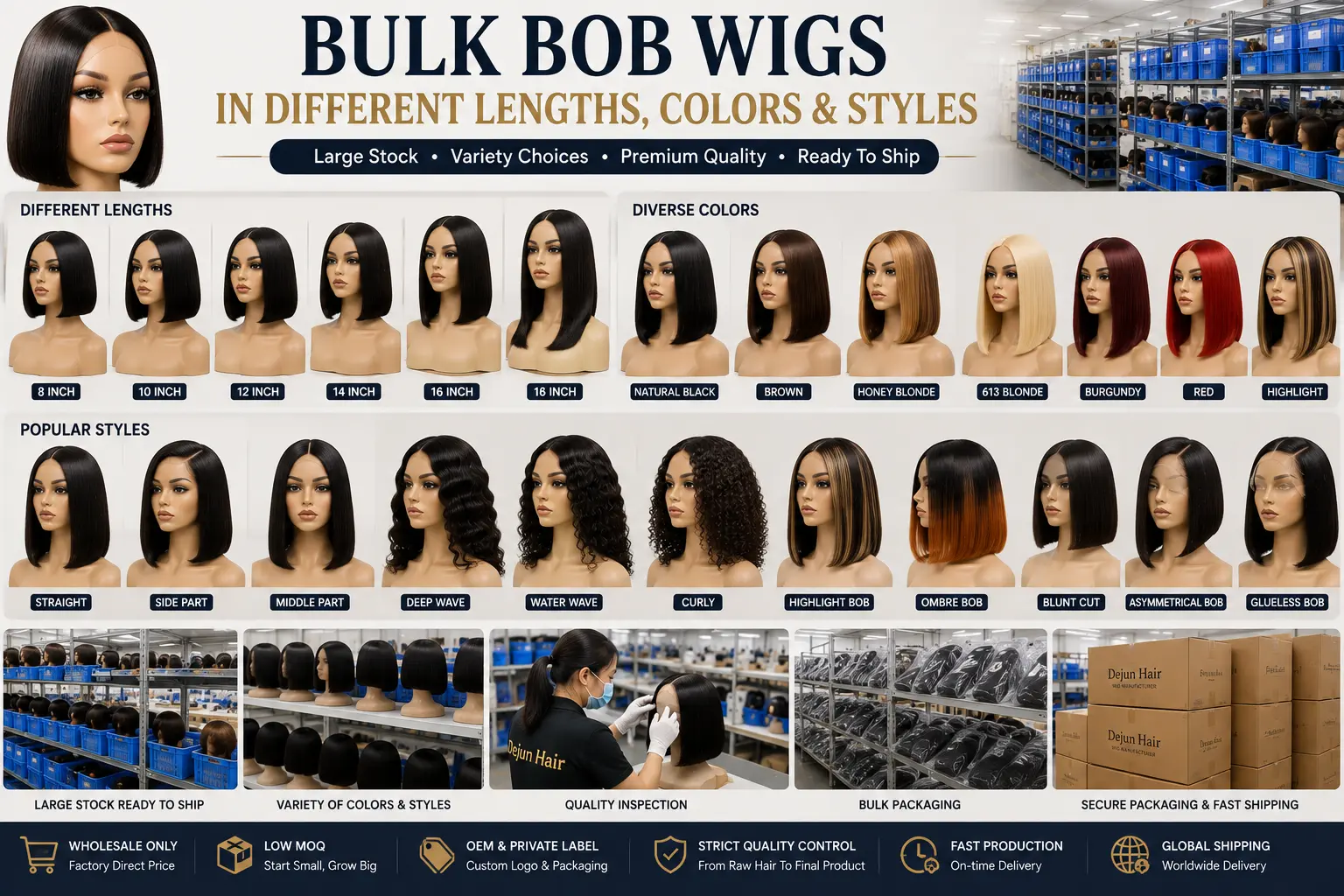
This allows buyers to purchase low MOQ Bob wigs, mix different lengths or styles in one order, and move to custom production after identifying their best-selling products.
This model can be particularly useful for:
- New wig businesses testing demand
- Salon owners purchasing multiple styles
- Online sellers building their first product range
- Distributors testing products before a larger order
For example, instead of investing heavily in one 12-inch Bob wig, a buyer may test several combinations of length, density, lace construction, and color.
Once sales data identifies the strongest products, larger orders can be placed.
When evaluating a supplier, therefore, do not ask only:
“What is your MOQ?”
Also ask:
“Can I mix different Bob wig styles, lengths, colors, or densities to reach the MOQ?”
That question often gives you a better picture of actual purchasing flexibility.
3. OEM/ODM and Customization: Where Manufacturers Have an Advantage
Customization is one of the clearest differences between a manufacturer and a conventional wholesaler.
If you only need standard products, ready-stock wholesale may be sufficient.
But if you are building a recognizable hair brand, working with a custom Bob wig manufacturer provides considerably more options.
A capable OEM Bob wig manufacturer may support customization of:
- Bob length
- Hair density
- Hair texture
- Hair color
- Lace size
- Lace color or material
- Cap circumference
- Glueless construction
- Hairline appearance
- Logo labels
- Hang tags
- Boxes and packaging
- Care instructions
OEM and ODM services also serve slightly different business needs.
With OEM Bob wigs, you may already know the specifications you want and need a factory to manufacture them consistently.
An ODM wig manufacturer, on the other hand, can help develop a product based on your target price, customer profile, reference style, or local market requirements.
For example, an African wholesaler may prioritize high-density styles and bold colors, while a U.S. online brand may focus on glueless construction, natural hairlines, beginner-friendly installation, and branded packaging.
A factory can adjust production around these different requirements.
4. Quality Control: Who Has More Control Over Human Hair Bob Wigs?
Quality consistency becomes increasingly important as order volume grows.
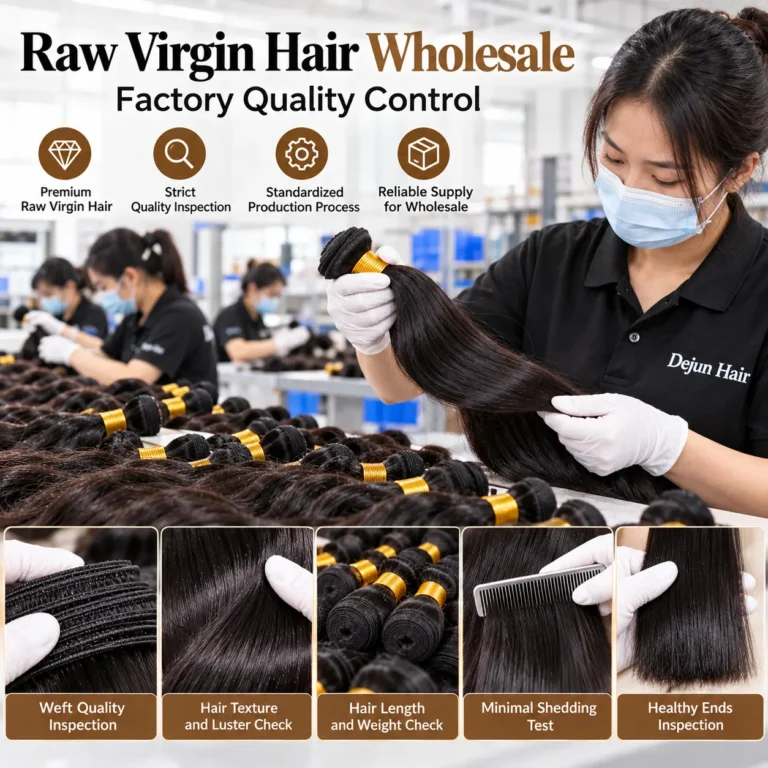
For a human hair wig manufacturer, quality control starts before the finished wig reaches the packing table.
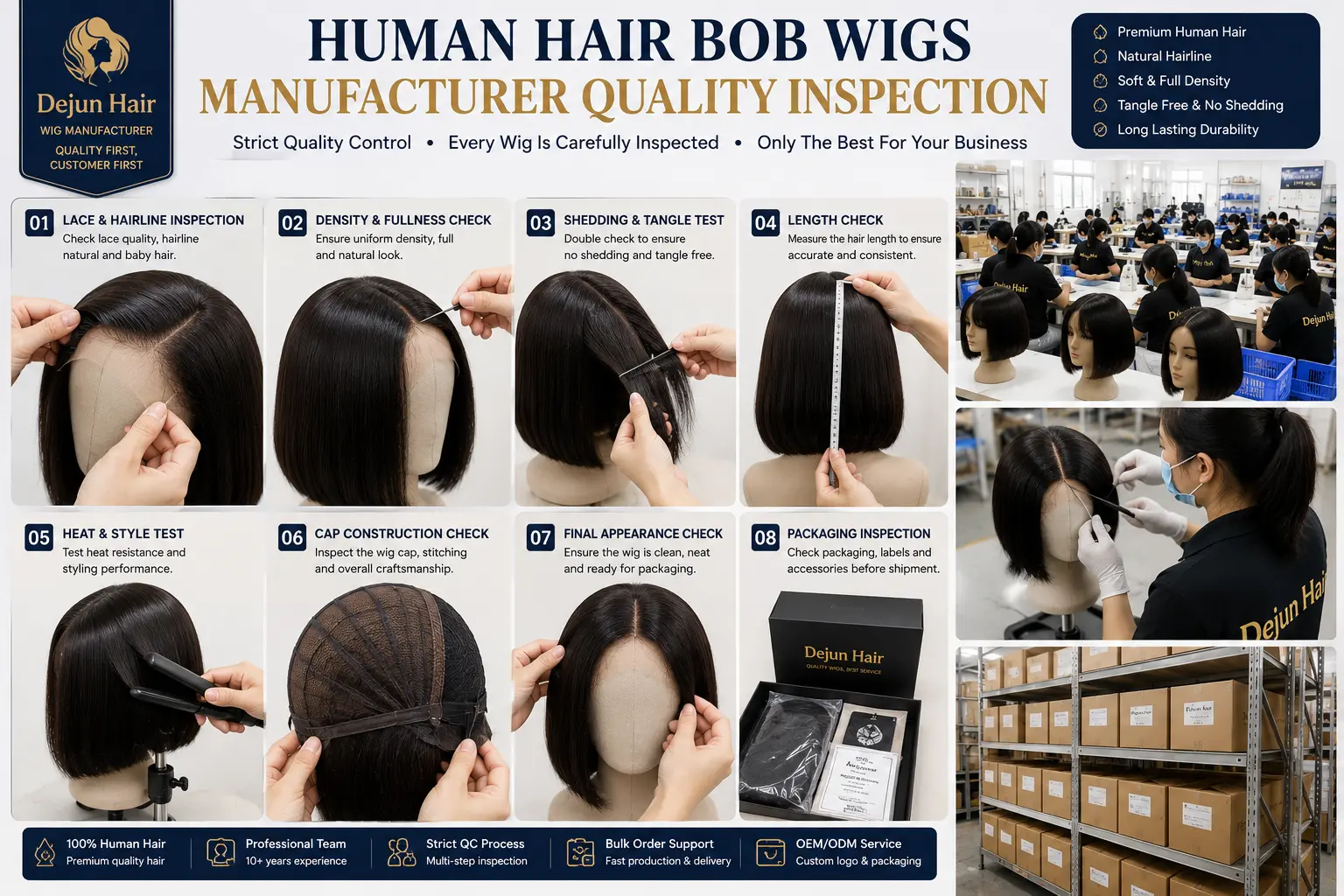
The factory can inspect hair materials, cap construction, lace attachment, stitching, hair density, shedding, color consistency, sizing, and final styling throughout production.
For human hair Bob wigs specifically, buyers should pay attention to factors such as:
Hair quality: Is the hair consistent with the sample you approved?
Cut and shape: Does the Bob maintain a consistent silhouette across the production batch?
Density: Is the density evenly distributed rather than concentrated in selected areas?
Lace: Is the lace construction consistent with the agreed specification?
Cap size: Are measurements within an acceptable production tolerance?
Shedding and construction: Are hair attachment and stitching secure enough for normal wear and maintenance?
Color: For dyed products, is color consistent across units and batches?
A wholesale supplier can certainly provide good-quality products, but when problems originate in production, it usually has to communicate with another factory to identify and resolve the issue.
A direct Bob wig factory has greater ability to trace the problem back to the production stage.
This can make communication and corrective action more efficient, especially for repeat bulk orders.
5. Lead Time and Inventory: Is a Factory Always Faster?
No.
This is another area where buyers should avoid oversimplifying the manufacturer-versus-wholesaler comparison.
For ready-stock products, a well-stocked wholesaler may ship faster than a factory that needs to manufacture your order.
For customized products, however, the manufacturer has direct control over production planning.
A useful way to evaluate delivery is to separate orders into three categories.
Ready-stock orders: Speed depends primarily on inventory availability and warehouse processing.
Repeat standard orders: A manufacturer with production planning and material preparation can provide more predictable replenishment.
Custom OEM/ODM orders: Manufacturing lead time is necessary because specifications, samples, materials, production, inspection, and packaging must be confirmed.
For businesses that regularly reorder wholesale human hair wigs, consistency of lead time can eventually matter more than getting one shipment a few days faster.
Ask potential suppliers about both current stock and production capacity rather than asking for a general delivery time.
6. SKU Flexibility: Wholesalers Have an Advantage—But Not Always
Wholesalers often perform well in SKU variety because they can source products from multiple factories.
This is useful when a small retailer wants to purchase many unrelated styles in very small quantities.
However, a manufacturer with a broad product range and sufficient ready inventory can provide a similar advantage while maintaining direct production capabilities.
This is especially valuable for buyers who want to combine:
- Short and long Bob wigs
- Lace and glueless constructions
- Different densities
- Natural and colored styles
- Human hair and synthetic products
- Multiple price levels
At Dejun, for example, we combine manufacturing with ready-stock supply and mixed-order support. This allows smaller buyers to test multiple products while giving growing customers a path toward customized manufacturing.
For buyers, the important question is not simply whether a company is a factory or wholesaler. It is whether its ordering model matches the way you manage inventory.
7. Which Supplier Model Is Better for Different Hair Businesses?
There is no single sourcing model that is ideal for every buyer.
| Business Type | Suitable Sourcing Model | Main Reason |
|---|---|---|
| New wig entrepreneur | Wholesaler or low-MOQ manufacturer | Lower initial inventory risk |
| Small salon | Stocked manufacturer or wholesaler | Flexible replenishment |
| Online wig store | Manufacturer with mixed-SKU inventory | More product control with flexible testing |
| Social media seller | Flexible stock supplier/manufacturer | Fast testing of trending styles |
| Private-label wig brand | OEM/ODM manufacturer | Product and branding customization |
| Regional distributor | Direct manufacturer | Volume pricing and stable supply |
| Large wholesaler | Direct manufacturer | Production capacity and scalability |
A new business may begin with ready-stock products and gradually transition toward direct manufacturing.
There is nothing wrong with this progression.
In fact, it can be a sensible sourcing strategy:
Test → identify best sellers → improve specifications → customize → scale.
The sourcing model should evolve with the business.
When Should You Buy Bob Wigs Directly From a Manufacturer?
It may be time to buy Bob wigs directly from a manufacturer when your business has moved beyond simple product testing.
Common signs include:
Your order volume is increasing
Larger and more frequent orders make factory pricing and production planning more important.
You need consistent specifications
If customers expect the same length, density, texture, color, lace, and cap construction every time they reorder, manufacturing consistency becomes critical.
You want to create private label Bob wigs
A manufacturer can usually provide more control over products, labels, packaging, and other brand elements.
You need products your competitors do not already sell
Instead of choosing from a wholesaler’s catalog, OEM/ODM manufacturing lets you modify or develop styles for your target customers.
You are planning long-term growth
A stable manufacturing relationship makes it easier to forecast inventory, negotiate volume pricing, develop new products, and improve existing specifications.
This is why many growing wig brands eventually move from general wholesale purchasing toward a direct manufacturing relationship.
When Is a Wholesale Supplier Still the Better Choice?
Working with a wholesaler can still make sense when flexibility is more important than customization.
For example, a wholesale supplier may be appropriate when:
- You are placing a very small first order.
- You need only standard ready-stock products.
- You want to test many unrelated styles.
- You do not need custom specifications.
- You do not yet require private labeling.
- Immediate availability matters more than factory-direct pricing.
The mistake is not choosing a wholesaler.
The mistake is continuing to use a sourcing model that no longer fits your business after your purchasing requirements have changed.
How to Verify a Real Bob Wigs Manufacturer Before Ordering
If you decide to source directly, verifying the manufacturer is essential.
Do not evaluate a factory based only on a low quotation or attractive product photos.
Ask about the production process
A real manufacturer should be able to explain how products move through production, styling, inspection, and packaging.
Factory photos, video calls, production videos, or third-party inspections can provide additional verification for large orders.
Request samples
Samples allow you to check hair quality, construction, density, cap size, lace, styling, shedding, and packaging before committing to bulk production.
More importantly, ask how the factory ensures that bulk production matches the approved sample.
Ask where quality control happens
Good QC should not consist only of looking at the finished wig before shipment.
Different checks should occur during production and final inspection.
Confirm OEM/ODM capability
If you need custom Bob wigs, ask exactly which specifications can be changed.
A manufacturer should be able to discuss technical feasibility, MOQ, sampling, pricing differences, and production lead times.
Evaluate communication
Good manufacturing relationships require detailed communication.
A supplier that responds quickly but avoids specific questions about materials, tolerances, production, or QC may create problems later.
Check export experience
For overseas buyers, manufacturing is only part of the process.
The supplier should also understand international packaging, commercial documents, shipping options, and the basic requirements for the markets it regularly serves.
Questions to Ask a Bob Wigs Manufacturer Before Placing an Order
Before choosing a manufacturing partner, prepare a consistent supplier questionnaire.
Useful questions include:
- Do you manufacture the Bob wigs in your own facility?
- What types and grades of human hair do you offer?
- What is the MOQ for ready-stock and custom orders?
- Can different lengths, colors, or styles be mixed in one wholesale order?
- Which cap, lace, density, and size options can be customized?
- Do you provide OEM/ODM and private-label services?
- Can you produce a sample before bulk production?
- How do you control consistency between samples and bulk orders?
- What is your normal lead time for stock and customized orders?
- What happens if defective products are found after delivery?
Compare the answers rather than simply comparing quotations.
For B2B wig sourcing, the cheapest supplier on a spreadsheet is not always the supplier with the lowest long-term purchasing cost.
How Dejun Supports Wholesale and Custom Bob Wig Orders
Dejun is a wig manufacturer based in Shaoyang, Hunan, China, with approximately 20 years of local manufacturing experience.
Our production capabilities cover human hair and synthetic wig categories, including Bob wigs, lace front wigs, full lace wigs, glueless wigs, hair bundles, closures, and other related products.
For Bob wig buyers, we support both ready-stock wholesale and customized production.
This allows customers to start with flexible product testing and move toward larger OEM/ODM programs as their businesses grow.
Customization can include hair length, density, color, lace construction, cap specifications, labels, logos, hang tags, and packaging, depending on the project.
Our integrated production process covers hair processing, cap construction, lace work, styling, inspection, and warehousing. Finished products are checked for factors such as hair smoothness, construction stability, color performance, and sizing before shipment.
For overseas wholesalers, salons, online sellers, and private-label brands, the objective is simple: provide a sourcing model that can support both today’s order and tomorrow’s growth.
Final Decision: Bob Wigs Manufacturer or Wholesale Supplier?
Choosing between a Bob Wigs Manufacturer and a wholesale supplier is ultimately a business decision rather than a simple question of which supplier type is “better.”
A wholesale supplier can be practical when you are testing the market, purchasing very small quantities, or need standard ready-stock products without customization.
A direct manufacturer becomes increasingly valuable when you need consistent bulk supply, better control over specifications, OEM/ODM development, private labeling, quality management, and a supply chain capable of growing with your business.
Before making the decision, evaluate six factors:
Order volume, MOQ flexibility, SKU requirements, customization, quality control, and future growth.
If your current goal is simply to test a few products, flexibility may matter most.
If you are building a long-term wig business, however, your sourcing partner should be able to do more than sell you the products it already has. It should be able to manufacture, customize, improve, and scale products with you.
Looking for a Bob wig manufacturer for wholesale or custom production? Contact Dejun to discuss your target styles, order quantity, OEM/ODM requirements, or private-label project. You can also request samples before planning a larger bulk order.
Industry reference resources related to wholesale wig manufacturing :
https://andriahair.com/best-short-bob-wig-manufacturer-a-b2b-buying-guide/
High Quality
All of our products have undergone production and quality control and come with certificates
Fast Delivery
Our supply chain management is a model of standardization and professionalism in the wig manufacturing industry, ensuring that our customers receive their wigs on time.
Customer Service
Fill out the wig order form to customize your base, size, hair length, and color.