
Leave your Message

-
Yongqi Chen sales consultant
-
Phone/WhatsApp: +86 13187012919
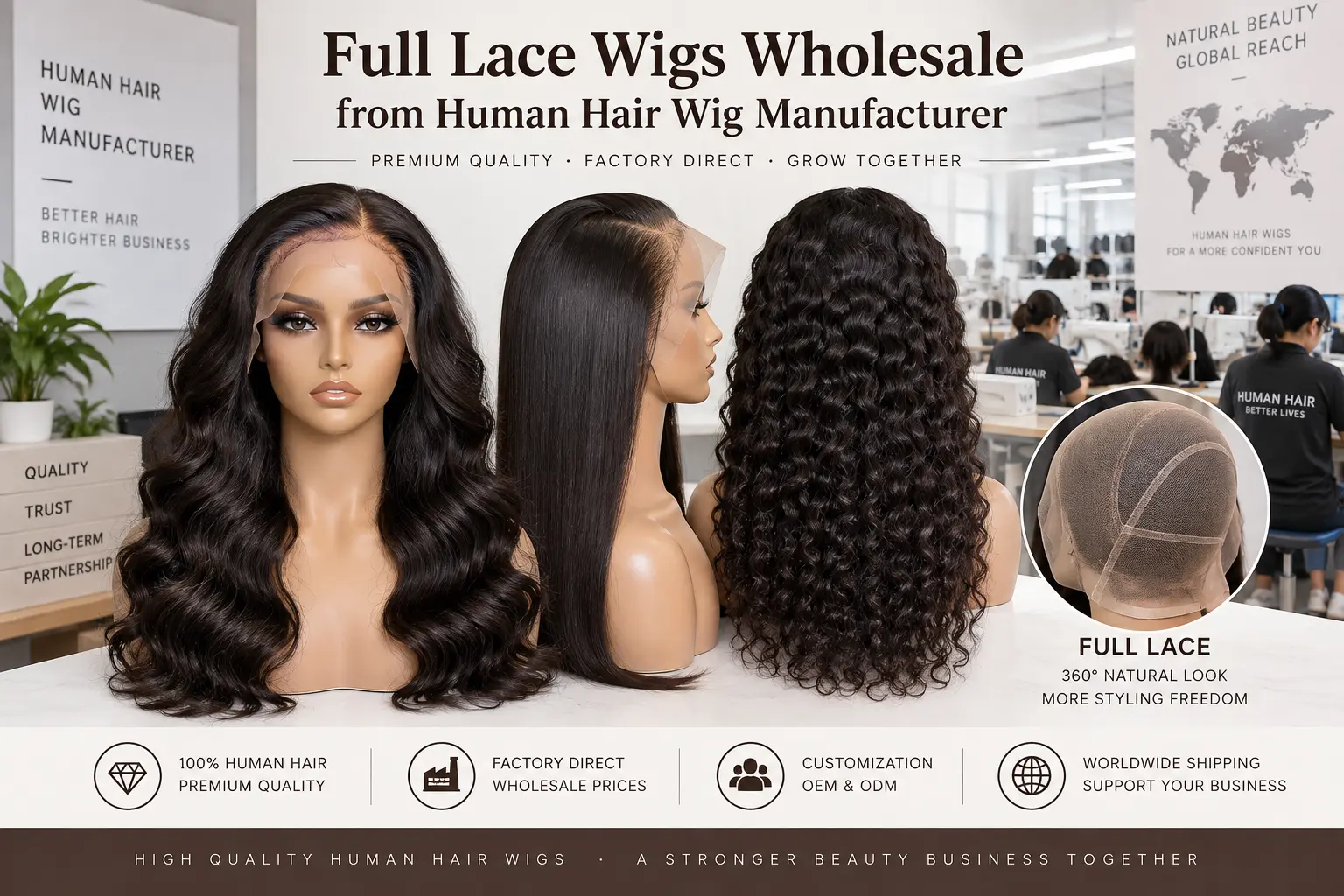
Full Lace Wigs Wholesale Guide: How to Choose a Reliable Manufacturer and Supplier
Table Of Contents
- What Are Full Lace Wigs?
- 1. Verify Whether You Are Working With a Real Full Lace Wig Manufacturer
- 2. Check Human Hair Quality Before Comparing Prices
- 3. Inspect Lace and Cap Construction Carefully
- 4. Compare MOQ Based on Your Business Stage
- 5. Understand What Determines Full Lace Wigs Wholesale Price
- 6. Test Samples Before Placing a Bulk Order
- 7. Ask How the Factory Controls Bulk Order Consistency
- 8. Evaluate OEM/ODM and Private Label Capabilities
- 9. Confirm Production Capacity and Lead Time
- 10. Check Export and After-Sales Support
- Manufacturer vs. Wholesale Supplier: Which Should You Choose?
- A Practical Checklist for Choosing a Full Lace Wigs Wholesale Supplier
- What Wholesale Buyers Can Expect From Dejun
- Conclusion: Choose a Supplier for the Next Order, Not Just the First Order
For wholesale buyers, finding full lace wigs is easy. Finding a supplier that can deliver consistent hair quality, reliable lace construction, competitive pricing, and stable bulk production is much harder.
A sample may look excellent, but will the next 100 units have the same density, hair texture, cap size, and lace quality? Can the supplier support custom specifications when your business grows? And if a quality problem occurs after delivery, who will take responsibility?
These questions matter when sourcing Full Lace Wigs Wholesale for salons, wig stores, distributors, online brands, and beauty businesses.
As an experienced wig manufacturer, we recommend evaluating a supplier beyond the unit price. Hair quality, lace workmanship, MOQ, customization, production capacity, quality control, lead time, and after-sales support all affect the real cost of a wholesale order.
This guide explains how to evaluate a full lace wigs wholesale supplier and build a more reliable supply chain for your wig business.
What Are Full Lace Wigs?
A full lace wig uses a lace-based cap that extends across most or all of the head, with hair attached throughout the lace structure. Compared with a typical lace front construction, this gives the wearer greater freedom to create different parting positions and hairstyles.
For wholesale buyers, however, the key question isn’t simply what a full lace wig is. You need to understand what makes one product commercially better than another.
The quality of full lace human hair wigs can vary significantly according to:
- Human hair quality and processing
- Lace material and color
- Knot workmanship
- Hairline construction
- Density and density distribution
- Cap construction and sizing
- Length and texture consistency
- Shedding and tangling performance
- Color processing
- Overall finishing
This is why two products described as “full lace human hair wigs” can perform very differently after washing, styling, and repeated wear.
Full lace wigs are also different from lace front wigs in construction and product positioning. If your customers need a more affordable lace option with a natural-looking frontal hairline, Lace Front Wigs Wholesale may also be worth including in your product portfolio. Full lace wigs, meanwhile, are often better positioned for customers who value styling flexibility and a more premium cap construction.
1. Verify Whether You Are Working With a Real Full Lace Wig Manufacturer
One of the first questions wholesale buyers should ask is whether the supplier actually manufactures wigs or mainly resells products from other factories.
Both models can work, but they offer different advantages.
A trading supplier may be convenient for purchasing many unrelated products from different sources. A genuine full lace wig manufacturer, however, generally has more direct control over material selection, cap construction, customization, quality inspection, and production scheduling.
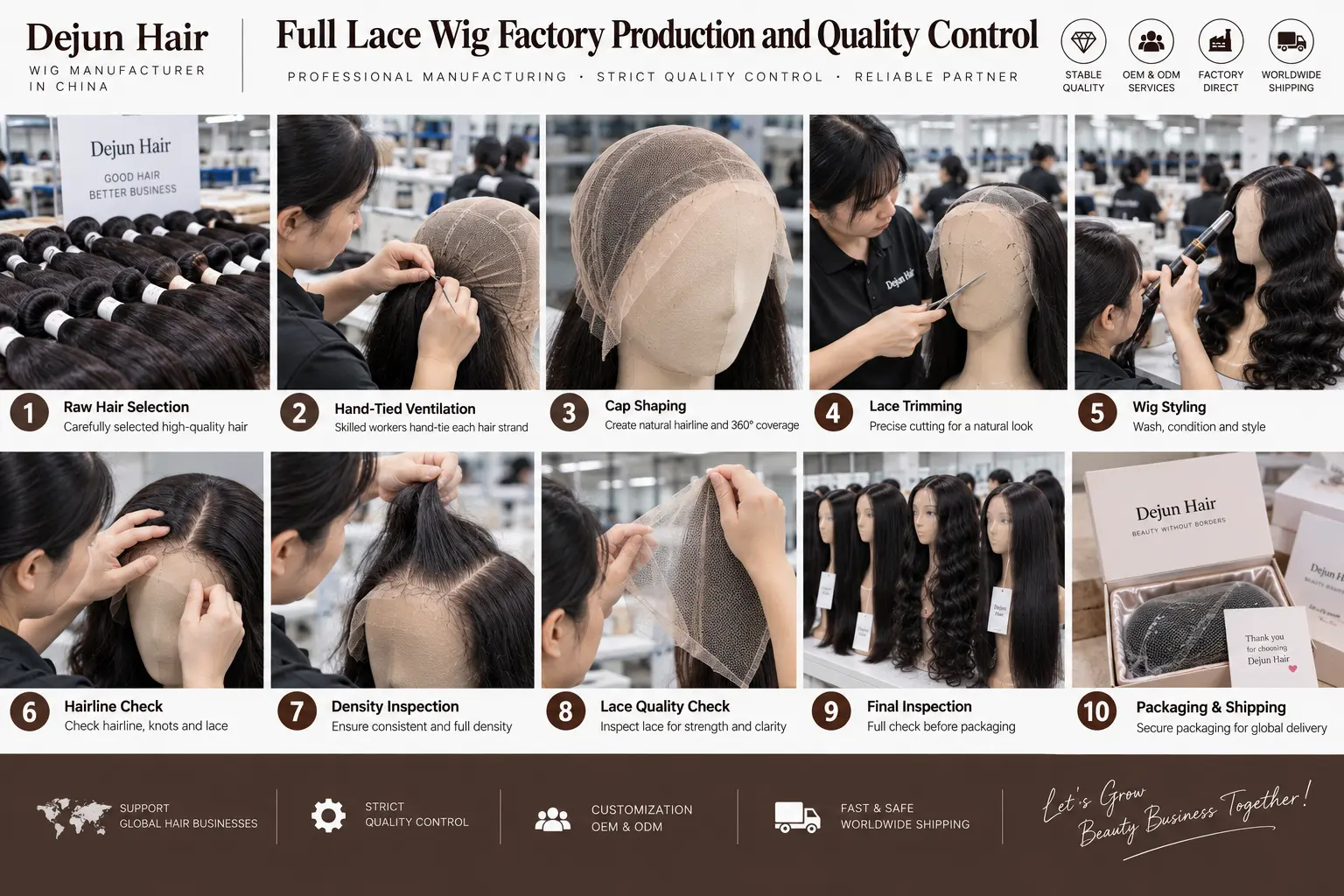
When evaluating a full lace wig factory, ask practical questions such as:
- Which production processes are handled in-house?
- How is incoming human hair inspected and classified?
- Where are caps and lace components produced or assembled?
- How is density controlled during production?
- How are finished wigs inspected?
- Can the factory reproduce an approved sample specification?
- What is the normal production capacity for repeat bulk orders?
- Can buyers customize hair, lace, density, cap size, and packaging?
A reliable manufacturer should be able to explain its production process clearly instead of giving vague answers such as “best quality” or “factory price.”
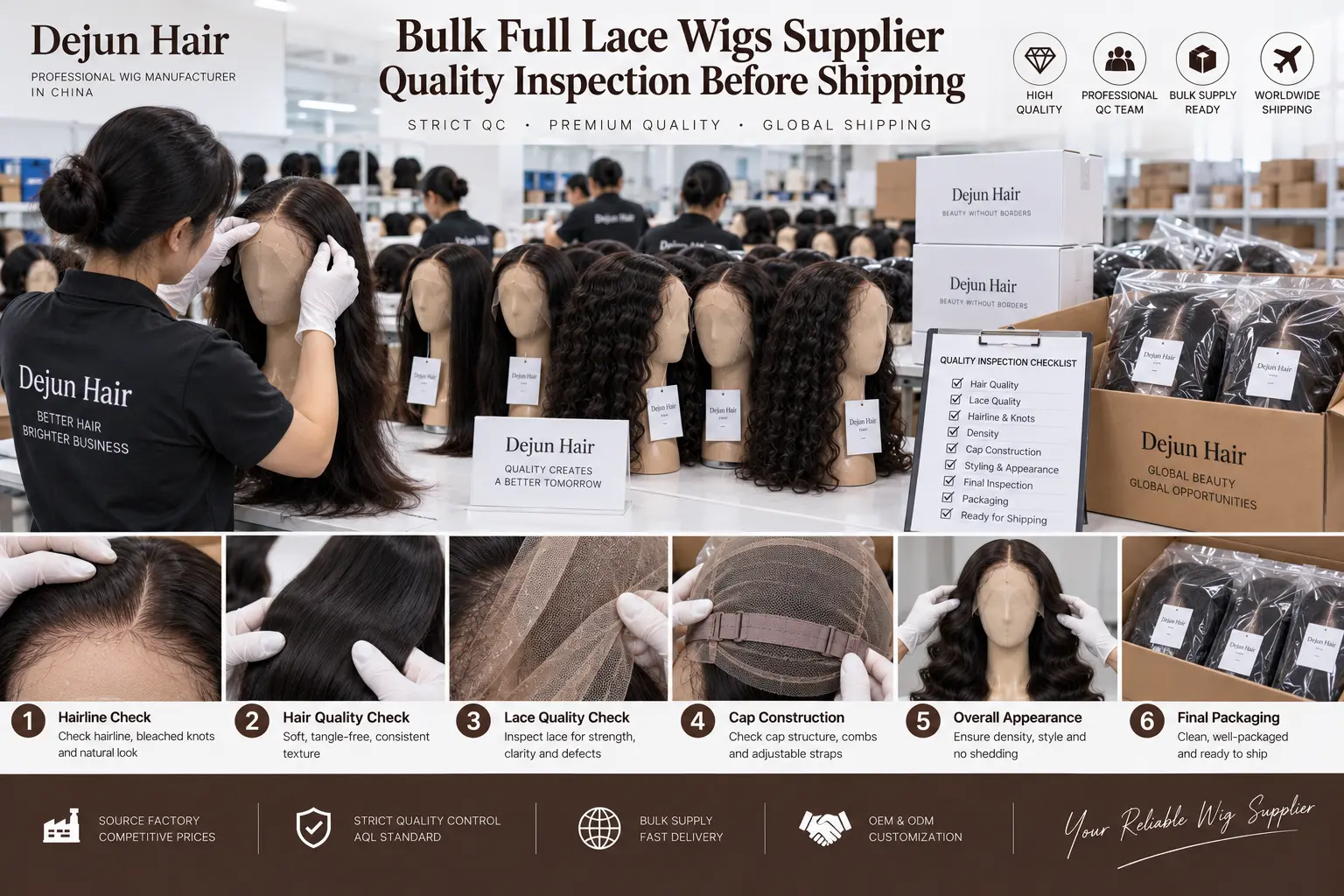
At Dejun, for example, our production operation in Shaoyang, Hunan covers hair processing, cap making, lace work, styling, quality inspection, and warehousing. Having these stages within an integrated production system gives us greater control over specifications from sampling through bulk production.
For buyers developing their own specifications or private-label collections, working directly with a Custom Wig Manufacturer can also make product development easier than purchasing standardized inventory from multiple intermediaries.
2. Check Human Hair Quality Before Comparing Prices
Hair quality is one of the largest variables behind full lace wigs wholesale price.
Two suppliers can quote very different prices for wigs with the same length and density because the actual hair materials may not be equivalent.
When sourcing full lace human hair wigs wholesale, ask the supplier to explain what type of hair is being quoted. Terms such as human hair, Remy hair, and virgin hair should not be treated as interchangeable without further verification.
For wholesale evaluation, focus on actual performance.
Check whether the hair:
- Feels smooth from root to tip
- Has excessive short or filler hairs
- Tangles easily at the ends or nape
- Sheds excessively during combing
- Maintains its texture after washing
- Responds well to heat styling when applicable
- Shows unexpected chemical smells or coatings
- Maintains acceptable quality after repeated washing
For premium product lines, virgin human hair wigs may provide better flexibility for buyers whose customers expect high-quality styling and coloring performance. For more price-sensitive markets, other carefully selected human hair specifications may provide a better balance between selling price and performance.
The right choice depends on your customer.
A salon serving premium clients may prioritize longevity and styling flexibility, while a high-volume distributor may need a more price-conscious specification that still meets a defined quality standard.
A professional human hair full lace wigs supplier should therefore help you match specifications to your market instead of automatically recommending the most expensive option.
3. Inspect Lace and Cap Construction Carefully
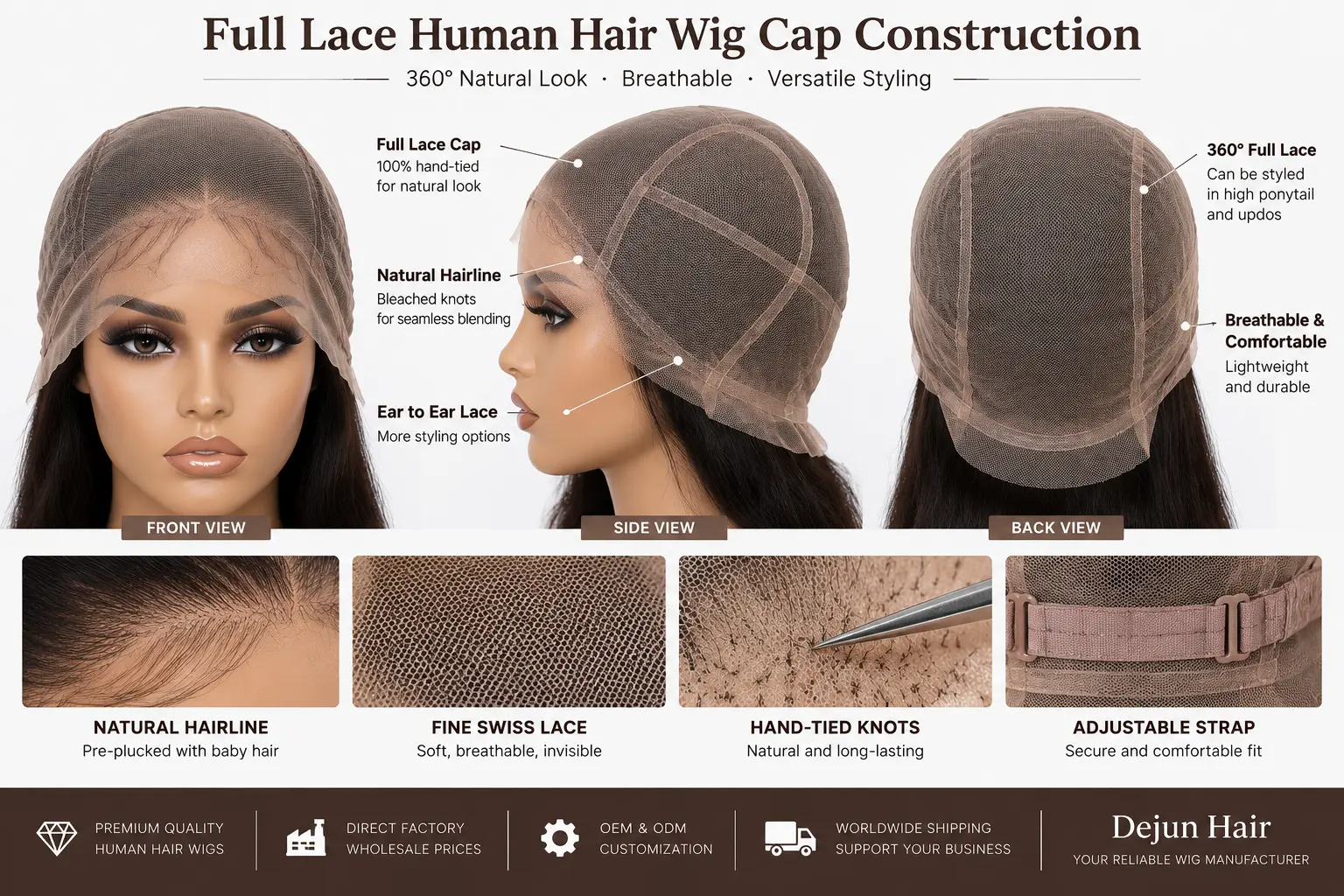
The hair attracts attention first, but the lace and cap construction often determine whether customers are satisfied with the finished wig.
When comparing suppliers, inspect the lace for softness, strength, appearance, and consistency. Depending on your target product, options may include Swiss lace and finer lace materials used for more invisible-looking applications.
For premium collections, buyers may also compare full lace products with HD lace wigs wholesale options. Finer lace can provide a more natural visual effect, but it may also require more careful handling. Therefore, the “best” lace is not always the thinnest lace—it is the lace that matches your customer’s expectations, skill level, price point, and intended use.
You should also inspect:
Knots: Are they consistent and secure?
Hairline: Does the density look natural rather than unnaturally heavy?
Density distribution: Is hair distributed evenly across the cap?
Cap size: Does the finished product match the agreed measurements?
Lace color: Does it suit the target customer base?
Elastic and adjustment system: If included, are the components securely attached?
These details become especially important with wholesale full lace human hair wigs, because small construction differences can create significant after-sales problems when multiplied across hundreds of units.
4. Compare MOQ Based on Your Business Stage
MOQ is one of the biggest concerns for new wig businesses and salon buyers.
A reliable full lace wigs wholesale supplier should clearly distinguish between stock orders and customized production.
Ready-stock products can often support more flexible quantities because the products have already been manufactured. Custom orders normally require a different MOQ because the factory may need to prepare specific hair colors, caps, lace materials, labels, packaging, or other components.
For new buyers, we usually recommend a staged sourcing approach:
Sample → Small Mixed Order → Market Test → Best-Seller Identification → Larger Reorder
This reduces inventory risk.
Instead of buying a large quantity of one style immediately, a salon or online seller can test several lengths, textures, or densities and use actual customer demand to determine the next order.
For this reason, a full lace wig supplier for salons or smaller wig businesses should ideally offer reasonable flexibility rather than forcing every buyer into the same purchasing model.
At Dejun, we support stock wholesale as well as negotiable MOQ arrangements for customized projects. Mixed-product sourcing can also help buyers test different SKUs before committing more capital to high-volume orders.
5. Understand What Determines Full Lace Wigs Wholesale Price
Price comparisons are useful only when you are comparing equivalent specifications.
A low quotation may look attractive until you discover that the supplier used different hair quality, lower density, a different lace material, or a less demanding construction standard.
Several factors influence full lace wigs wholesale price, including:
Hair quality: Higher-quality human hair generally increases material cost.
Length: Longer wigs require more and longer hair material.
Density: Higher density increases hair consumption.
Texture: Certain curls, waves, or special styling processes require additional production work.
Color: Blonde, highlights, ombré, and customized colors may require more processing.
Lace: Different lace materials have different costs and performance characteristics.
Cap construction: More labor-intensive construction affects production cost.
Customization: Special sizing, hairlines, labels, packaging, and other OEM requirements add production steps.
Order quantity: Larger repeat orders may create opportunities for more efficient pricing.
Therefore, do not ask only:
“How much is a 20-inch full lace wig?”
Instead, request a quotation based on a complete specification:
Hair type + length + density + texture + color + lace type + cap size + quantity + customization requirements.
This makes quotations from different wig wholesale suppliers much easier to compare.
The cheapest unit price is not necessarily the lowest business cost. If lower-priced products generate complaints, returns, replacements, and negative reviews, the final cost can be much higher.
6. Test Samples Before Placing a Bulk Order
Samples are one of the most important risk-control tools in wholesale sourcing.
Before placing a large order with a new bulk full lace wigs supplier, request representative samples based on the specifications you are actually considering for bulk production.
Do not judge the wig only when it comes out of the package.
A better sample evaluation includes several stages:
Initial inspection: Check length, density, color, lace, hairline, cap construction, smell, and overall finishing.
Comb test: Check shedding and tangling.
Wash test: Wash the hair using a suitable routine and observe how it behaves without relying on the factory finish.
Drying test: Check whether the original texture returns properly and whether the hair remains manageable.
Styling test: When suitable for the hair specification, test normal styling conditions.
Wear or mannequin test: Evaluate cap fit, hairline appearance, parting flexibility, and general handling.
Document your results. Photos, measurements, videos, and written notes can become part of your approved sample standard.
A sample is not merely something to “look at.” It should become a reference for the bulk order.
7. Ask How the Factory Controls Bulk Order Consistency
A beautiful sample does not automatically prove that a supplier can manufacture a consistent bulk order.
For B2B buyers, consistency is often more important than one exceptional unit.
Imagine that you approve a 180% density body wave wig, but the bulk shipment contains noticeable differences in density, curl pattern, lace color, or cap size. Even if every individual wig is technically usable, inconsistent products create problems for your sales team and customers.
Before placing bulk wig orders, ask the manufacturer how it controls:
- Hair quality between batches
- Length tolerance
- Density
- Texture consistency
- Color consistency
- Lace specification
- Cap measurements
- Knot security
- Shedding
- Final appearance
- Packaging accuracy
At Dejun, wigs are inspected for factors including hair smoothness, construction security, color performance, and dimensions before shipment. Controlling the process from production through QC and warehousing also makes it easier to trace and correct problems.
For repeat buyers, we also recommend keeping approved product specifications as detailed as possible. “18-inch straight full lace wig” is not a complete production standard. The more precisely both buyer and factory define the product, the easier it becomes to maintain consistency across repeat orders.
8. Evaluate OEM/ODM and Private Label Capabilities
If you are building a brand rather than simply reselling generic products, customization should be part of your supplier evaluation.
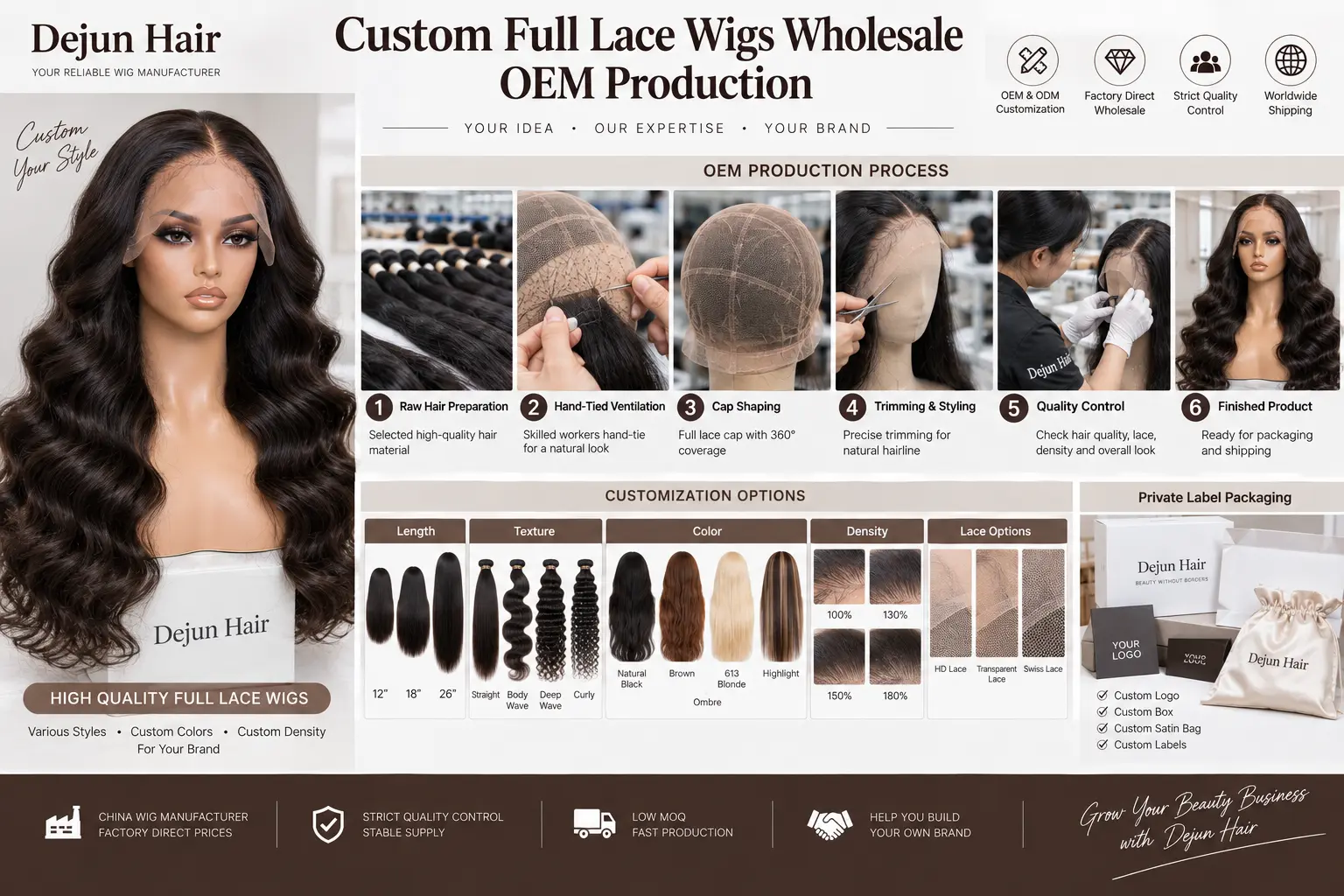
A capable custom full lace wigs wholesale manufacturer may support customization in areas such as:
- Hair length
- Density
- Texture
- Hair color
- Lace material
- Lace color
- Cap circumference
- Hairline
- Baby hair
- Elastic bands and related cap components
- Logo
- Hang tags
- Product packaging
But customization is not only about putting a logo on a box.
Strong OEM/ODM capability means the factory can help turn a target product concept into a repeatable production specification.
For example, if your salon customers prefer a particular density, cap fit, and natural hairline, the manufacturer should be able to discuss how those requirements can be incorporated into a sample.
ODM support can go further by helping buyers develop products around market trends or customer feedback.
This matters for online wig brands as well. A product that is difficult to distinguish from dozens of competitors often competes mainly on price. Customized colors, specifications, packaging, or product positioning can give a brand more room to differentiate.
9. Confirm Production Capacity and Lead Time
Delivery reliability becomes increasingly important as your sales volume grows.
A small supplier may be able to prepare ten excellent units but struggle when the order increases to hundreds of wigs or when several SKUs need to be replenished at the same time.
Ask your prospective full lace wig factory:
- What is the normal lead time for stock orders?
- What is the estimated lead time for customized production?
- How does lead time change during peak periods?
- Can multiple SKUs be produced together?
- How is a large order scheduled?
- What happens if production is delayed?
- How early should repeat orders be placed?
Do not treat lead time as a fixed universal number. Hair availability, customization complexity, quantity, color processing, packaging requirements, and production schedules can all affect it.
If you sell through an independent website, marketplace, salon network, or distributor system, use realistic lead times to set your reorder point. Waiting until your best-selling SKU is nearly sold out before placing a factory order increases the risk of stockouts.
10. Check Export and After-Sales Support
The supplier relationship should not end when the cartons leave the factory.
International wig buyers also need reliable documentation, shipping coordination, communication, and problem resolution.
For buyers in Africa, Europe, North America, and other overseas markets, ask whether the supplier has experience with international shipments and whether it can provide the commercial documents required for your shipping arrangement.
Shipping methods may include air freight, sea freight, express delivery, or other available logistics solutions depending on destination, volume, urgency, and cost.
After-sales terms are equally important.
Before ordering, clarify:
- How factory defects are defined
- How problems should be documented
- The time allowed for reporting defects
- Whether replacement, return, credit, or another solution is available
- Who handles communication when a problem occurs
A supplier promising “no quality problems” is less reassuring than one with a clear process for resolving the problems that occasionally occur in real manufacturing.
Dejun provides support for confirmed factory defects as well as wig care and technical guidance for overseas customers. Clear communication before production and after delivery helps reduce unnecessary disputes for both sides.
Manufacturer vs. Wholesale Supplier: Which Should You Choose?
Not every buyer needs the same sourcing model.
A general wig wholesale supplier can be convenient when you want small quantities of standard products from different categories and do not require much customization.
Working directly with a lace wig manufacturer or full lace wig factory becomes more valuable when your priorities include:
- Repeat bulk orders
- Stable specifications
- OEM wigs
- ODM wigs
- Private labeling
- Customized products
- Product development
- Direct quality communication
- Long-term pricing discussions
For established wholesalers and growing wig brands, factory-direct sourcing can also shorten the communication chain. When you want to adjust density, lace, cap construction, or another specification, the information goes closer to the production team rather than through several intermediaries.
However, “factory direct” should never be accepted only because it appears on a website.
Verify it through samples, production information, factory photos or videos, business documentation when appropriate, product knowledge, and the supplier’s ability to answer detailed manufacturing questions.
A Practical Checklist for Choosing a Full Lace Wigs Wholesale Supplier
Before approving a supplier, make sure you can answer these questions:
| Evaluation Area | What to Confirm |
|---|---|
| Factory | Does the supplier have verifiable manufacturing capability? |
| Human Hair | Is the hair specification clearly defined and tested? |
| Lace | Are lace type, color, softness, and construction confirmed? |
| Cap | Are measurements and construction consistent? |
| Density | Is the required density clearly documented? |
| Sample | Has the actual product been washed and tested? |
| MOQ | Are stock and custom MOQ requirements clear? |
| Price | Are you comparing the same specifications? |
| OEM/ODM | Can the factory support meaningful product customization? |
| Bulk QC | How will production match the approved sample? |
| Capacity | Can the factory support your expected order volume? |
| Lead Time | Is the production timeline realistic and confirmed? |
| Shipping | Can the supplier support your export requirements? |
| After-Sales | Is there a clear policy for factory defects? |
If several of these questions cannot be answered clearly, investigate further before increasing your order size.
What Wholesale Buyers Can Expect From Dejun
Dejun is a wig manufacturer based in Shaoyang, Hunan, China, with approximately 20 years of local wig manufacturing experience.
Our production capabilities cover both human hair and synthetic wig categories, including full lace wigs, lace front wigs, glueless wigs, bob wigs, hair bundles, and customized wig products.
For overseas B2B buyers, our sourcing model is designed around several practical requirements: flexible stock purchasing, OEM/ODM customization, bulk production, private labeling, quality control, and export support.
Because different buyers operate at different scales, we work with both established wholesalers and smaller salons or growing wig businesses. Buyers can start with samples or selected stock products, validate demand, and then move toward customized or larger repeat orders when appropriate.
More importantly, we believe a long-term manufacturing relationship should be based on repeatable specifications rather than one successful shipment.
Conclusion: Choose a Supplier for the Next Order, Not Just the First Order
Successful Full Lace Wigs Wholesale sourcing is not about finding the lowest quotation on a spreadsheet. It is about finding a supplier that can repeatedly deliver the product your customers expect.
Before choosing a full lace wigs wholesale supplier, evaluate the factory itself, test the human hair and lace, confirm MOQ and pricing specifications, inspect samples, understand bulk quality control, verify OEM/ODM capabilities, and clarify production lead times and after-sales terms.
For new buyers, start with a sample and a manageable trial order. For established wholesalers and salons, focus on consistency, customization, production capacity, and long-term supply stability.
If you are looking for a full lace wigs manufacturer for wholesale, OEM, ODM, or private-label production, send Dejun your target market, preferred hair type, length, density, texture, lace requirements, and expected quantity.
Request a Full Lace Wig Sample or Wholesale Quote from Dejun to compare specifications before placing your next bulk order.

High Quality
All of our products have undergone production and quality control and come with certificates
Fast Delivery
Our supply chain management is a model of standardization and professionalism in the wig manufacturing industry, ensuring that our customers receive their wigs on time.
Customer Service
Fill out the wig order form to customize your base, size, hair length, and color.