
Leave your Message

-
Yongqi Chen sales consultant
-
Phone/WhatsApp: +86 13187012919
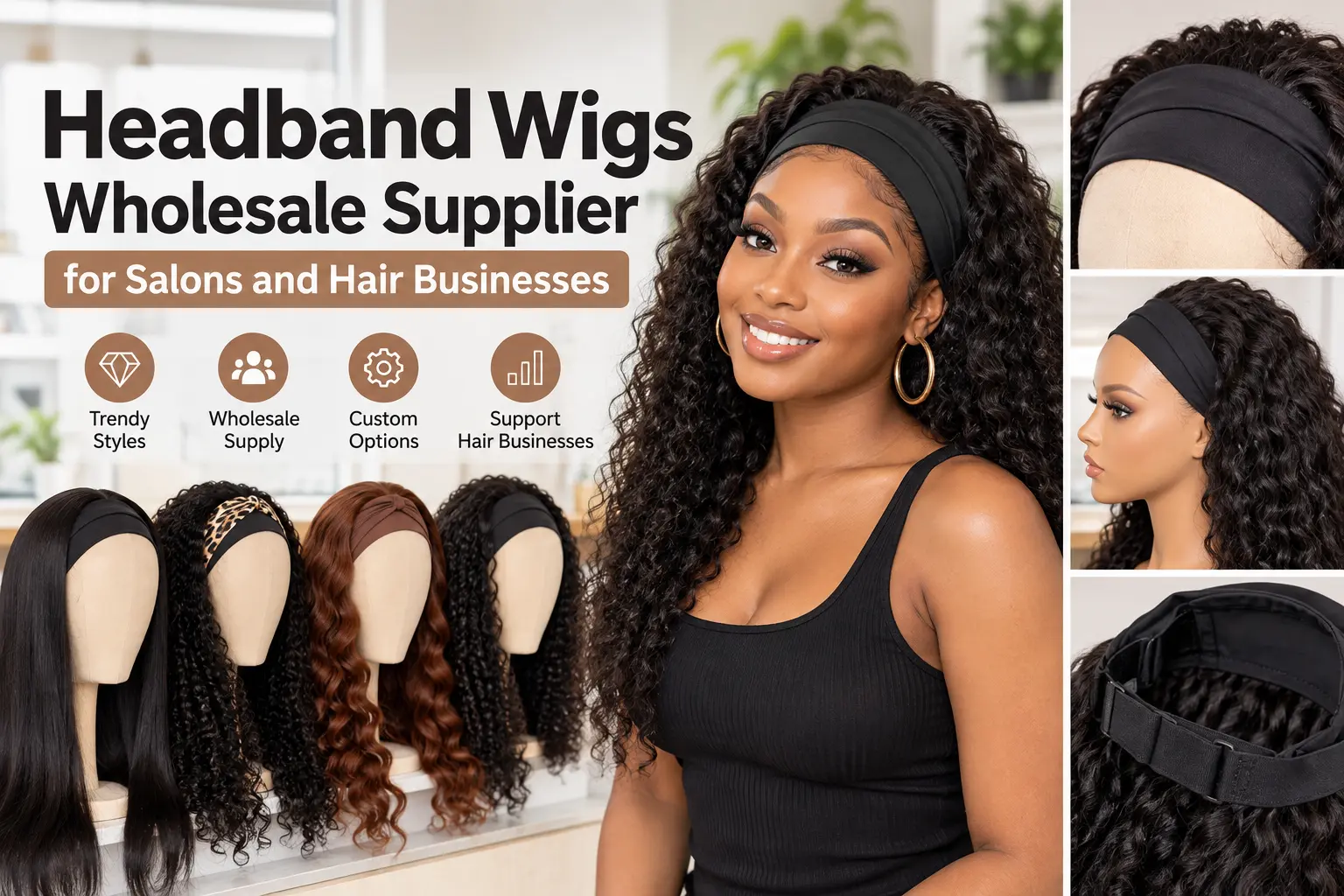
Headband Wigs Wholesale Guide: How to Choose the Right Supplier for Your Business
Table Of Contents
- Why Headband Wigs Are a Practical Category for Wholesale Buyers
- 1. Start by Evaluating the Hair Quality
- 2. Inspect the Headband Wig Construction
- 3. Compare Product Range, Not Just One Best-Selling Style
- 4. Understand the Supplier's MOQ Policy
- 5. Compare Wholesale Prices Based on Specifications
- 6. Always Test Samples Before a Large Bulk Order
- 7. Evaluate OEM, ODM, and Private Label Capabilities
- 8. Verify Production Capacity and Lead Times
- 9. Examine the Supplier's Quality-Control Process
- 10. Consider Shipping and Export Experience
- 11. Evaluate Communication Before You Evaluate the Relationship
- 12. Match the Supplier to Your Business Model
- Headband Wig Supplier Evaluation Checklist
- Questions to Ask a Headband Wig Wholesale Supplier
- Why Work Directly With a Wig Manufacturer?
- Conclusion: Choose Your Headband Wigs Wholesale Supplier for Long-Term Growth
For wig wholesalers, salon owners, online hair stores, and emerging wig brands, finding products is usually not the hardest part. The real challenge is finding a supplier that can deliver the same quality repeatedly, offer workable minimum order quantities, respond quickly to changing demand, and support your business as order volumes grow.
This is especially important when sourcing headband wigs wholesale.
Headband wigs are relatively simple for end customers to understand: they are easy to wear, require no lace cutting, and generally do not require glue. But from a wholesale buyer’s perspective, there are still significant differences in hair quality, cap construction, headband workmanship, density, sizing, finishing, packaging, and production consistency.
A low quotation alone therefore does not tell you whether a supplier is suitable for long-term cooperation.
This guide explains how to evaluate headband wig wholesale suppliers from a B2B purchasing perspective, including product quality, MOQ, wholesale pricing, samples, OEM/ODM capabilities, production capacity, quality control, and delivery reliability.
Why Headband Wigs Are a Practical Category for Wholesale Buyers
Headband wigs occupy a useful position between traditional wigs and more installation-intensive lace products.
Unlike many lace wigs, they are designed for quick installation. Customers do not normally need to trim lace, apply adhesive, or spend a long time preparing the hairline. This makes them suitable for consumers who prioritize convenience.
From a wholesale perspective, that creates several potential customer groups:
- Wig beginners looking for easy-to-wear products
- Salon customers who want quick hairstyle changes
- Busy consumers seeking everyday wigs
- Social-commerce shoppers attracted by simple demonstrations
- Customers who prefer glue-free wig options
- Buyers looking for more accessible alternatives to premium lace wigs
For businesses already purchasing wholesale wigs, headband styles can also complement rather than replace other product categories.
For example, a retailer may use headband wigs as an easy-wear category while offering Lace Front Wigs Wholesale products to customers who prioritize a more customizable hairline, Full Lace Wigs Wholesale products for customers seeking greater styling flexibility, and Bob Wigs Wholesale products for buyers interested in short, fashion-focused styles.
The key is choosing a supplier that can support your target product positioning.
1. Start by Evaluating the Hair Quality
Hair quality should be one of the first things you examine when comparing human hair headband wigs wholesale suppliers.
Two wigs may look nearly identical in supplier photographs while performing very differently after washing, brushing, heat styling, and repeated wear.
For B2B buyers, this matters because inconsistent hair quality eventually becomes a customer-service problem.
Check What Type of Human Hair Is Actually Being Offered
Do not rely only on broad descriptions such as “100% human hair,” “premium hair,” or “virgin quality.”
Ask the supplier to explain its material specifications.
Depending on your market and price segment, you may encounter different grades of processed human hair, Remy hair, virgin hair, or other quality classifications.
The important issue is not simply choosing the most expensive grade. It is matching the hair quality to your customers and maintaining that specification from one order to the next.
A salon serving premium customers may require higher-quality hair with better longevity and styling performance. A value-oriented distributor may need a different balance between price and durability.
A reliable human hair headband wig supplier should be able to explain these differences rather than offering every buyer the same vague “best quality” description.
Test the Hair Instead of Judging It Only by Appearance
Before placing a significant bulk order, evaluate:
- Softness and smoothness
- Excessive shedding
- Tangling after washing
- Odor
- Dryness after shampooing
- Hair-end condition
- Density consistency
- Heat-styling response
- Color consistency
- Texture recovery after washing
A wig can feel extremely soft when it first arrives because of finishing treatments. The more useful question is how it performs after washing.
For that reason, sample testing is usually more informative than photographs or short supplier videos.
2. Inspect the Headband Wig Construction
The hair itself is only one part of the product.
For wholesale headband wigs, cap construction has a direct impact on comfort, security, appearance, and return rates.
Check the Headband Attachment
The headband should be securely attached to the cap without obvious weak points, loose stitching, or uneven seams.
For repeated use, poor stitching can cause the band to loosen or separate from the cap.
Ask your supplier whether different headband designs, colors, patterns, or detachable options are available if these features are important to your target market.
Examine the Cap Structure
A well-made cap should provide a reasonable balance between security and comfort.
When checking samples, look at:
- Cap size
- Elasticity
- Breathability
- Internal stitching
- Adjustable straps
- Combs or clips
- Headband security
- Overall fit
The wig should feel secure without creating unnecessary pressure.
If your customers are concentrated in a specific market, discuss cap-size preferences with your supplier instead of assuming one standard specification will work for every buyer.
Verify Density and Length
One frequent source of disagreement in wholesale wig orders is the difference between the specification on paper and the product received.
If you order a particular length and density, ask how the supplier measures them and what manufacturing tolerance is considered acceptable.
This becomes increasingly important when you are purchasing bulk headband wigs across several lengths and textures.
3. Compare Product Range, Not Just One Best-Selling Style
A supplier that can produce only one or two basic products may be sufficient for a very small test order. However, expanding retailers usually need a broader range.
A capable headband wig manufacturer should ideally be able to offer multiple combinations of:
- Straight hair
- Body wave
- Deep wave
- Curly textures
- Natural black
- Brown shades
- Highlight or colored options
- Short, medium, and long lengths
- Different densities
- Different cap sizes
- Different headband designs
This does not mean you should order every available SKU.
In fact, new buyers can often reduce inventory risk by beginning with a focused assortment and expanding according to actual sales data.
The supplier’s product range matters because it gives you room to grow without rebuilding your supply chain every time you add a new category.
For buyers planning a broader wig business, working with a manufacturer capable of supplying headband wigs alongside lace wigs, bob wigs, synthetic wigs, and other human hair wig wholesale categories can also simplify procurement.
4. Understand the Supplier’s MOQ Policy
MOQ is one of the most important considerations for both new and established wig businesses.
However, asking only “What is your MOQ?” is not enough.
You need to understand how the MOQ works.
For example:
- Is the MOQ calculated per style or per total order?
- Can different lengths be mixed?
- Can different textures be combined?
- Are natural colors available at lower MOQs?
- Does custom color require a higher MOQ?
- Does private-label packaging have a separate MOQ?
- Is the sample MOQ different from the production MOQ?
- Are in-stock products available in smaller quantities?
These questions are particularly important for small wholesalers, salon owners, and online sellers who need to test demand before committing to large inventory.
Mixed Orders Can Be More Valuable Than an Extremely Low MOQ
Imagine Supplier A offers a very low MOQ but requires every order to contain the same style, length, and texture.
Supplier B has a slightly higher total MOQ but allows you to combine several specifications.
For a business testing the market, Supplier B may provide greater inventory flexibility.
Instead of evaluating MOQ as one number, examine how the supplier’s ordering rules affect your inventory risk.
At Dejun, we work with different types of overseas buyers, from smaller trial-order customers to established wholesalers. For suitable products, available inventory and mixed purchasing can help buyers test multiple SKUs before scaling their orders.
Custom production requirements should be confirmed separately because MOQ can vary according to hair material, color, construction, packaging, and other specifications.
5. Compare Wholesale Prices Based on Specifications
Price matters, but meaningful price comparison requires comparable specifications.
If one headband wig supplier quotes significantly less than another, first determine whether you are actually comparing the same product.
Differences may include:
- Hair grade
- Hair length
- Density
- Hair weight
- Texture
- Cap materials
- Construction quality
- Headband materials
- Packaging
- Quality-control requirements
- Customization
- Order quantity
The cheapest unit price can become expensive if the products generate excessive returns, complaints, refunds, or replacement costs.
Ask for a Structured Quotation
For a serious B2B purchase, request a quotation showing the main variables clearly.
For example:
| Specification | Details to Confirm |
|---|---|
| Hair material | Human hair grade/type |
| Texture | Straight, body wave, deep wave, curly, etc. |
| Length | Available range |
| Density | Standard/custom options |
| Cap size | Standard or customized |
| Color | Natural/custom colors |
| Quantity | Price breaks by volume |
| Packaging | Standard/private label |
| Lead time | Stock vs. custom production |
| Shipping | Method and destination |
This makes it much easier to compare different headband wigs wholesale vendors fairly.
6. Always Test Samples Before a Large Bulk Order
A sample is one of the most effective tools for reducing sourcing risk.
Supplier photos can show appearance. Video calls can help confirm that a business has physical products. But neither replaces hands-on product testing.
Before you buy headband wigs in bulk, use samples to verify the specifications that matter most to your customers.
A Practical Headband Wig Sample Checklist
Inspect the sample when it first arrives, then test it again after washing and styling.
Check:
- Hair softness before and after washing
- Shedding during brushing and washing
- Tangling
- Hair density
- Length accuracy
- Texture consistency
- Cap comfort
- Adjustable strap strength
- Comb attachment
- Headband stitching
- Color accuracy
- Heat-styling performance where applicable
- Overall appearance after repeated handling
If you plan to order multiple textures, do not assume one straight-hair sample proves that every other texture will perform identically.
Test the styles that will represent a meaningful share of your future order.
Keep the Approved Sample as a Reference
Once you approve a sample, confirm the final specifications in writing.
For repeat orders, an approved sample can serve as a reference for hair feel, texture, color, density, construction, and finishing.
This is especially useful when your business begins placing larger orders.
7. Evaluate OEM, ODM, and Private Label Capabilities
If you are building your own brand, you need more than a supplier that can put products into a shipping carton.
You need to know what can actually be customized.
A professional headband wig manufacturer may support customization involving:
- Hair length
- Density
- Texture
- Color
- Cap size
- Headband design
- Brand labels
- Hangtags
- Logo printing
- Packaging boxes
- Care cards
- Product inserts
The exact options and MOQ will vary according to the project.
OEM Is Especially Important for Brand Differentiation
When multiple online sellers source similar standard products, branding and product specification become important ways to differentiate an offer.
Instead of simply reselling a generic SKU, you might develop:
- A specific texture and density combination
- Exclusive color combinations
- Custom headband patterns
- Market-specific cap sizing
- Branded packaging
- A coordinated product collection
Businesses that need this level of development should evaluate a Custom Wig Manufacturer or OEM/ODM factory rather than choosing a supplier solely because it offers the lowest ready-stock price.
At Dejun, our OEM/ODM services can cover product specifications as well as private-label elements such as packaging, hangtags, and logo customization. For new projects, sample confirmation should take place before mass production.
8. Verify Production Capacity and Lead Times
A supplier that performs well on a 10-piece order may not necessarily perform equally well when you need hundreds or thousands of pieces.
Ask how production is organized and how lead time changes with order quantity.
Important questions include:
- Which products are normally held in stock?
- What is the typical lead time for custom production?
- How does the factory handle peak-season orders?
- Can it support repeat orders with the same specifications?
- How early should buyers confirm large orders?
- Can production progress be documented?
- How are urgent replenishment orders handled?
For fast-moving online sellers, replenishment speed can be almost as important as the original wholesale price.
A product that sells well but takes too long to replenish may lead to lost sales.
Factory Capability Matters as Your Business Grows
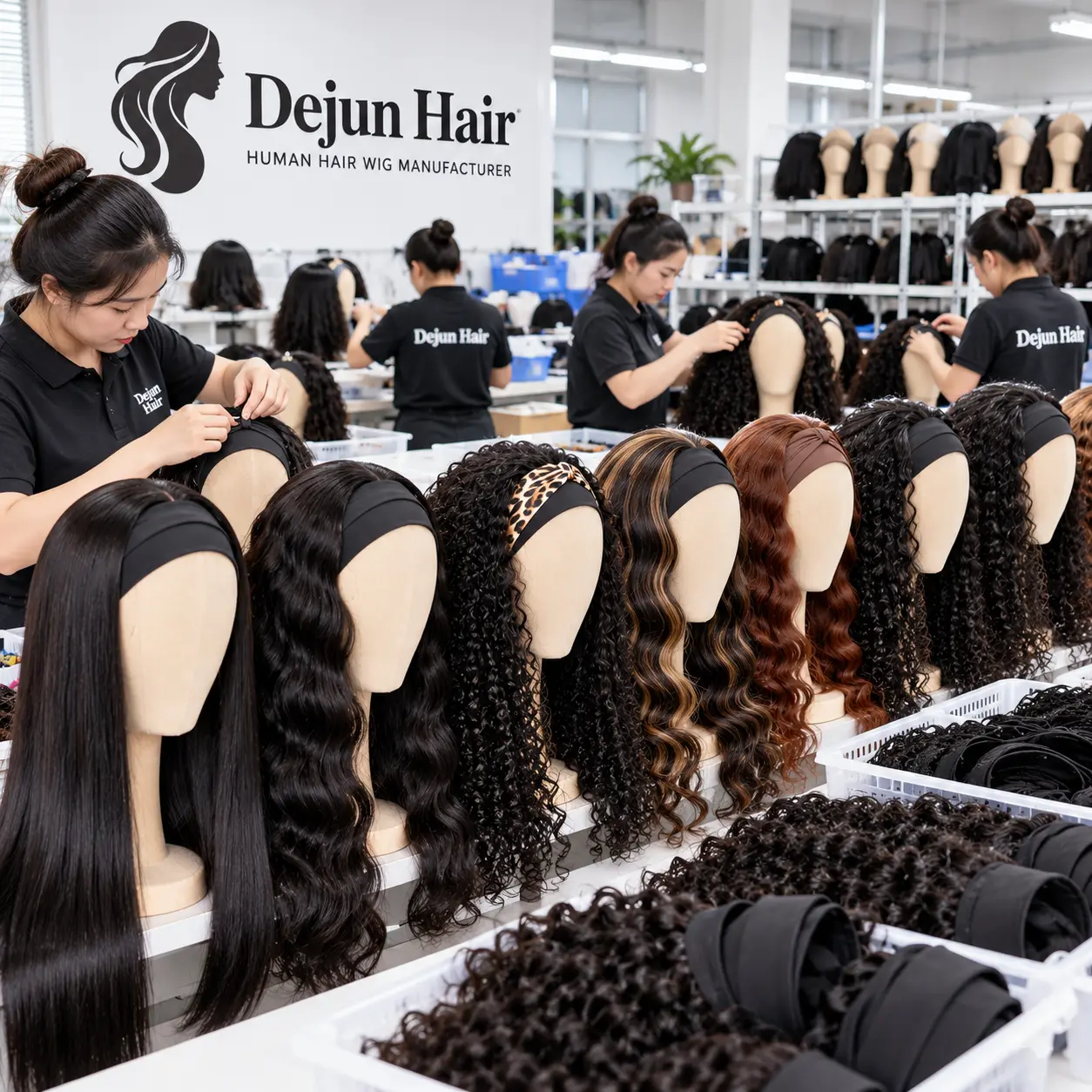
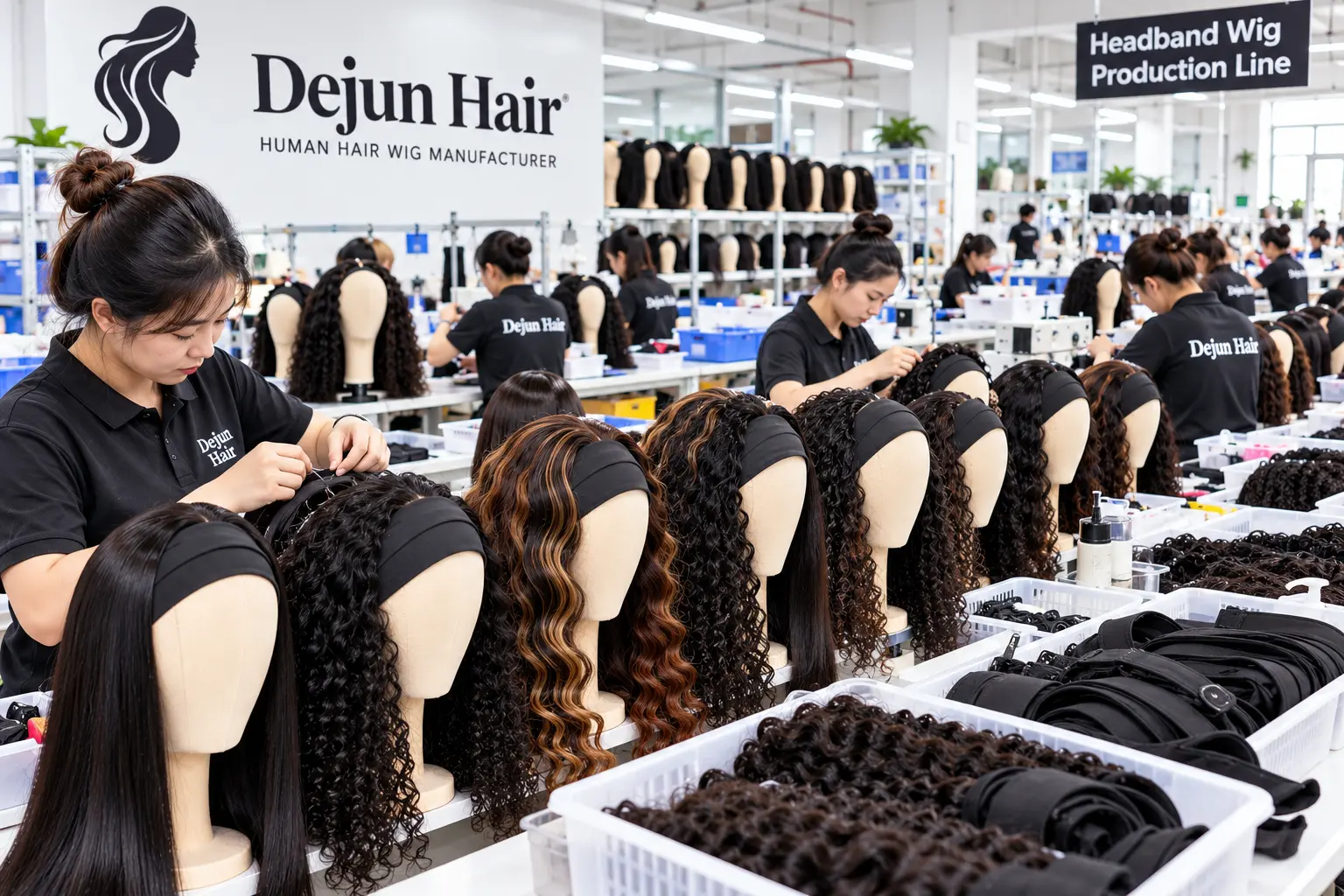
Dejun is based in Shaoyang, Hunan, China, with an integrated production workflow covering hair processing, cap production, sewing, styling, inspection, and warehousing.
For wholesale buyers, the advantage of dealing directly with production is not simply “factory price.” It also makes it easier to communicate specifications, solve production issues, coordinate custom projects, and plan repeat orders.
This becomes increasingly important as a buyer moves from occasional purchases to stable bulk procurement.
9. Examine the Supplier’s Quality-Control Process
Wholesale buyers should ask a simple question:
How does the supplier make sure the 300th wig is consistent with the sample you approved?
Quality control is not only about checking whether a finished wig looks attractive.
For headband wigs, inspection may include:
- Hair quality
- Shedding
- Tangling
- Length
- Density
- Color
- Texture
- Cap dimensions
- Stitching
- Headband attachment
- Strap function
- Comb security
- Overall styling
- Packaging accuracy
The larger the order, the more important process consistency becomes.
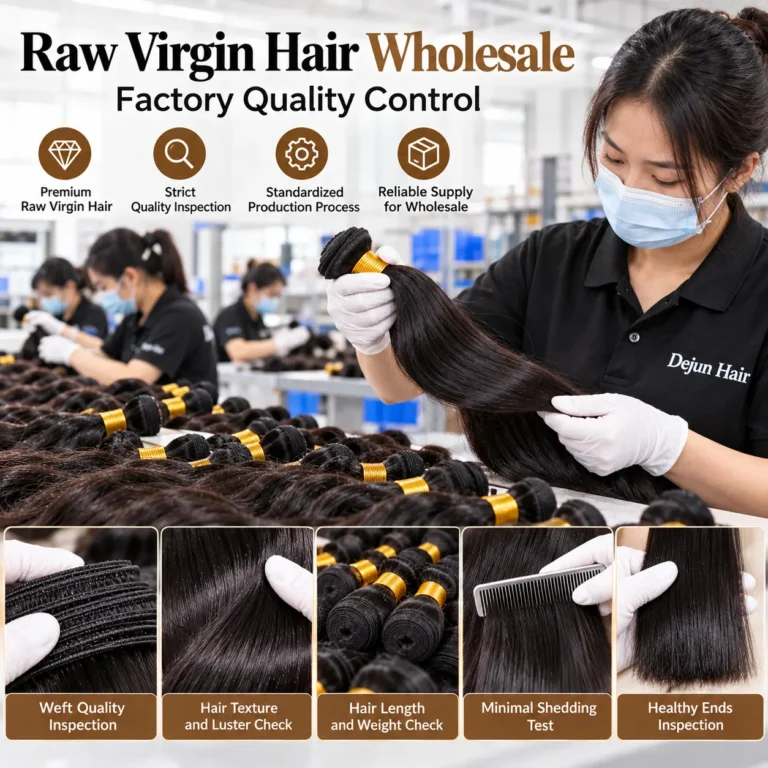
A reliable wig factory should have defined inspection points rather than relying entirely on a final visual check before shipping.
At Dejun, finished wigs go through multiple checks covering factors such as hair smoothness, construction security, color, sizing, and overall product condition before shipment.
For custom orders, buyers should also agree on specifications before mass production so that the production team and buyer are working from the same reference.
10. Consider Shipping and Export Experience
International purchasing does not end when production is finished.
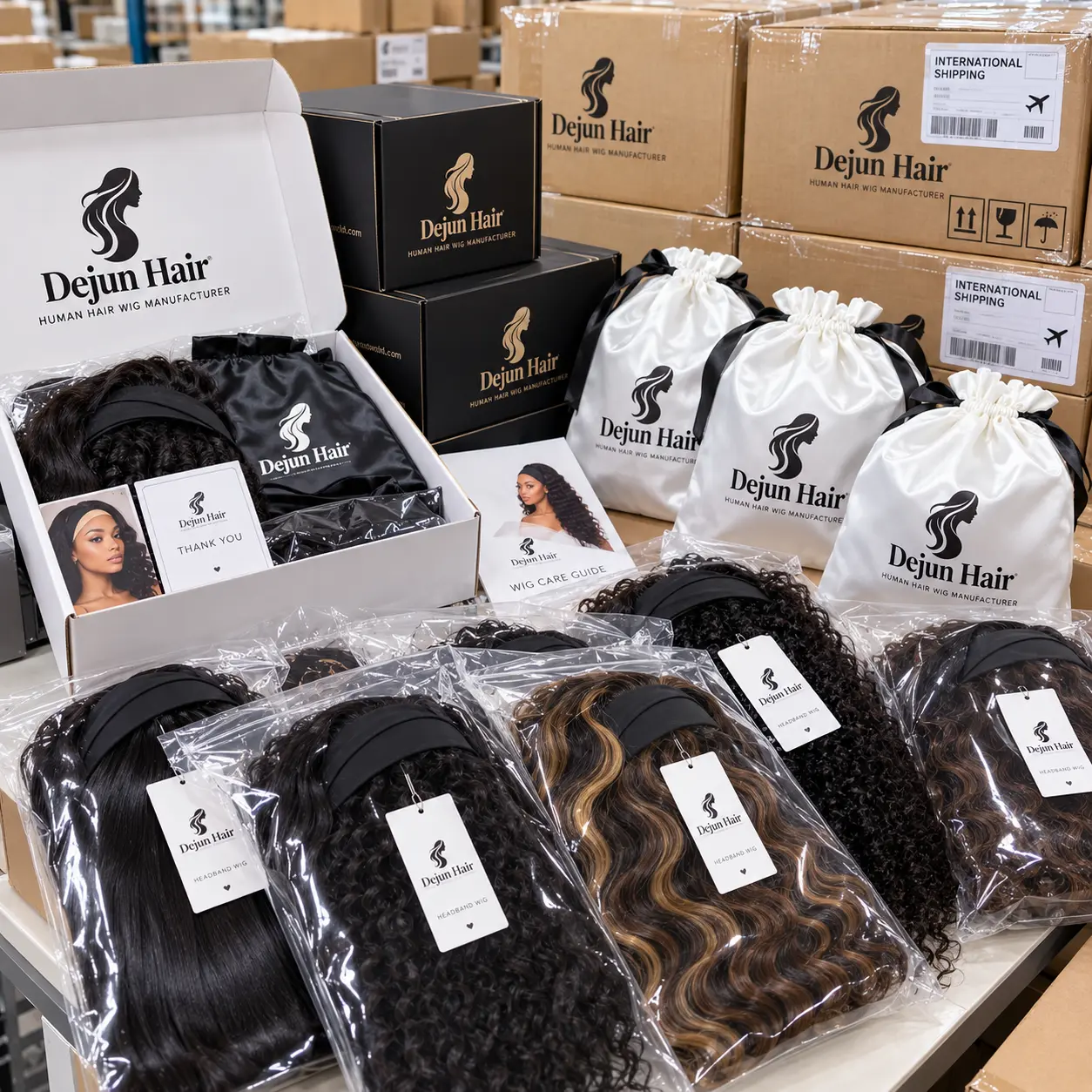
Your supplier should also understand export documentation and the practical requirements of shipping wigs to your market.
This is particularly important for buyers in Africa, Europe, and North America, where preferred logistics solutions can differ according to shipment size, urgency, destination, and customs requirements.
Discuss:
- Express shipping
- Air freight
- Sea freight
- Shipping documents
- Carton specifications
- Product descriptions
- Destination requirements
- Estimated transit times
A supplier with experience serving overseas customers can help you prepare appropriate export documents and evaluate different logistics options.
However, buyers should still confirm local customs duties, import rules, and tax obligations with their own customs broker or relevant local authority.
11. Evaluate Communication Before You Evaluate the Relationship
Supplier communication during the inquiry and sampling stage often provides useful information about what future cooperation may look like.
Pay attention to whether the supplier:
- Answers technical questions clearly
- Confirms specifications in writing
- Explains limitations instead of promising everything
- Provides consistent quotations
- Responds to sample feedback
- Understands your target market
- Keeps you informed about production
- Addresses problems rather than avoiding them
For B2B sourcing, communication quality affects real costs.
A misunderstanding about density, length, color, packaging, or delivery date can be far more expensive than a small difference in unit price.
The best supplier relationship is therefore not simply buyer versus seller. It is a repeatable process in which specifications, expectations, production, inspection, and delivery are clearly communicated.
12. Match the Supplier to Your Business Model
Not every buyer needs the same supplier.
For African Wholesalers and Distributors
Prioritize suppliers that can support competitive pricing, stable bulk supply, mixed styles, popular textures, and practical logistics options.
Product durability and consistent quality are particularly important when goods move through several distribution levels before reaching the final customer.
For Salons and Beauty Stores
Focus on reliable quality, comfortable construction, customer-friendly products, manageable MOQ, and repeat-order consistency.
Your reputation is directly connected to the products you recommend to clients.
For Independent Websites and Social-Commerce Sellers
Product appearance, quick replenishment, packaging, trending styles, samples, and flexible SKU testing may deserve greater attention.
TikTok and Instagram sellers may also benefit from products that are easy to demonstrate. The quick-wear structure of headband wigs can make them suitable for before-and-after and installation content.
For New Wig Businesses
Avoid investing heavily in too many SKUs before you have sales data.
A practical approach is to test a small selection of core textures and lengths, identify the products that generate repeat demand, and then expand inventory.
Flexible headband wigs wholesale terms and mixed ordering can be more valuable at this stage than chasing the lowest possible unit price.
For Established Wig Brands
Your priorities may shift toward stable large-volume production, custom specifications, private labeling, consistent quality control, production planning, and supplier responsiveness.
At this stage, direct cooperation with a capable wig manufacturer becomes increasingly important.
Headband Wig Supplier Evaluation Checklist
Before placing your next order, use this checklist to compare suppliers.
| Evaluation Area | What to Check |
|---|---|
| Hair Quality | Hair type, softness, shedding, tangling, wash performance |
| Construction | Cap, headband, straps, combs, stitching |
| Product Range | Textures, lengths, densities, colors |
| MOQ | Per-SKU MOQ, total MOQ, mixed orders |
| Pricing | Specification-based quotation and volume pricing |
| Samples | Sample availability and consistency |
| OEM/ODM | Product customization and development |
| Private Label | Logo, tags, packaging, inserts |
| Production | Capacity and repeat-order capability |
| Quality Control | Inspection standards and process |
| Lead Time | Stock and custom-order timelines |
| Shipping | Export and logistics experience |
| After-Sales | Defect handling and communication |
| Communication | Accuracy, speed, and transparency |
Do not make your decision based on one factor alone.
A suitable supplier should provide a workable balance of quality, price, MOQ, flexibility, delivery, and service for your particular business model.
Questions to Ask a Headband Wig Wholesale Supplier
Before requesting a final quotation, consider sending the supplier a structured list of questions:
- What types of human hair do you offer for headband wigs?
- What textures, lengths, densities, and colors are available?
- What is your MOQ for stock products?
- Can different styles, lengths, or textures be mixed?
- What is the MOQ for custom products?
- Can I order samples before bulk production?
- Can you customize cap size or headband design?
- Do you offer OEM/ODM and private-label packaging?
- What is the production lead time for my estimated quantity?
- What quality checks are completed before shipment?
- Can you maintain the same specifications for repeat orders?
- What shipping options do you provide to my country?
- How do you handle products with confirmed manufacturing defects?
The quality of the supplier’s answers can tell you almost as much as the quotation itself.
Why Work Directly With a Wig Manufacturer?
For some buyers, purchasing from a trading company or distributor may be convenient, especially for small ready-stock orders.
For others, direct factory cooperation can provide advantages when customization, volume, repeat production, or specification control becomes more important.
As a wig manufacturer in Shaoyang, Hunan, China, Dejun has approximately 20 years of local manufacturing experience and supplies both human hair and synthetic wig categories.
Our production system covers hair processing, wig-cap construction, sewing, styling, inspection, and warehousing. This enables us to support both stock wholesale requirements and OEM/ODM projects.
For overseas B2B buyers, we focus on several practical purchasing concerns:
- Flexible ordering for suitable stock products
- Mixed product purchasing
- Human hair and synthetic wig supply
- OEM/ODM customization
- Private-label packaging
- Sample development
- Bulk production
- Quality inspection
- International shipping support
- After-sales technical guidance
The purpose is not simply to sell one shipment. For repeat wholesale customers, consistency between orders is just as important as the quality of the first sample.
Conclusion: Choose Your Headband Wigs Wholesale Supplier for Long-Term Growth
Finding the right headband wigs wholesale supplier requires more than comparing catalog photos and unit prices.
Start with hair quality and construction. Then examine MOQ flexibility, samples, wholesale pricing, OEM capabilities, production capacity, quality control, lead times, logistics experience, and communication.
Most importantly, test before scaling.
A sample order gives you the opportunity to evaluate the product under real conditions before committing more inventory capital. Once the sample is approved, define the specifications clearly and use them as the standard for future bulk orders.
If you are currently sourcing human hair headband wigs wholesale, Dejun can help you evaluate suitable textures, lengths, densities, order quantities, and customization options according to your market.
Send us your target styles, expected quantity, destination market, and customization requirements to request samples or a wholesale quotation.
High Quality
All of our products have undergone production and quality control and come with certificates
Fast Delivery
Our supply chain management is a model of standardization and professionalism in the wig manufacturing industry, ensuring that our customers receive their wigs on time.
Customer Service
Fill out the wig order form to customize your base, size, hair length, and color.