
Leave your Message

-
Yongqi Chen sales consultant
-
Phone/WhatsApp: +86 13187012919
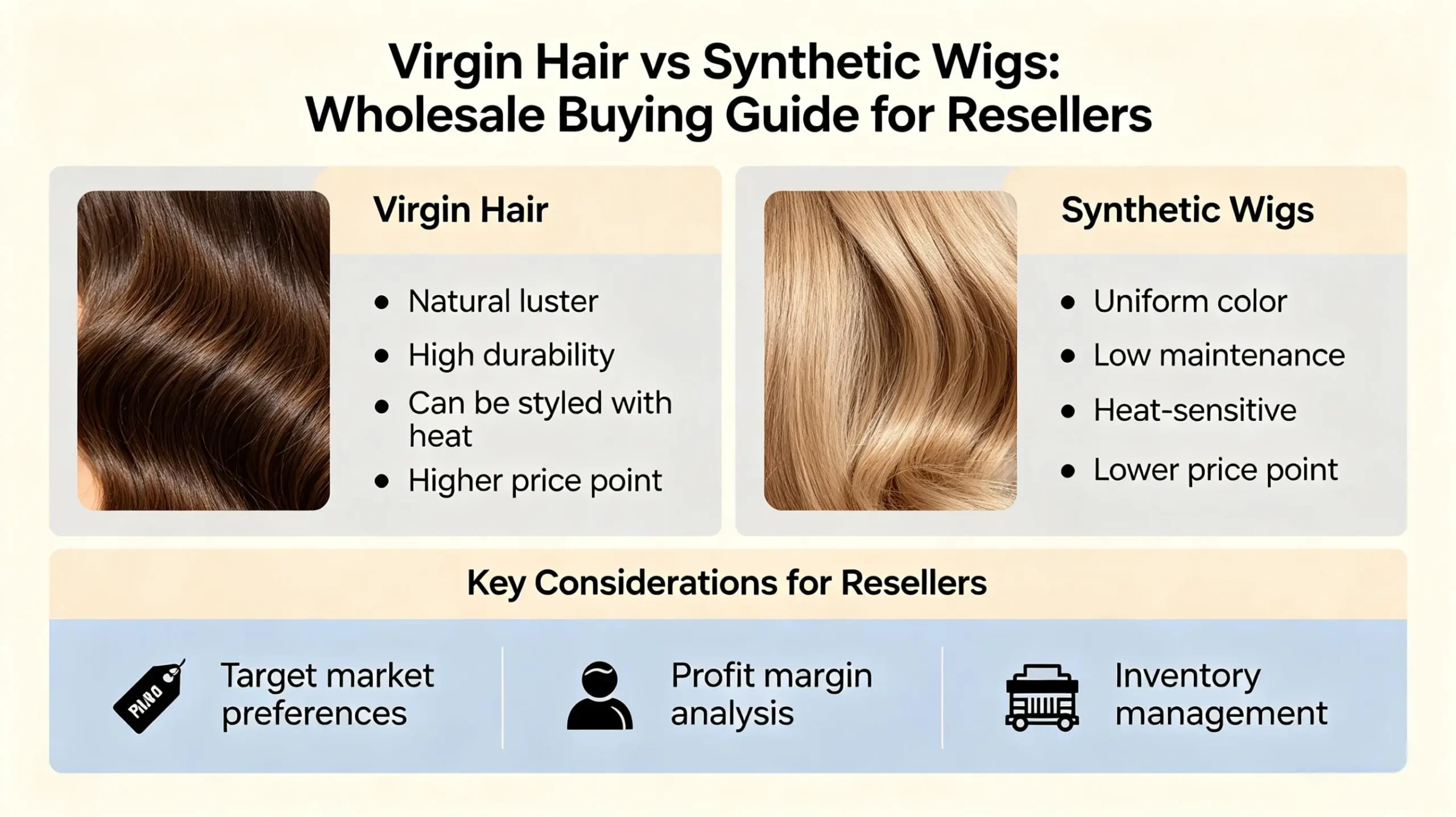
Virgin Hair vs Synthetic Wigs: Wholesale Buying Guide for Resellers
Are you a wig retailer or wholesaler? What are the most common challenges you face when selecting products? Many sellers struggle with the decision: should they stock human hair wigs or synthetic wigs? This choice directly impacts your profits, customer satisfaction, and repeat purchase rates. That’s why we’ve created this guide: Virgin Hair vs Synthetic Wigs: Wholesale Buying Guide for Resellers. As Dejun Wigs Manufacturer, we interact with buyers every day and understand your concerns. After reading this article, you’ll clearly understand the differences between the two, their respective pros and cons, and practical advice for wholesale purchasing.
Table Of Contents
- Part 1: Why Does Every Reseller Need to Understand Virgin Hair vs Synthetic Wigs?
- Part 2: What Is Virgin Hair? What Are Synthetic Wigs?
- Part Three: Price and Profit — Which Is Better for Wholesale?
- Part 4: Lifespan and Customer Repurchase Rate
- Part 5: Styling Flexibility — Can customers change their hairstyle themselves?
- Part 6: Natural Look and Realistic Appearance
- Part 7: Maintenance Difficulty — Are Customers Willing to Spend Time on Care?
- Part 8: Wholesale Purchasing Recommendations — How to Combine Product Selection?
- Part 9: How to Avoid Common Pitfalls When Purchasing?
- Part 10: Why Choose Dejun Wigs Manufacturer as Your Supplier?
- Part 11: Start Your Wholesale Business Today
- Virgin Hair vs Synthetic Wigs: Wholesale Buying Guide for Resellers Summary
- Frequently Asked Questions
Part 1: Why Does Every Reseller Need to Understand Virgin Hair vs Synthetic Wigs?
Your customers are getting smarter. They do their research before making a purchase. If you don’t understand the product differences, you won’t be able to answer their questions. Worse yet, you might stock the wrong inventory, leaving it sitting in your warehouse unsold. This is where “Virgin Hair vs Synthetic Wigs: Wholesale Buying Guide for Resellers” comes in.
Virgin hair and synthetic wigs are two completely different product categories. They differ in price, lifespan, styling methods, and target customers. As a wholesaler or retailer, you must make the right choice based on your distribution channels, customer base, and price range.
Part 2: What Is Virgin Hair? What Are Synthetic Wigs?
Before diving into “Virgin Hair vs. Synthetic Wigs: Wholesale Buying Guide for Resellers,” let’s clarify the definitions.
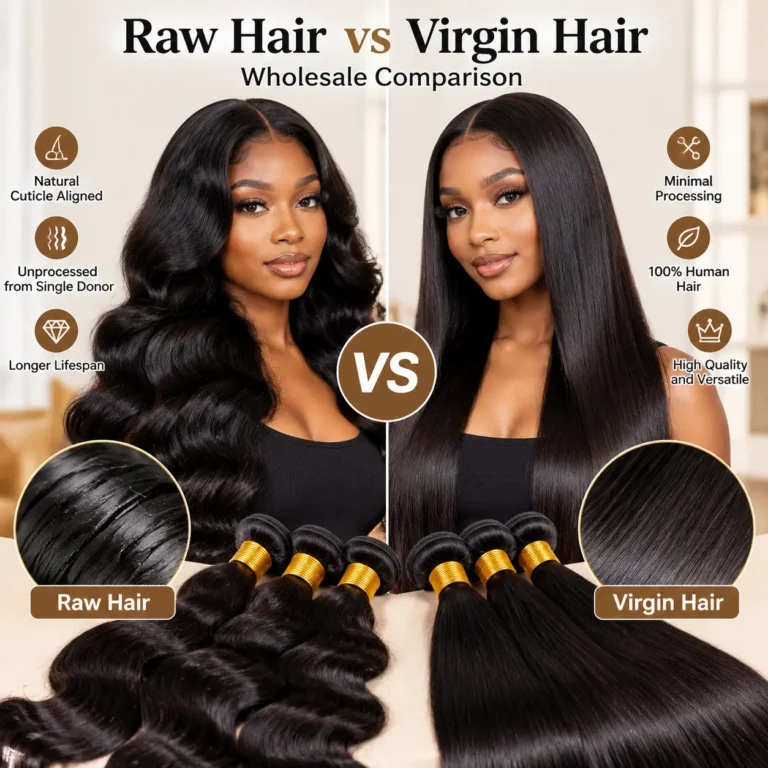
Virgin Hair refers to human hair that has never undergone any chemical processing. It has not been dyed, permed, or acid-treated. It retains the hair’s natural shine, elasticity, and cuticles. Virgin hair can be permed, dyed, straightened, or curled just like your own hair. It comes from various origins: Brazil, Peru, Myanmar, India, and others. Currently, the highest grade available on the market is Raw Virgin Hair (which is washed only with the mildest soap and water).
Synthetic Wigs, on the other hand, are made from synthetic fibers. Common materials include high-temperature fibers, low-temperature fibers, and Kanekalon. Synthetic wigs are pre-styled when they leave the factory. You cannot use curling irons or hot air from a hair dryer to change their style (unless they are made from specific heat-resistant fibers). Synthetic wigs are inexpensive, come in a wide variety of colors, and are easy to maintain, but they have a short lifespan and lack a natural look.
Now that you understand these two basic concepts, let’s move on to the core comparison in “Virgin Hair vs Synthetic Wigs: Wholesale Buying Guide for Resellers.”
Part Three: Price and Profit — Which Is Better for Wholesale?
Price is the first factor wholesalers consider. This is most evident in “Virgin Hair vs. Synthetic Wigs: A Wholesale Buying Guide for Resellers.”
Virgin hair has a high unit price. A 100-gram bundle of Brazilian virgin hair can cost anywhere from tens to hundreds of dollars wholesale. A full-lace virgin hair wig is even more expensive wholesale. However, its retail price is also high, offering substantial profit margins. Moreover, customers are willing to pay for quality and are highly likely to make repeat purchases.
Synthetic wigs have a very low unit price. A synthetic wig might cost just a few to a dozen dollars wholesale. Retail prices typically range from $20 to $50. While the absolute profit margin isn’t high, inventory turns over quickly. This makes them ideal for high-volume sales targeting customers on a budget.
When choosing between Virgin Hair and Synthetic Wigs, you should base your decision on your market positioning. If you cater to high-end clients or professional salons, virgin hair is a must. If you target fast fashion, students, or party supply stores, synthetic wigs are a better fit.
Part 4: Lifespan and Customer Repurchase Rate
How long can a customer wear a wig? This directly impacts the repurchase rate. It is also a crucial factor in the “Virgin Hair vs. Synthetic Wigs: Wholesale Buying Guide for Resellers.”
With proper care, virgin hair can last over a year—or even longer. When customers purchase high-quality virgin hair and maintain it correctly, they don’t need to replace it frequently. This means longer intervals between purchases but higher customer loyalty. Once a customer recognizes your quality, she’ll keep coming back to you.
Synthetic wigs typically last only 2 to 4 months. The fibers gradually lose their luster, become tangled, and develop fuzz. Customers need to purchase new ones more frequently. The repurchase rate is high, making them a typical consumable product. For “Virgin Hair vs Synthetic Wigs: Wholesale Buying Guide for Resellers,” if you want to run a business with high frequency and low average order value, synthetic wigs are a good choice.
Part 5: Styling Flexibility — Can customers change their hairstyle themselves?
Modern consumers love variety. This factor determines whether customers will return to purchase different styles. In “Virgin Hair vs Synthetic Wigs: Wholesale Buying Guide for Resellers,” the difference in styling capabilities is significant.
Virgin hair can be styled freely with curling irons, flat irons, and hair dryers. It can be dyed, highlighted, or ombre-dyed—just like natural hair. A single virgin hair wig can be transformed into straight hair, large waves, or tight curls. Customers feel like “buying one is like buying many.”
Synthetic wigs come from the factory with a fixed curl or straight texture. Standard synthetic fibers cannot withstand heat, or they will melt. Even heat-resistant fibers can only withstand limited temperatures, and repeated styling will damage the fibers. Customers who buy synthetic wigs must accept them exactly as they are.
Therefore, “Virgin Hair vs Synthetic Wigs: Wholesale Buying Guide for Resellers” reminds you: if your customers like to change their hairstyles or experiment with their hair, you must recommend virgin hair.
Part 6: Natural Look and Realistic Appearance
The biggest concern with wigs is that they look “fake.” Customers want others to be unable to tell they’re wearing one. In “Virgin Hair vs. Synthetic Wigs: Wholesale Buying Guide for Resellers,” naturalness is one of the decisive factors.
Virgin hair has a natural luster, softness, and movement. The strands vary in thickness, and the color has subtle depth and shading. It glistens in the sunlight, just like real hair. With a lace base combined with real human hair, the hairline is virtually invisible.
Synthetic wigs often have an overly intense shine, giving them a “plastic” look. The strands are uniformly thick, and the color is monotonous. They move stiffly and lack the elasticity of real human hair. Although high-end synthetic fibers have improved, they can still be distinguished up close.
For “Virgin Hair vs. Synthetic Wigs: Wholesale Buying Guide for Resellers,” if you’re targeting the mid-to-high-end market and seeking ultimate naturalness, virgin hair is irreplaceable.
Part 7: Maintenance Difficulty — Are Customers Willing to Spend Time on Care?
How much time are your customers willing to spend maintaining a wig? This is another user habit to consider in “Virgin Hair vs. Synthetic Wigs: Wholesale Buying Guide for Resellers.”
Virgin hair requires the same care as real hair. Use a mild shampoo, air-dry naturally, and apply conditioner occasionally. Wear a hair net while sleeping to prevent friction. It takes time and patience. But precisely because the care routine is more involved, customers tend to cherish it more.
Synthetic wigs require almost no maintenance. After washing, hang them to dry—do not wring them out. Do not use conditioner. Do not use a hair dryer. It’s simple and convenient. For customers who lack time or patience, synthetic wigs are the hassle-free choice.
In “Virgin Hair vs Synthetic Wigs: Wholesale Buying Guide for Resellers,” you should clearly explain the care requirements to your customers to avoid post-sale disputes.
Part 8: Wholesale Purchasing Recommendations — How to Combine Product Selection?
As a wholesaler or retailer, you don’t have to choose just one. A smart strategy is to build a product matrix based on your sales channels and customer profiles.
If you primarily focus on online retail (Amazon, independent websites, Shopify):
· Feature high-end and mid-range Virgin hair styles. They offer high profit margins and a stable customer base.
· Supplement with a small selection of trendy-colored synthetic wigs to drive traffic and cover the low-price market.
If you primarily supply salons and hair salons:
· Prioritize Virgin hair. Stylists need to perm, dye, and cut hair for customers—something synthetic fiber cannot do.
· You can also sell some colored synthetic wigs for specific looks (e.g., cosplay, stage performances).
If you do live-stream sales or community group buying:
· Focus on high volume; synthetic wigs sell more easily. They’re low-priced and convert quickly.
· However, you can periodically feature a Virgin hair product as a high-margin item to boost the overall average order value.
If you target the African American market:
· For high-end hair extensions and lace wigs, focus on Virgin hair. African American customers are very knowledgeable about hair and only accept Virgin-grade products.
· Colored synthetic braids (pre-braided) also have a market.
The core message of this “Virgin Hair vs Synthetic Wigs: Wholesale Buying Guide for Resellers” is: don’t follow trends blindly; select products based on your customers’ needs.
Part 9: How to Avoid Common Pitfalls When Purchasing?
Whether you choose virgin hair or synthetic wigs, there are risks involved in purchasing. Below are some tips to help you avoid pitfalls from “Virgin Hair vs Synthetic Wigs: Wholesale Buying Guide for Resellers.”
Pitfalls with Virgin Hair:
· The label says “Virgin,” but the hair has actually been acid-treated or dyed. Request proof of untreated hair from the supplier.
· Misrepresented length. An 18-inch product may actually be only 16 inches. Require that each strand be measured upon receipt.
· Mixed with low-quality hair. The batch contains non-straight hair. Require that multiple strands be sampled for inspection.
Pitfalls with Synthetic Wigs:
· Claimed to be “heat-resistant,” but actually melts when exposed to high temperatures. Require the supplier to provide a heat-resistance test video.
· Rough cap lining that rubs against the ears and forehead. Request a sample for a test fit.
· Colors that differ significantly from the images. Request actual product photos taken in natural light.
In “Virgin Hair vs Synthetic Wigs: Wholesale Buying Guide for Resellers,” we also recommend: Always place a sample order for your first collaboration. The sample fee can be applied toward your subsequent bulk order. Do not skip this step.
Part 10: Why Choose Dejun Wigs Manufacturer as Your Supplier?
You’ve read so much about “Virgin Hair vs Synthetic Wigs: Wholesale Buying Guide for Resellers.” Now you need a reliable supplier.
Dejun Wigs Manufacturer produces both high-quality virgin hair products and heat-resistant synthetic fiber wigs. Our advantages include:
· Direct from the factory: No middlemen markups, ensuring competitive wholesale prices.
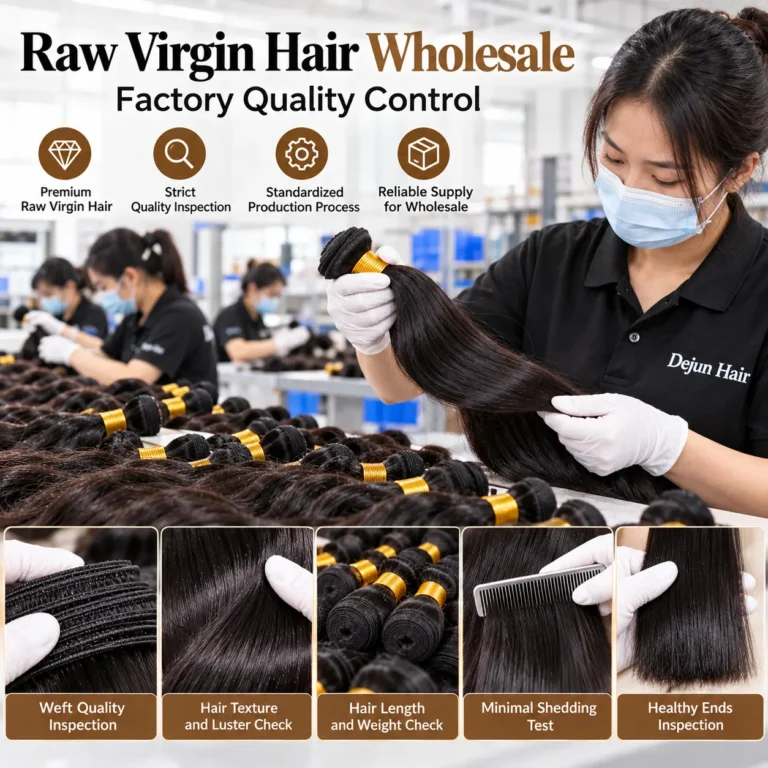
· Authentic hair quality: Virgin hair comes with burn tests and cuticle inspections.
· Diverse synthetic fiber options: We stock high-temperature fibers, low-temperature fibers, Kanekalon, and more.
· Flexible minimum order quantities: We support small mixed batches, making it easy for you to test the market.
· After-sales guarantee: We offer returns and exchanges for quality issues, ensuring worry-free purchasing.
Whether you ultimately choose virgin hair or synthetic wigs, Dejun Wigs Manufacturer can meet your needs. We also provide product training and marketing advice to help you sell faster.
Part 11: Start Your Wholesale Business Today
You have now read this entire “Virgin Hair vs. Synthetic Wigs: Wholesale Buying Guide for Resellers.” You should have a clear understanding of the differences, advantages, and suitable applications of both. Now is the time to take action.
Contact us immediately. Let us know via our website form, live chat, or email:
· Whether you primarily want to purchase Virgin hair or synthetic wigs (or both)
· What your target customer base is (salons, online retail, live-streaming sales, etc.)
· Your estimated initial order quantity
Based on your specific needs, we’ll recommend the most suitable implementation plan for “Virgin Hair vs Synthetic Wigs: Wholesale Buying Guide for Resellers.” We’ll also provide sample prices and bulk quotes.
A high-quality wig can help you earn your customers’ trust. A knowledgeable supplier can help your wholesale business thrive. Dejun Wigs Manufacturer looks forward to working with you.
Virgin Hair vs Synthetic Wigs: Wholesale Buying Guide for Resellers Summary
The focus of this article is “Virgin Hair vs. Synthetic Wigs: A Wholesale Buying Guide for Resellers.” We’ve thoroughly compared these two types of wigs from multiple angles, including price, lifespan, styling, natural appearance, ease of care, product selection, and tips for avoiding pitfalls. As a wholesaler or retailer, you should choose the right product category based on your distribution channels, customer base, and pricing strategy. You can also combine both types to cater to different needs.
No matter what you ultimately choose, quality should always be your top priority. Dejun Wigs Manufacturer looks forward to being your long-term partner.
Now, get started with your wig wholesale business.
Frequently Asked Questions
Q: Can Virgin Hair and Synthetic Wigs be stored together in the same warehouse?
A: Yes. However, be sure to store them separately to prevent odors from mixing. Synthetic fibers are sensitive to high temperatures, so keep them away from heaters and direct sunlight.
Q: What should I do if customers can’t tell the difference between the two products?
A: Clearly label the product description as “100% Human Hair” or “Synthetic.” Also provide care instructions, such as using natural shampoo versus washing with cold water.
Q: Which has a lower return rate?
A: Under normal circumstances, Virgin Hair has a slightly lower return rate because customers have clearer expectations. Synthetic wigs are more likely to be returned due to issues with color or shine. However, this ultimately depends on the accuracy of your product descriptions.
Q: Can we create our own brand labels?
A: Yes. Dejun Wigs Manufacturer supports OEM private labeling; both Virgin Hair and synthetic wigs can be customized with your own labels and packaging.

High Quality
All of our products have undergone production and quality control and come with certificates
Fast Delivery
Our supply chain management is a model of standardization and professionalism in the wig manufacturing industry, ensuring that our customers receive their wigs on time.
Customer Service
Fill out the wig order form to customize your base, size, hair length, and color.