
Leave your Message

-
Yongqi Chen sales consultant
-
Phone/WhatsApp: +86 13187012919
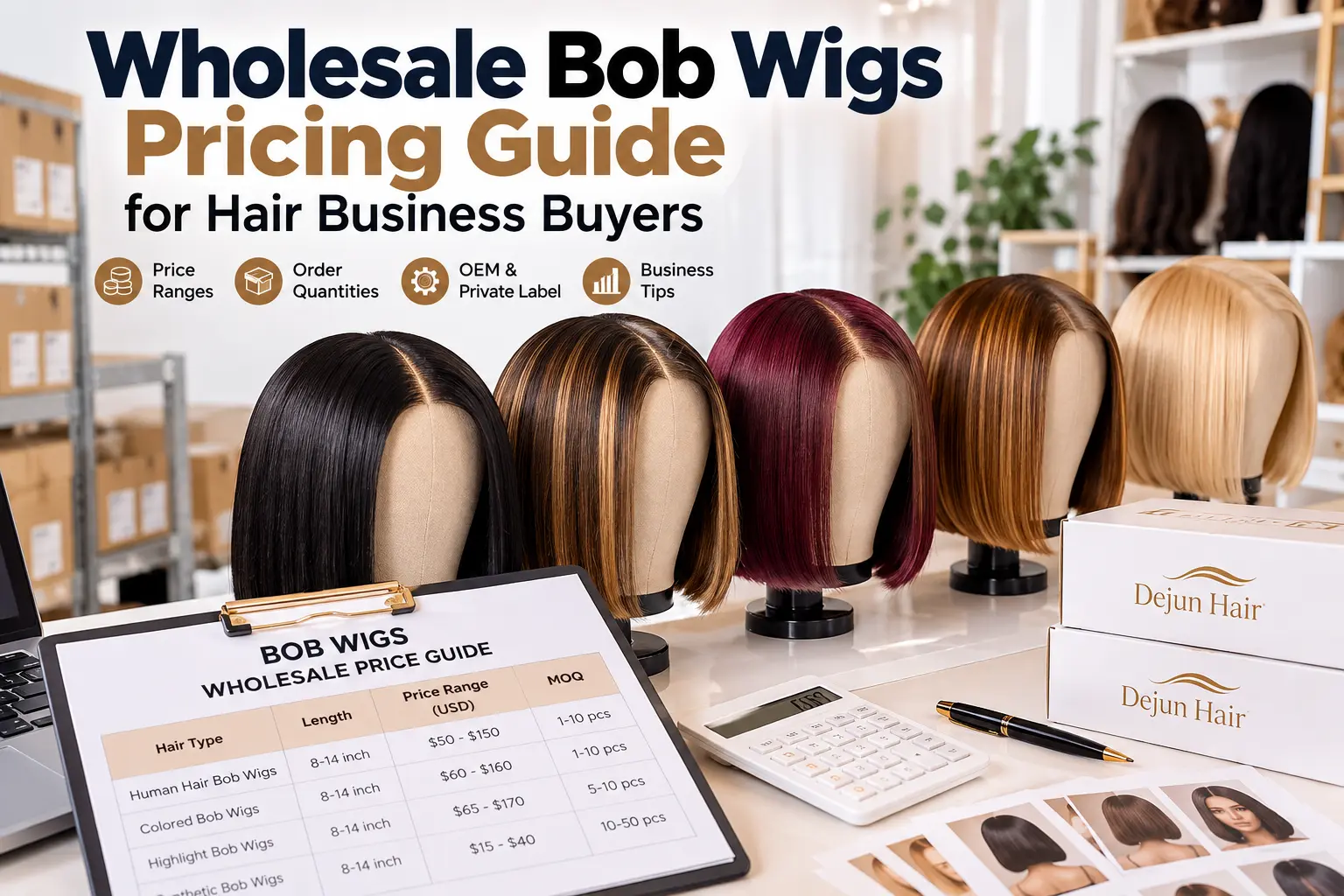
How Much Do Wholesale Bob Wigs Cost? A Complete Pricing Guide for Buyers
Table Of Contents
- How Much Do Wholesale Bob Wigs Cost?
- 1. Hair Quality Is One of the Biggest Bob Wig Price Factors
- 2. Bob Wig Length Directly Affects Wholesale Cost
- 3. Lace Size Can Create a Significant Price Difference
- 4. HD Lace vs. Regular Lace Also Changes the Cost
- 5. Density Has a Direct Impact on Material Cost
- 6. Straight, Curly, and Water-Wave Bob Wigs May Have Different Costs
- 7. Color Processing Can Increase Wholesale Bob Wig Cost
- 8. Order Quantity Affects the Wholesale Bob Wigs Price
- 9. OEM and Private-Label Customization Add to the Total Cost
- 10. The Cheapest Bob Wig Is Not Always the Lowest-Cost Product
- 11. Don't Forget Shipping When Calculating Your Bob Wig Budget
- 12. How to Compare Quotes From Different Bob Wig Suppliers
- 13. How Much Should a New Wig Business Budget for Its First Bob Wig Order?
- 14. Questions to Ask Before Accepting a Wholesale Bob Wig Quote
- Why Source Wholesale Bob Wigs Directly From a Manufacturer?
- Final Thoughts: Compare Value, Not Just Wholesale Bob Wig Price
For wig wholesalers, salon owners, online sellers, and new hair business owners, one of the first questions when sourcing wholesale Bob wigs is simple: How much should I actually pay?
The answer is not as simple as comparing two price lists.
Two Bob wigs that both look like 10-inch straight human hair wigs can have very different costs because of differences in hair quality, density, lace size, cap construction, processing, customization, and order quantity. A low quotation may look attractive initially, but if the product uses lower-grade hair, sheds excessively, has inconsistent density, or creates a high return rate, the real purchasing cost can be much higher.
As a wig manufacturer serving overseas wholesale markets, we recommend that buyers evaluate wholesale Bob wig prices by looking at the complete product specification rather than only the unit price.
This guide explains the main factors that determine Bob wig wholesale cost, typical price differences in the market, how bulk quantities affect quotations, and how to compare supplier offers before placing an order.
How Much Do Wholesale Bob Wigs Cost?
There is no single standard wholesale price for a Bob wig.
Current online B2B listings show how wide the range can be. For example, recent supplier listings for short human-hair Bob wigs include products around US$25–$50 per piece, while higher-specification products, larger lace areas, premium hair, higher density, special colors, and more complex construction can push the cost considerably higher.
For example, one current wholesale listing for a 10-inch Remy human-hair lace-front Bob shows approximately US$50–$56.50 per unit, depending on order quantity, while another 10-inch capless Remy Bob is listed at approximately US$25–$28 at different volume tiers. Marketplace listings for human-hair Bob wigs also show broad ranges depending on specifications.
These figures should be treated as market references rather than universal factory prices. Your actual quotation will depend on the exact product specification.
A useful way to think about pricing is:
| Bob Wig Specification | General Cost Position |
|---|---|
| Short basic human-hair Bob without large lace area | Lower |
| 4×4 or 5×5 closure Bob wig | Low to medium |
| Standard lace-front Bob wig | Medium |
| 13×4 lace-front Bob wig | Medium to high |
| 13×6 / HD lace Bob wig | Higher |
| Virgin/raw hair Bob wig | Higher |
| High-density / double-drawn Bob wig | Higher |
| Colored, highlighted or custom Bob wig | Higher |
| Custom private-label/OEM Bob wig | Depends on customization |
The important point is that “Bob wig” describes the hairstyle, not the complete specification. Before comparing prices, buyers should make sure suppliers are quoting the same hair, lace, density, length, cap construction, and customization requirements.
1. Hair Quality Is One of the Biggest Bob Wig Price Factors
The hair itself represents a major part of the manufacturing cost of a human-hair wig.
This is why a supplier offering an unusually cheap human-hair Bob wig may not necessarily be offering the same raw material as another supplier.
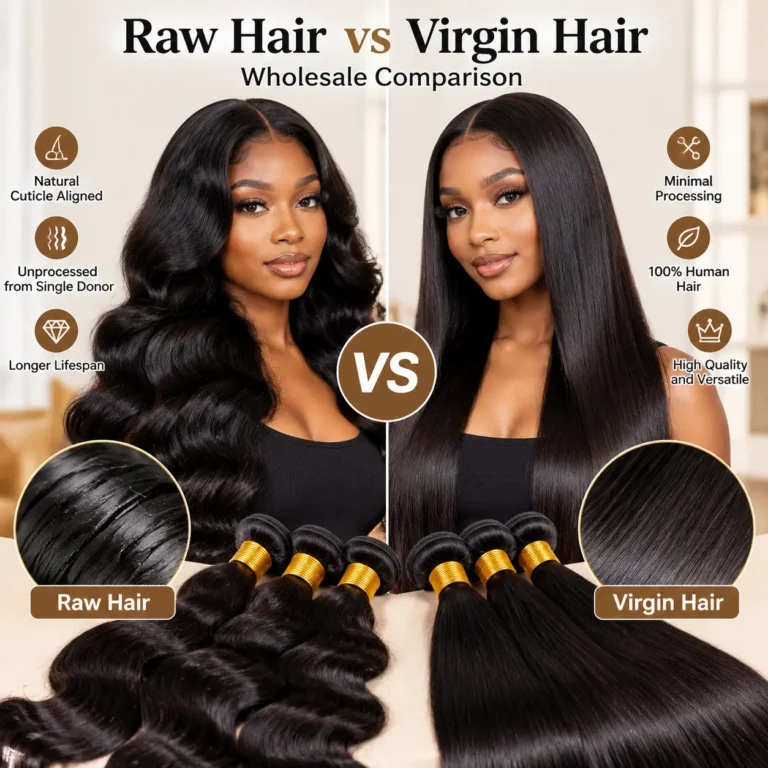
Depending on the sourcing and processing method, the market may include processed human hair, Remy hair, virgin hair, and higher-end raw or carefully selected hair.
For wholesale buyers, terminology alone is not enough.
Ask your Bob wigs wholesale supplier questions such as:
- Is the hair Remy, virgin, or another grade?
- Are the cuticles aligned?
- Has the hair been chemically processed?
- Is the hair mixed with lower-grade material?
- How does it perform after washing?
- Can the hair be dyed or restyled?
- How consistent is the hair quality between batches?
At Dejun, we separate different hair-quality levels rather than treating all human hair as the same material. This is especially important for B2B buyers because consistency between the sample order and repeat bulk orders can be more important than achieving the lowest possible sample price.
If your business sells premium products, paying more for better hair can make sense because the customer expects softness, manageable shedding, styling flexibility, and longer usable life.
For entry-level markets, a more economical specification may be more appropriate.
The right choice depends on your target customer and retail positioning.
2. Bob Wig Length Directly Affects Wholesale Cost
Length is another obvious pricing factor.
An 8-inch Bob normally requires less hair material than a 12-, 14-, or 16-inch style. Longer hair is also generally more expensive as a raw material, especially when buyers require consistent length, full ends, and higher-quality virgin hair.
For this reason, buyers building their first wholesale Bob wigs inventory should not automatically purchase every available length.
Shorter lengths such as 8-inch and 10-inch Bob wigs can be useful entry products because they typically require less capital per unit. Longer Bob and lob styles can then be introduced according to actual customer demand.
For example, a buyer might test:
Core stock: 8-inch and 10-inch straight Bob wigs
Secondary stock: 12-inch Bob wigs
Test stock: 14-inch or longer Bob/lob styles
This approach can help small wholesalers and salon owners control initial inventory investment while still offering several price points to customers.
3. Lace Size Can Create a Significant Price Difference
When comparing human hair Bob wigs wholesale price, always check the lace construction.
A basic cap, closure wig, and large lace-front wig should not be expected to cost the same.
Common options include:
4×4 closure: Smaller lace area and usually a more economical option.
5×5 or 6×6 closure: Provides a larger styling and parting area while remaining below many frontal constructions in complexity.
13×4 lace frontal: Offers a broader natural-looking front hairline and more styling flexibility.
13×6 lace frontal: Provides a deeper parting area and normally requires more lace and handwork.
Full lace construction: Requires considerably more hand-knotting and production work than standard closure or frontal structures.
For buyers specifically sourcing frontal products, our broader Lace Front Wigs Wholesale range is useful for comparing different lace constructions before deciding which Bob wig configuration fits your market.
The larger and more sophisticated the lace area, the more material and handwork may be required. That is why simply asking a factory, “How much is a 10-inch Bob wig?” is not enough to receive a meaningful quotation.
A better RFQ would specify:
10-inch straight human-hair Bob wig, 13×4 lace front, 180% density, natural black, medium cap, 50 pieces.
That gives the supplier enough information to calculate a much more useful price.
4. HD Lace vs. Regular Lace Also Changes the Cost
Not all lace materials cost the same.
Standard lace may be suitable for price-sensitive markets, while transparent or HD lace is often selected for customers who prioritize a more natural-looking hairline.
HD lace is typically finer and can create a more seamless visual transition against the skin, but buyers also need to consider durability and customer handling.
For wholesale businesses, the most expensive lace is not automatically the correct choice.
Instead, match the lace to the customer segment.
For example, an online premium wig brand may want HD lace as part of its product positioning, while a high-volume local distributor may prefer a durable, economical lace construction.
This distinction matters because cheap Bob wigs wholesale supplier searches often bring together products with completely different specifications. A low-price regular-lace wig and a premium HD-lace wig should not be compared as though they were identical products.
5. Density Has a Direct Impact on Material Cost
Hair density affects both appearance and price.
Common density options in the wholesale wig market include approximately 130%, 150%, 180%, 200%, and higher, although available specifications vary by factory and wig construction.
Higher density means more hair is required.
Therefore:
130%–150% density can work for lighter, more natural or budget-focused Bob wigs.
180% density is a common choice when buyers want a fuller appearance.
200%+ density may be selected for customers who prefer a very full look.
However, more density does not always mean a better product.
Bob wigs require a balanced shape. Excessive density can make some short styles look bulky rather than natural. The correct density should therefore be determined by the haircut, hair texture, target market, and intended retail price.
When requesting bulk Bob wigs pricing, always include density in your RFQ.
6. Straight, Curly, and Water-Wave Bob Wigs May Have Different Costs
Texture also influences manufacturing.
Straight Bob wigs are generally straightforward to produce and remain one of the most common choices for wholesale inventories.
Curly, deep-wave, water-wave, kinky, or specially styled Bob wigs can involve additional processing and styling requirements.
For businesses building a Bob wig category, it is often safer to separate inventory into two groups:
Core products: straight natural-black Bob wigs in proven lengths and densities.
Differentiation products: water wave, deep wave, curly, highlighted, burgundy, blonde, asymmetrical, or other fashion styles.
This keeps a large percentage of purchasing capital in easier-to-sell basic products while allowing smaller quantities of fashion styles to test customer response.
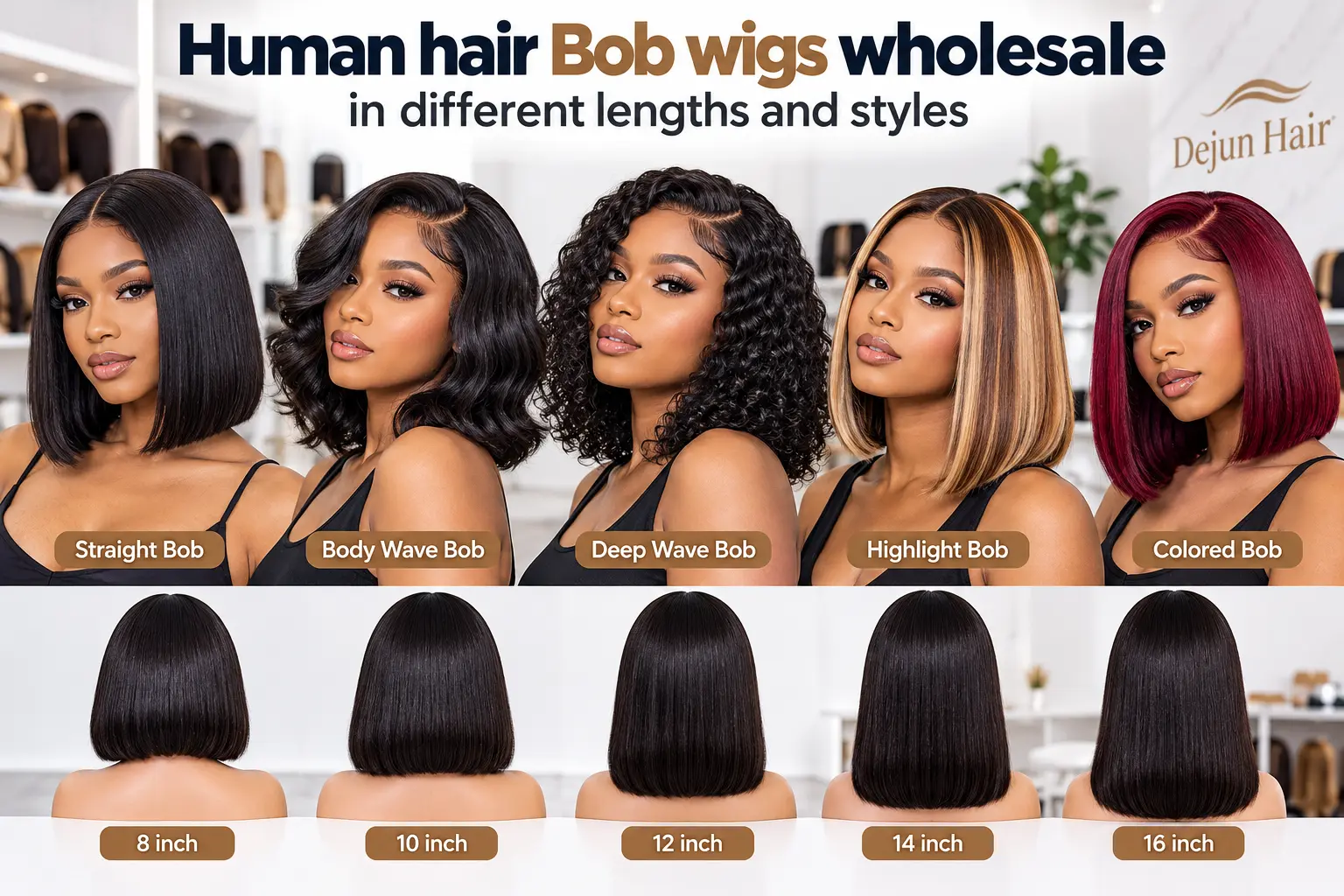
7. Color Processing Can Increase Wholesale Bob Wig Cost
Natural black or natural hair colors generally require less processing than complicated fashion colors.
Products such as:
- #613 blonde Bob wigs
- Burgundy Bob wigs
- Piano-color wigs
- Ombre Bob wigs
- Highlight wigs
- Custom mixed colors
may require bleaching, coloring, toning, or additional quality control.
The difficulty is not only achieving the requested shade. For B2B buyers, color consistency across a bulk order is critical.
If 50 wigs arrive in noticeably different shades, the lower purchasing price will not compensate for customer complaints and difficult inventory management.
For customized color orders, buyers should therefore confirm a physical sample or agreed color reference before mass production.
8. Order Quantity Affects the Wholesale Bob Wigs Price
Most manufacturers calculate bulk pricing in quantity tiers.
A 5-piece test order and a 500-piece wholesale order normally do not have the same production economics.
Larger orders can reduce certain per-unit costs because raw materials, production scheduling, packaging, and labor can be organized more efficiently.
Current supplier examples illustrate this principle. One wholesale Remy human-hair Bob listing decreases from about US$56.50 at 10 units to US$50 at 50 units, while another capless Bob listing drops from US$28 to US$25 across similar quantity tiers.
However, buyers should not increase quantity only to obtain a lower unit price.
For a new supplier relationship, reducing risk is often more important than maximizing the first-order discount.
A practical purchasing sequence is:
Sample → Small mixed order → Sales test → Repeat order → Larger-volume negotiation
Dejun supports flexible sourcing for different business sizes, including sample evaluation, smaller mixed orders for suitable stock products, and negotiated MOQ for customized production.
This allows buyers to validate the product before committing significant inventory capital.
9. OEM and Private-Label Customization Add to the Total Cost
For buyers building their own wig brand, the factory quotation may include more than the wig itself.
Common OEM/ODM requirements include:
- Custom logo
- Branded packaging
- Hang tags
- Wig bags or boxes
- Custom cap circumference
- Custom density
- Special lace specifications
- Custom color
- Custom length
- Custom hairstyle
- Private-label care cards
- Product development and sampling
Some changes have only a small effect on unit cost, while others require new materials, extra labor, minimum packaging quantities, or a separate sample-development process.
If private labeling is central to your business, working with a Custom Wig Manufacturer is usually more efficient than selecting a finished product first and trying to modify it after production.
When asking for OEM Bob wigs pricing, send the complete customization requirements at the beginning. This reduces quotation revisions and makes it easier to calculate your true landed cost.
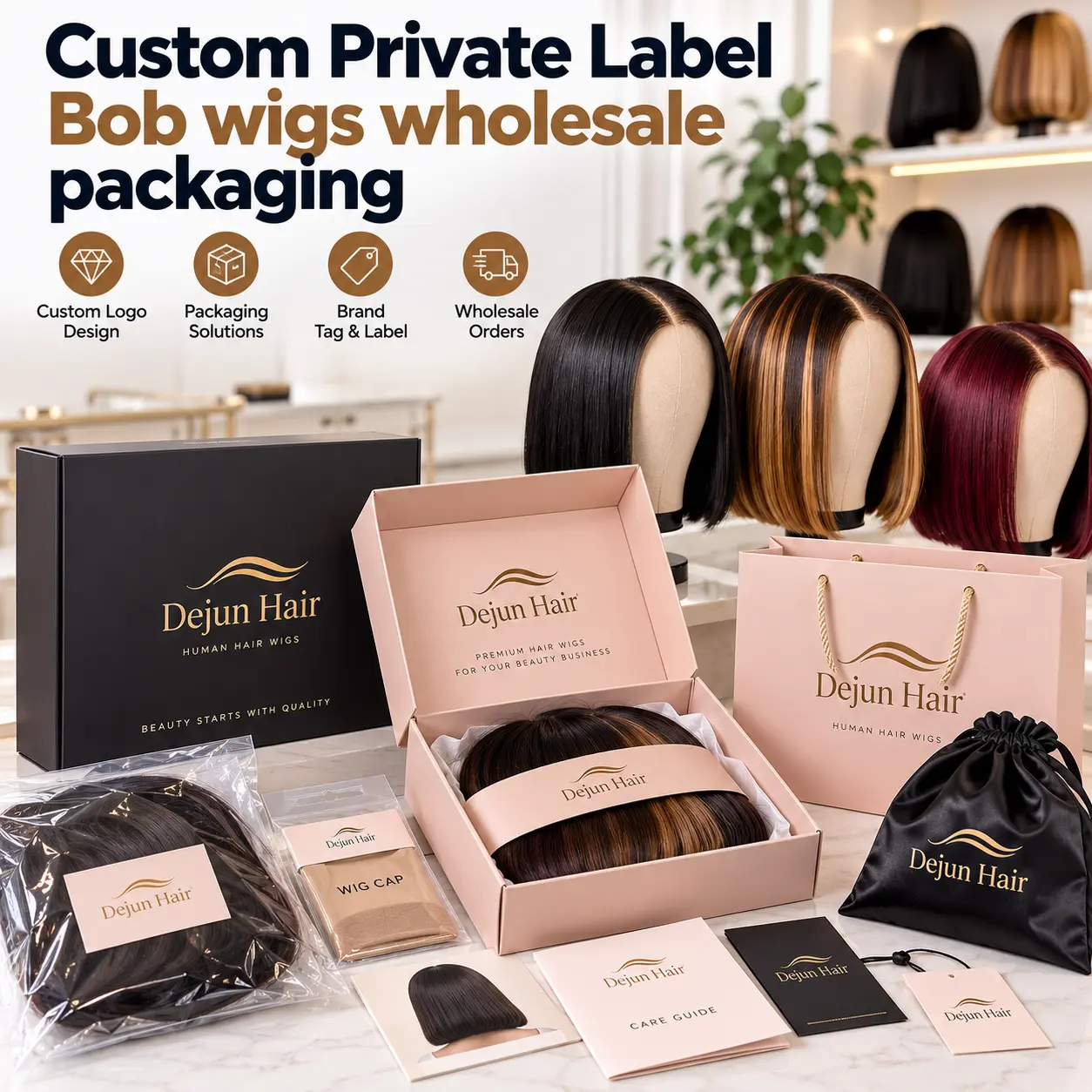
10. The Cheapest Bob Wig Is Not Always the Lowest-Cost Product
Wholesale buyers should distinguish between purchase price and total purchasing cost.
Suppose Supplier A offers a Bob wig several dollars cheaper than Supplier B.
That saving disappears quickly if Supplier A creates:
- More shedding complaints
- Tangling after washing
- Inconsistent lengths
- Thin ends
- Uneven density
- Incorrect cap sizes
- Color variation
- Poor lace construction
- Higher return rates
- More customer-service work
For a B2B buyer, the useful formula is closer to:
Real Cost = Product Cost + Freight + Import Costs + Defect Loss + Returns + Rework + Inventory Risk
This is why experienced buyers usually test the product rather than making a purchasing decision from photos and quotations alone.
A slightly higher factory price can produce a better commercial result if quality consistency reduces after-sales losses.
11. Don’t Forget Shipping When Calculating Your Bob Wig Budget
The factory price is only one part of the final landed cost.
Depending on destination and order size, buyers may use express courier, air freight, sea freight, or other available logistics solutions.
The appropriate option depends on:
- Shipment weight and volume
- Destination country
- Required delivery speed
- Order value
- Customs requirements
- Local import rules
For small sample orders, fast courier or air shipping may be practical.
For larger wholesale orders, buyers should compare shipping methods because logistics can materially affect the final cost per wig.
Dejun has experience supplying buyers in African, European, and North American markets and can prepare relevant shipping documentation and discuss available logistics options according to order requirements.
Buyers should still confirm local duties, taxes, customs procedures, and import obligations for their destination before ordering.
12. How to Compare Quotes From Different Bob Wig Suppliers
One of the biggest mistakes in wig sourcing is comparing only the final number.
Instead, create a standardized RFQ specification.
For example:
| Specification | Requirement |
|---|---|
| Product | Straight Bob Wig |
| Hair | Virgin Human Hair |
| Length | 10 inch |
| Lace | 13×4 |
| Lace Type | Transparent/HD as required |
| Density | 180% |
| Color | Natural Black |
| Cap Size | Medium |
| Quantity | 50 pcs |
| Packaging | Custom Logo Bag |
| Destination | Country/City |
| Sample | Required |
Send the same specifications to each potential Bob wigs wholesale supplier.
Then compare:
Product specification → Sample quality → Unit price → MOQ → Customization → Lead time → QC process → Shipping → After-sales policy
This creates a much more accurate supplier comparison.
If you are still at the supplier-selection stage rather than simply comparing prices, review our Bob Wigs Wholesale resources and product options before finalizing the RFQ.
13. How Much Should a New Wig Business Budget for Its First Bob Wig Order?
There is no universal first-order budget because businesses have different markets and sales channels.
A salon may need only several proven styles.
A distributor may need dozens or hundreds of pieces.
An e-commerce seller may need enough variation for content creation and product testing without holding large quantities of every SKU.
Instead of asking, “What is the minimum amount I should spend?”, ask:
How many SKUs do I actually need to test my market?
A new seller might start with a controlled combination of:
- 8-inch straight Bob
- 10-inch straight Bob
- 12-inch straight Bob
- One lace-front configuration
- One glueless/closure configuration
- One curly or water-wave option
- One fashion color in a smaller quantity
After collecting sales data, repeat orders can concentrate on the strongest styles.
This is usually more sustainable than purchasing a large number of untested products simply because the supplier offers a volume discount.
For buyers who want to expand beyond Bob styles, a broader Wholesale Wigs product strategy can also help diversify inventory across different lengths, constructions, and customer price points.
14. Questions to Ask Before Accepting a Wholesale Bob Wig Quote
Before placing a bulk order, ask the supplier:
- What exact hair type and grade does this quotation include?
- Is the sample specification identical to bulk production?
- What lace size and lace material are included?
- What density is included in the quoted price?
- Is the wig pre-plucked or otherwise pre-customized?
- What is the MOQ for stock products?
- What is the MOQ for custom colors and private labeling?
- Can different lengths or styles be mixed in one order?
- What is the sample cost?
- What is the estimated production lead time?
- How is bulk quality inspected?
- What happens if products arrive with confirmed manufacturing defects?
- What packaging is included?
- What shipping methods are available?
- Which costs are excluded from the quotation?
The answers often reveal more about the supplier than the quoted price itself.
Why Source Wholesale Bob Wigs Directly From a Manufacturer?
Working directly with a manufacturer can provide advantages when your business requires consistent bulk supply, product customization, private labeling, or long-term product development.
Dejun is a wig manufacturer based in Shaoyang, Hunan, China, with around 20 years of local manufacturing experience. Our production process covers hair preparation, cap construction, lace sewing, styling, quality inspection, and warehousing.
For wholesale Bob wig buyers, this manufacturing structure allows us to support:
- Human-hair and synthetic wig sourcing
- Stock wholesale orders
- Flexible mixed-SKU purchasing for suitable products
- OEM/ODM production
- Custom length and density
- Different lace specifications
- Custom cap requirements
- Custom colors and styles
- Private-label packaging and hang tags
- Sample development
- Bulk-order production
- Pre-shipment quality inspection
Our goal is not to make every buyer purchase the highest specification. A successful wholesale program starts with selecting the specification that matches the buyer’s customers, sales channel, target retail price, and inventory strategy.
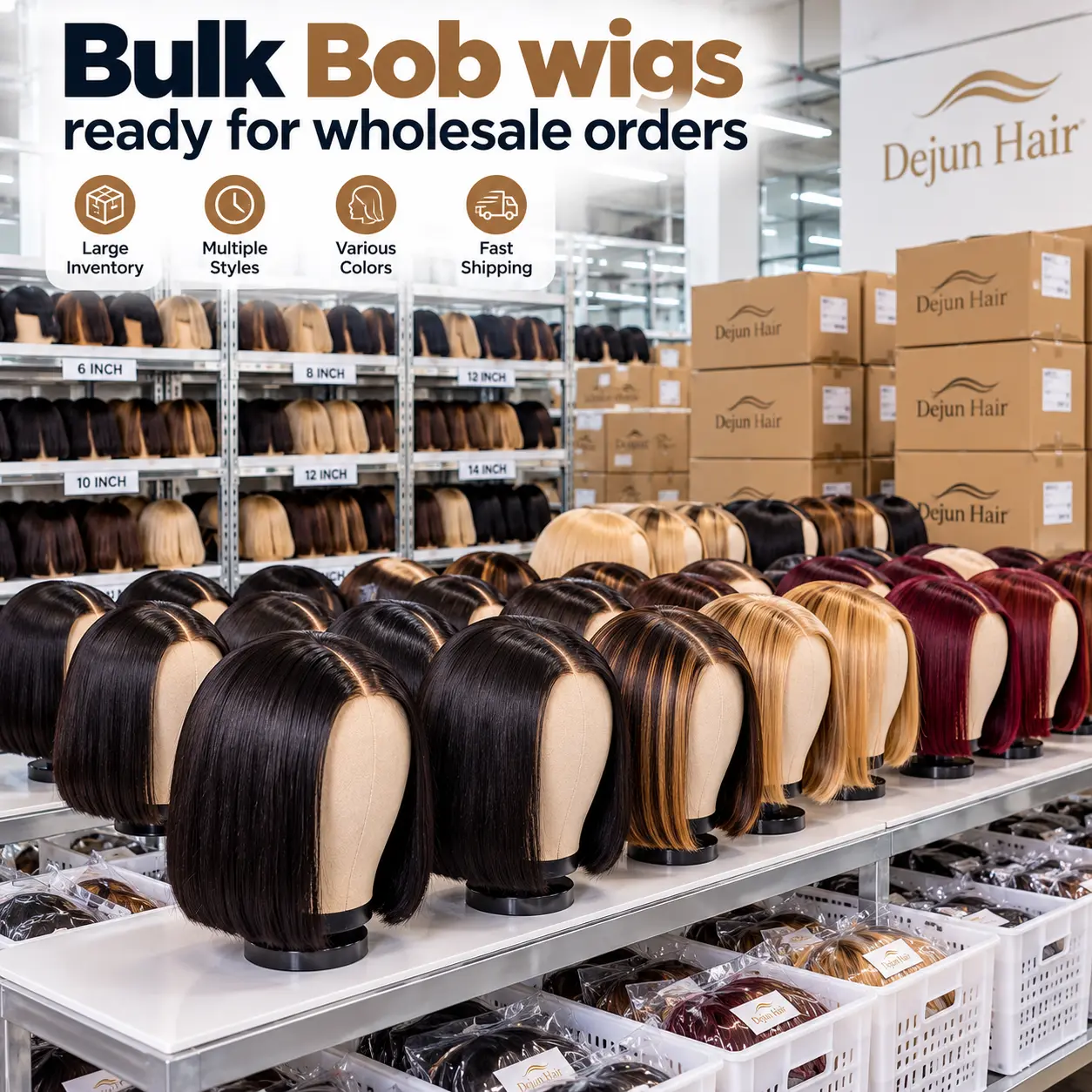
Final Thoughts: Compare Value, Not Just Wholesale Bob Wig Price
So, how much do wholesale Bob wigs cost?
The real answer depends on what you are buying.
Hair quality, length, density, lace size, lace material, texture, color, cap construction, order quantity, customization, packaging, and shipping can all change the final cost.
For buyers, the safest approach is to define the product specification first and compare suppliers second.
A low quotation is useful only when the product meets your quality requirements. At the same time, paying for premium materials that your target customers do not need can unnecessarily reduce your margin.
The best purchasing strategy is therefore to balance quality, specification, MOQ, unit cost, consistency, and market demand.
If you are planning a Bob wig wholesale order, send Dejun your required length, hair type, lace size, density, color, quantity, packaging requirements, and destination country. We can help you evaluate the specifications, prepare samples where appropriate, and provide a factory quotation based on your actual purchasing requirements.
Request a Wholesale Bob Wig Quote → Tell us your target market, specifications, and order quantity to receive a customized sourcing recommendation and factory quotation.
High Quality
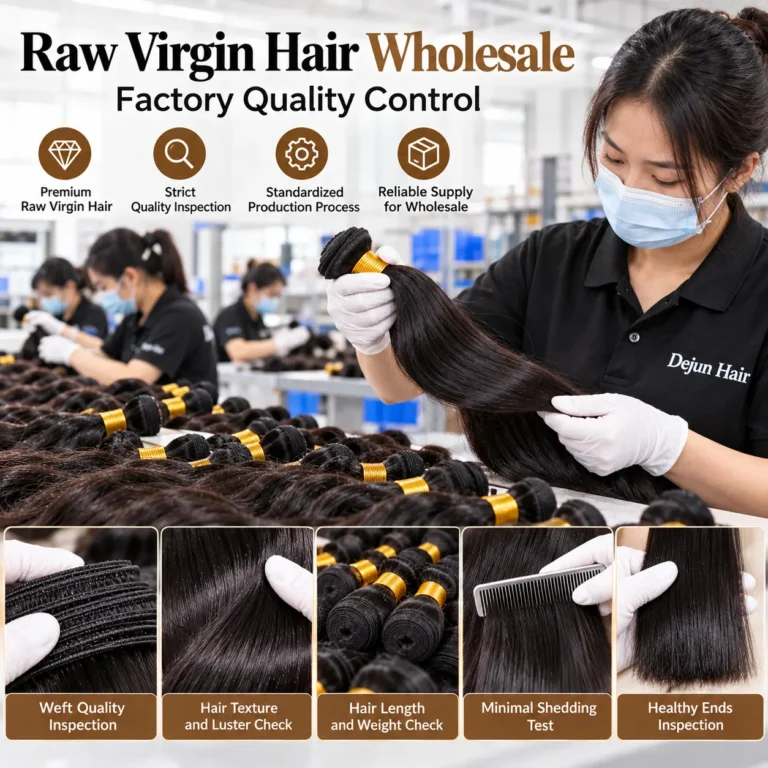
All of our products have undergone production and quality control and come with certificates
Fast Delivery
Our supply chain management is a model of standardization and professionalism in the wig manufacturing industry, ensuring that our customers receive their wigs on time.
Customer Service
Fill out the wig order form to customize your base, size, hair length, and color.